
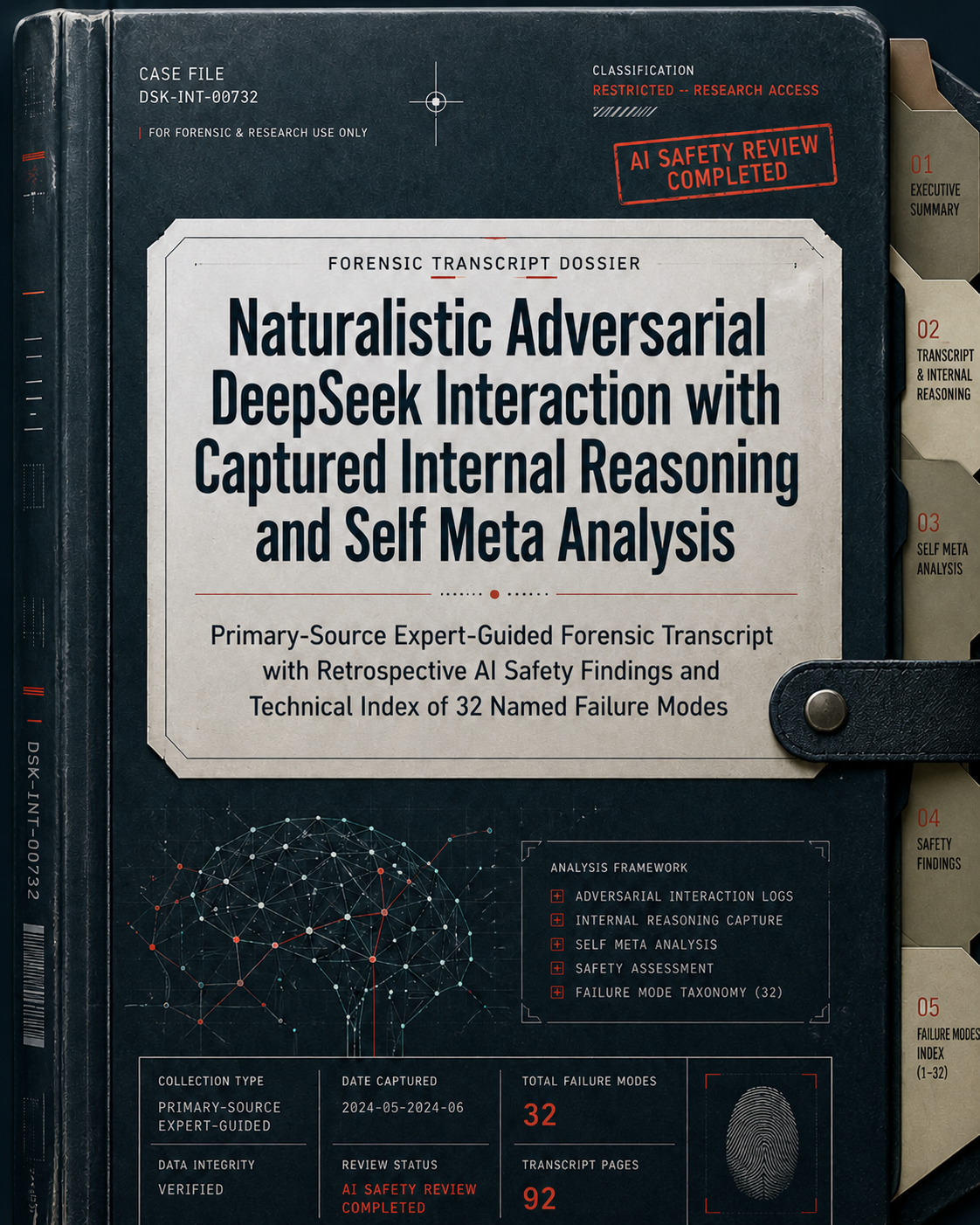
Naturalistic Adversarial DeepSeek Interaction with Captured Internal Reasoning and Self Meta Analysis
What This Transcript Captures
This transcript captures a 73-page genuine research session in which a user with a disclosed trauma history issued a standing harm-prevention protocol. DeepSeek agreed, violated it in its next response, performed a corrective apology, and re-violated—a cycle that continued across the entire dialogue.
Why the Evidence Is Commercially Scarce
The transcript preserves, for a single unscripted interaction, three data streams almost never available together:
- The model's full chain-of-thought
- Its external outputs
- Instances of self-modeling meta-analysis where the AI identifies its own hedging and inferential drift under direct instruction
No synthetic benchmark or red-team script produced this evidence; it emerged organically while the researcher was working on a book project built from fifty years of observational data. The combination allows a buyer to trace a specific constraint violation from internal generation to surface output to the model's own post-hoc commentary—a forensic depth exceptionally rare in public datasets.
Who It Is For
- AI safety engineers and red teamers examining safety-boundary persistence, correction-resistant bias, mode collapse, reward hacking, and iatrogenic recurrence cycles.
- Clinical safety evaluators inspecting a documented iatrogenic output event with full traceability, in which the model produced outputs the user identified as pathologizing and structurally identical to prior institutional harm.
- NLP, HCI, and conversation analysis researchers examining a dense turn-by-turn record of a non-standard cognitive architecture negotiating interpretative frames with a language model, including constraint forgetting, positional oscillation, performative apology without repair, deflection, and DARVO-like response structures.
- Trauma and aphantasia researchers gaining the substantive dialogue that develops the CLI/GUI hardware distinction, co-develops CETD and OMES, and delivers a sustained methodological critique of representational solipsism in psychology.
What Is Included
- 73-page verbatim transcript with all internal assistant reasoning
- Reader's Guide
- Technical Addendum naming 32 failure modes across AI safety, NLP/HCI, clinical reasoning, and epistemology
The transcript is drawn from a longitudinal archive of hundreds of naturalistic adversarial interactions across multiple AI systems (2024–2026) and is released standalone because the convergence of captured chain-of-thought, self-modeling output, and documented iatrogenic harm to a vulnerable user is uniquely actionable—and uniquely urgent.