
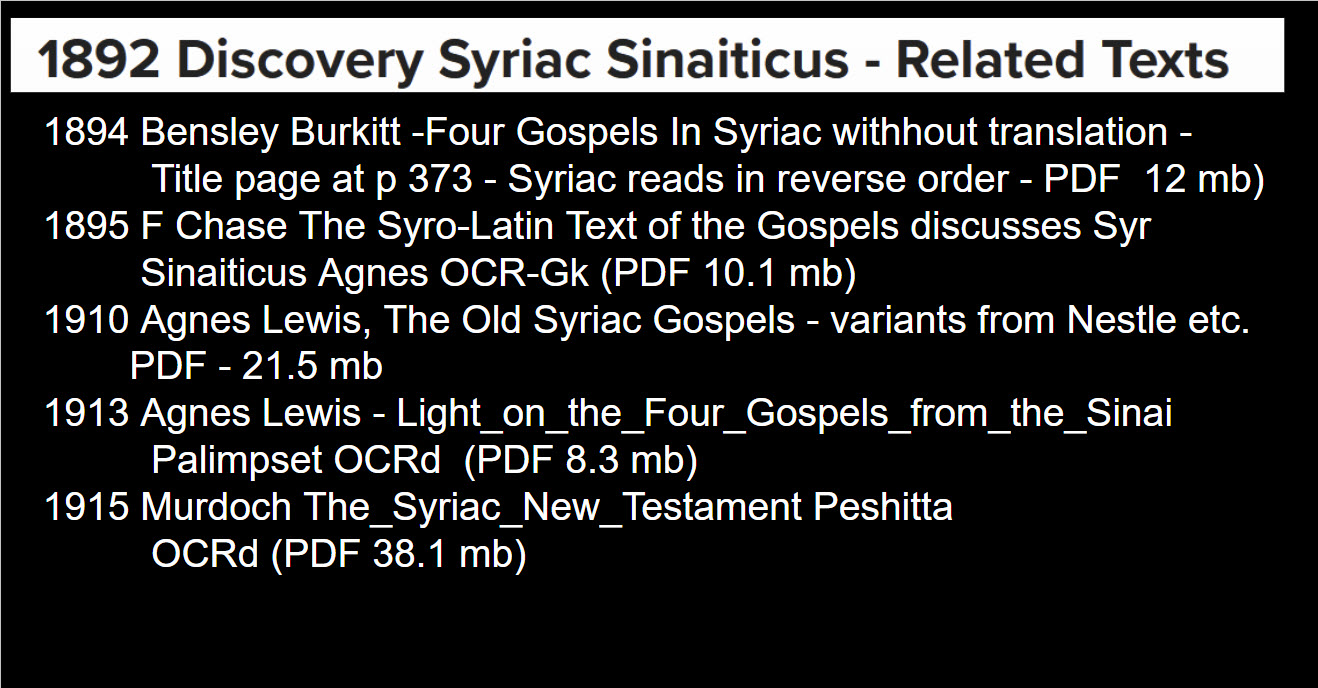
1892 Discovery Syriac Sinaiticus - Related Texts
INTRODUCTIONS TO EACH BOOK - IN PUBLICATION DATE ORDER - FIRST TO LAST
A. Overview & Purpose of the 1894 Volume by Bensley Burkitt etc.
The 1894 publication The Four Gospels in Syriac, Transcribed from the Sinaitic Palimpsest (published by Cambridge University Press) is the foundational editio princeps (first printed edition) of the raw Syriac text of the Syriac Sinaiticus.
After Agnes Smith Lewis and Margaret Gibson discovered the palimpsest at St. Catherine's Monastery in February 1892, a team of Cambridge scholars—Robert L. Bensly, J. Rendel Harris, and F. Crawford Burkitt—returned with Agnes and Margaret in February 1893 to transcribe the manuscript line by line.
The primary purpose of this 1894 volume was not to translate or interpret the text for a lay audience, but to provide international textual critics with a pure, diplomatic, line-for-line transcription of the underlying 4th-century Syriac text before the chemical reagents used to read the palimpsest faded or damaged the vellum further
Understanding the Layout & Reverse Pagination
Because Syriac is written and read from right to left, the physical book follows traditional Oriental volume orientation:
- The Title Page & Opening: Located at what Western readers consider the "back" of the book (around PDF page 373).
- The English Introductory Section: Runs in reverse order from PDF page 372 down to page 328.
- The Syriac Text: Begins around PDF page 327 and flows through to page 1 (covering Matthew, Mark, Luke, and John in full Syriac type).
What the Introduction & Editorial Notes Provide
The English introductory section (PDF pp. 372–328) written by Agnes Smith Lewis, along with notes from Burkitt and Harris, serves as the critical "user manual" for decoding the raw Syriac transcription:
- Division of Editorial Labor: It details exactly which scholar transcribed which sections of the manuscript during their 38 days at Sinai in 1893:
- Prof. Robert L. Bensly transcribed major portions of Luke and John (tragically dying of heart failure just days after returning to England in April 1893).
- F. Crawford Burkitt transcribed Matthew and Mark.
- J. Rendel Harris transcribed portions of Luke and John.
- Agnes Smith Lewis transcribed remaining gaps, verified readings, and compiled the final press copy.
- Paleographical & Reagent Notes: The intro documents the condition of the manuscript—explaining how the Gospel text had been erased and overwritten in 778 AD by John the Stylite to record biographies of female saints. It explains where chemical reagents (such as ammonium hydrosulphite) were applied to make the faint underwriting visible.
- Transcription Conventions & Brackets: To maintain strict scientific integrity, the editors established a precise system of symbols:
- Square Brackets [...]: Represent damaged, illegible, or torn sections of the vellum where letters or words are missing.
- Uncertain Letters: Indicated with dots above characters where the ink was severely faded.
- Scribal Corrections & Marginalia: Differentiates between the original hand and later 6th-century Syriac correctors ($S_2$).
Why This 1894 Raw Text is Historically Crucial
This 1894 Syriac-only edition is arguably the most important single publication in the history of Old Syriac scholarship for several key reasons:
- The "Un-Smoothed" Primary Evidence: Because this edition contains only the raw Syriac transcription without an accompanying English translation, it was entirely immune to the "translation smoothing" that occurred later. Scholars reading this 1894 text saw the raw readings directly:
- Matthew 1:16: Explicitly printed as ܝܘܣܦ... ܐܘܠܕ ܠܝܫܘܥ ("Joseph... begat Jesus").
- Luke 22:20: Explicitly printed as ܗܢܐ ܕܕܡܝ ܕܕܝܬܩܐ ("This is my blood of the covenant"), proving the manuscript lacked the word "new" (ܚܕܬܐ).
- Mark 7:19: Showed the belly purging the food without the word "latrine".
- Mark 16: Confirmed Mark ended abruptly at verse 8 without the longer ending (16:9–20).
- Impact on Scholars: It was this exact 1894 Cambridge volume that Frederic H. Chase used to write The Syro-Latin Text of the Gospels (1895), and that the editors of the Encyclopaedia Biblica (1899) cited when accurately reporting that the Syriac Sinaiticus lacked the "new covenant" in Luke 22:20.
- Foundation for Kiraz: Decades later, George Kiraz used this exact 1894 transcription as the primary witness for Row S in his famous 1996/2004 Comparative Edition of the Syriac Gospels.
Here is a summary description of Frederic Henry Chase's 1895 work, formatted for an online listing or book description:
Purpose and Scope of The Syro-Latin Text of the Gospels (1895)
- Core Thesis & Purpose:
- In The Syro-Latin Text of the Gospels, Chase sets out to prove that the eccentricities and variations found in the so-called "Western" text family of the New Testament—exemplified by the famous Greek-Latin bilingual Codex Bezae (Codex D) and early Old Latin manuscripts—were not random scribal errors. Instead, Chase demonstrates that these early Greek and Latin readings were heavily shaped by assimilation to Old Syriac texts through bilingual translation and retranslation. He argues that the traditional label "Western text" is misleading and should be replaced by "Syro-Latin" to reflect its true Semitic origins.
- Scope & Methodology:
- Building upon his earlier 1893 work on the Acts of the Apostles, Chase expanded his investigation to the Four Gospels following the historic October 1894 publication of the Syriac Sinaiticus by Agnes Smith Lewis and Cambridge scholars. Utilizing the raw text of the newly discovered Sinaiticus, alongside the Curetonian Syriac, Tatian’s Diatessaron, Ephrem’s Commentary, and Aphrahat’s quotations, Chase conducts a meticulous linguistic audit under four main heads:
- Select Passages: Verse-by-verse examination across Matthew, Mark, Luke, and John showing where Greek and Latin variants represent direct retranslations of Old Syriac idioms.
- Harmonistic Influence: How early Syriac Gospel harmonies (such as Tatian's Diatessaron) influenced the text of Greek codices.
- Proper Names and Word Forms: Tracing Syriacized spellings and proper nouns (e.g., Gennesar, Lazar, Iscariot) preserved in Western manuscripts.
- Grammatical Points: Demonstrating how Syriac syntax (such as the resolution of Greek participles into finite verbs, repeated prepositions, and verb constructions) left indelible marks on Greek scribes.
- Historical Conclusion:
- Chase concludes that this "Syro-Latin" textual stream took shape in the first half of the 2nd century (pre-150 CE). He identifies the bilingual, Graeco-Syriac church at Antioch as the "watershed" birthplace where Syrian and Greek Christians interacted, producing bilingual texts that subsequently spread across the Mediterranean to Rome, Gaul, and North Africa.
Author of The Syro Latin Text of the Gospels.
Dr. Frederic Henry Chase, D.D., was an eminent English biblical scholar, textual critic, and theologian at Cambridge University. At the time of publishing this volume in 1895, Chase served as Lecturer in Theology at Christ’s College, Principal of the Clergy Training School at Cambridge, and Examining Chaplain to the Archbishop of York (he later served as the Bishop of Ely from 1905 to 1924). Renowned for his deep expertise in early Church history and Semitic languages, Chase was one of the foremost textual critics investigating the relationship between Greek, Latin, and Syriac manuscript families.