

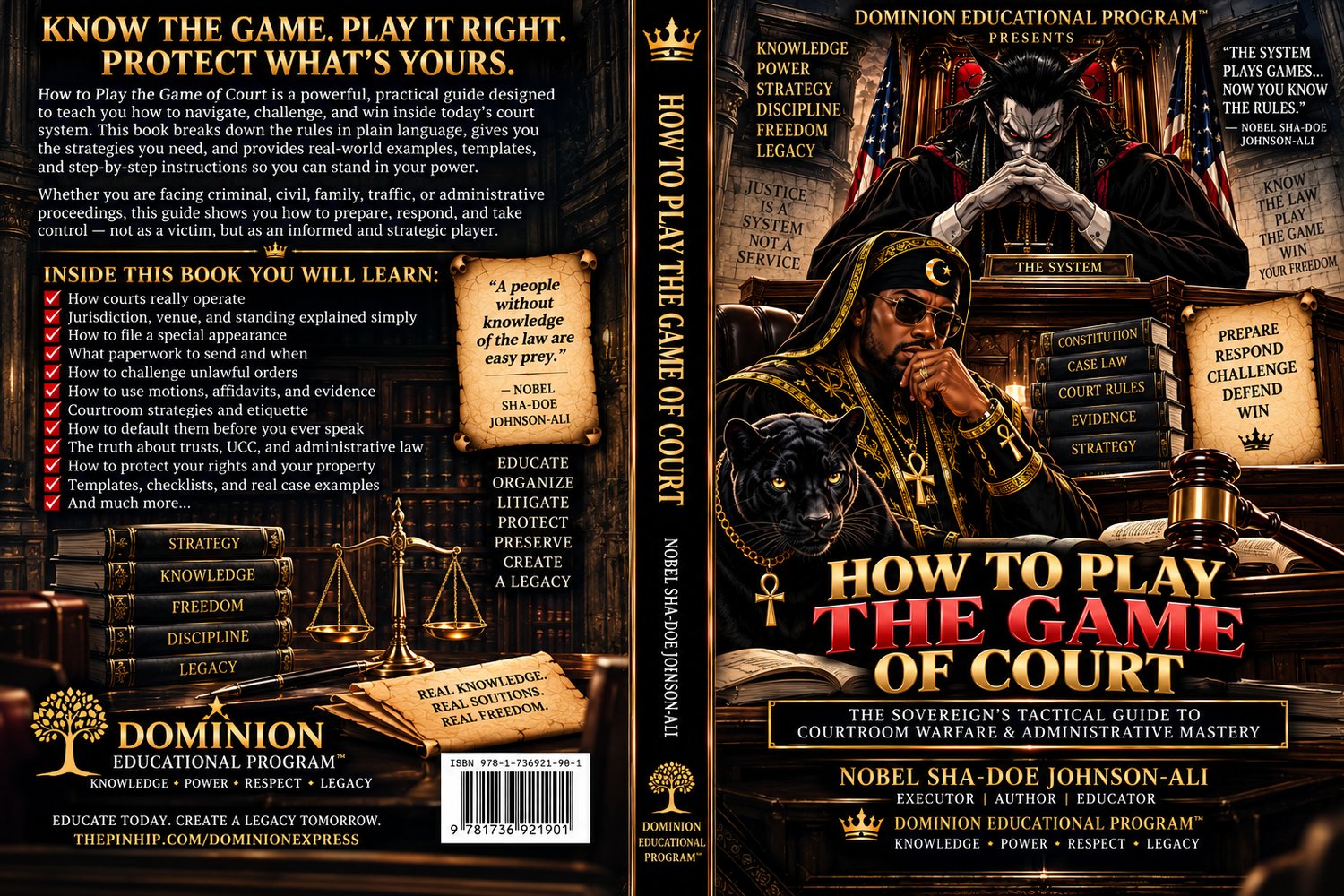
How to play the game (Court) Standard Edition
⚖️ HOW TO PLAY THE GAME OF COURT
Standard edition
How to Play the Game of Court is a practical, plain-English courtroom survival and strategy guide designed to teach everyday people how to prepare, research, organize, respond, and protect their rights inside the court system.
This corrected edition takes the mission of the original How to Play the Game and strengthens it by separating real courtroom procedure and black-letter law from popular legal theories that do not operate the way they are often presented online. Instead of relying on magic words, paperwork theories, or automatic-dismissal claims, readers learn how to identify the actual legal issue, controlling law, required evidence, procedural tool, and available remedy.
The book walks readers step by step through the courtroom process—from receiving the first court papers to preparing for hearings, trial, sentencing, and appeal.
Readers learn how to read a summons, complaint, citation, indictment, petition, docket, and court order; calculate deadlines; organize a master case binder; research statutes and case law; comprehend jurisdiction, venue, standing, and service; and determine what the opposing party or government must actually prove.
The guide also breaks down self-representation, the right to counsel, arraignment, bail, speedy-trial issues, discovery, Brady and Giglio evidence, subpoenas, search warrants, traffic stops, Miranda, suppression motions, motions to dismiss, motions to compel, continuances, judicial recusal, and motions in limine.
Once the case reaches the evidence and trial stage, readers are introduced to relevance, authentication, hearsay, the Confrontation Clause, exhibits, witness preparation, direct examination, cross-examination, impeachment, objections, offers of proof, jury selection, opening statements, sufficiency-of-the-evidence challenges, closing arguments, and jury instructions.
The book then explains what happens after trial, including plea considerations, sentencing preparation, mitigation, allocution, post-trial motions, transcripts, preservation of error, notices of appeal, and building a record for appellate review.
A major feature of this corrected edition is its Courtroom Myth Audit. The book directly examines commonly circulated claims involving gold-fringed flags, admiralty jurisdiction, ALL-CAPS names, UCC 1-308, UCC-1 filings, birth certificates, private administrative defaults, postal jurisdiction, contractual consent to statutes, automatic traffic-ticket dismissals, and other theories—then shows readers the legitimate legal questions and procedures they should research instead.
Throughout the guide, readers receive step-by-step instructions, courtroom language examples, research boxes, checklists, worksheets, motion-building guidance, evidence preparation methods, and practical strategies that can be adapted to the laws and rules of their own jurisdiction.
The central lesson is simple:
KNOW THE ISSUE.
KNOW THE LAW.
KNOW THE EVIDENCE.
KNOW THE PROCEDURE.
MAKE THE RECORD.
PRESERVE YOUR RIGHTS.
This is not about pretending there is a secret phrase that automatically defeats a court case.
It is about learning how the game is actually played.
Dominion Educational Program™
Knowledge • Power • Respect = Legacy
NobEL Sha-doe Johnson-Ali
Executor • Author • Educator