
OPERATE THE LEGACY™ Binder
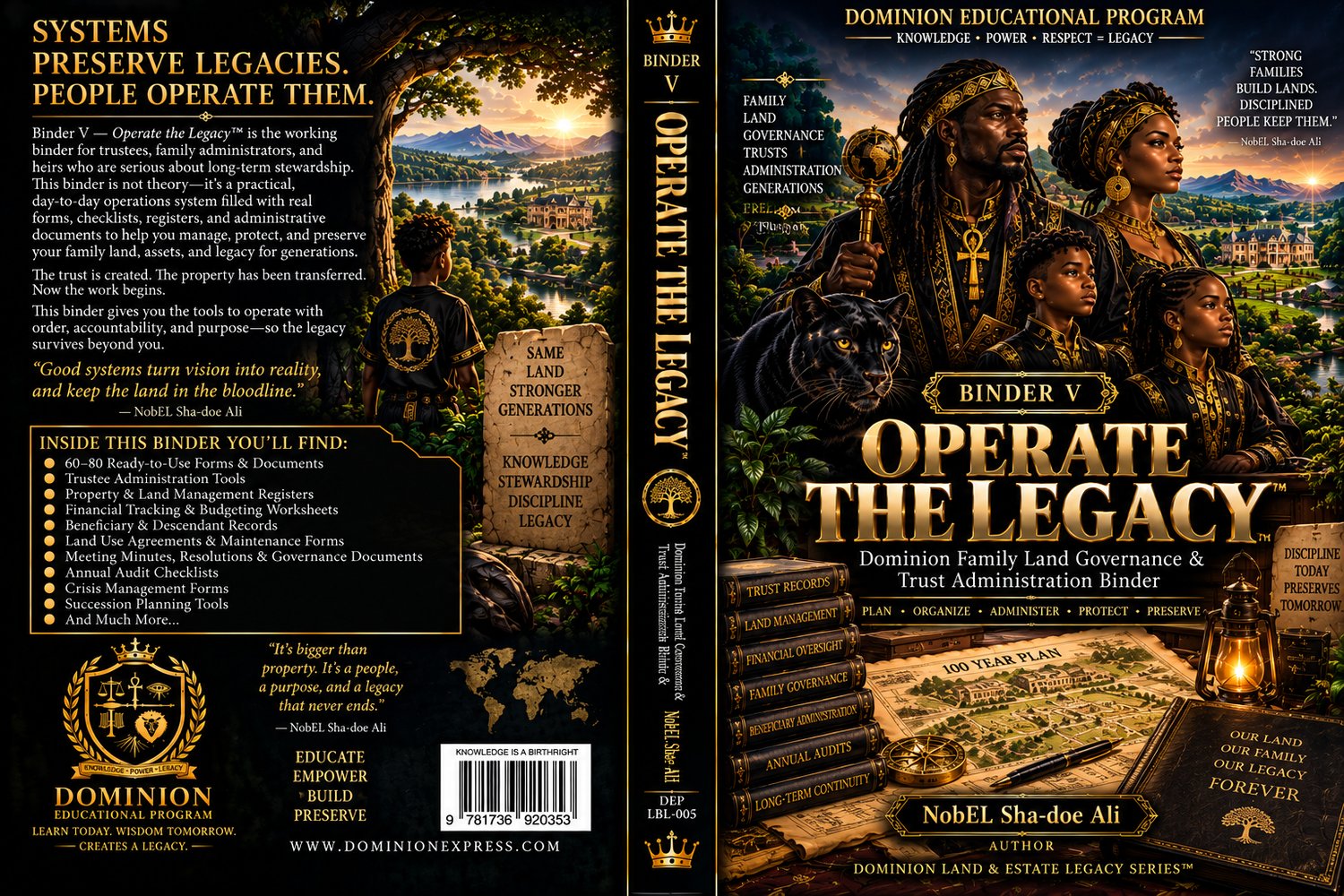
OPERATE THE LEGACY™
Dominion Family Land Governance & Trust Administration Binder
Binder V — The Dominion Land & Bloodline Legacy System™
The family has been identified.
The estate has been mapped.
The trust has been constructed and funded.
The heirs have been taught how to preserve it.
Now somebody has to operate it.
A legacy cannot survive on good intentions. It needs records, procedures, accountability, and people who know what to do next.
OPERATE THE LEGACY™ is the fifth and final component of the Dominion Land & Bloodline Legacy System™—a working administration binder designed to sit on the trustee's desk.
Unlike the previous volumes, this is not primarily a textbook.
This is the operating system.
It transforms the principles taught throughout the series into organized trustee records, property registers, financial ledgers, land-use documents, beneficiary records, governance procedures, succession records, annual audits, checklists, and administrative forms.
The central question is:
Could a qualified successor trustee open this binder tomorrow and figure out how to continue operating the family's system?
If the answer is no, the administrative record is incomplete.
THE TRUSTEE'S COMMAND CENTER
OPERATE THE LEGACY™ gives trustees one organized system for answering critical questions:
What does the trust own?
Who currently serves as trustee?
Who comes next?
Who are the beneficiaries and descendants?
Where are the deeds and surveys?
Is the insurance current?
Are property taxes paid?
What money came in?
What money went out?
How much is held in reserves?
Who occupies the land?
What leases or agricultural agreements exist?
What distributions were made?
What decisions did the trustees approve?
What problems remain unresolved?
And where is the evidence?
The binder is organized into seven major operating sections.
SECTION A — MASTER RECORDS
The administrative foundation of the trust, including trust information, trustee and successor-trustee directories, beneficiary and descendant registers, professional advisers, important deadlines, amendments, emergency contacts, and document-location records.
SECTION B — PROPERTY
The permanent operating history of the land and other property, including property registers, deeds, surveys, title reports, mortgages, insurance, property taxes, inspections, maintenance, improvements, restrictions, incidents, and claims.
SECTION C — MONEY
The financial control center.
Trustees receive systems for maintaining the trust ledger, income, expenses, reserves, distributions, investments, annual budgets, bank accounts, reconciliations, bills, receivables, and reserve withdrawals.
Because valuable land without sufficient liquidity can become a liability rather than a legacy.
SECTION D — LAND USE
Family land needs rules.
This section provides working records for occupancy, agricultural use, leases, improvements, construction, maintenance, utilities, beneficiary business use, property damage, violations, and move-in/move-out inspections.
The objective is to replace:
“But everybody knows what Grandma wanted.”
with an actual documented administrative system.
SECTION E — TRUSTEE GOVERNANCE
Trustees must be able to prove not only what they decided, but why, when, and under what authority they acted.
This section includes trustee acceptances, fiduciary commitments, resolutions, meeting minutes, conflict disclosures, resignations, removals, successor appointments, emergency appointments, delegations, compensation records, and decision/adviser logs.
SECTION F — BENEFICIARIES
Beneficiaries are part of the system, but beneficiary status does not automatically equal authority over trust property.
This section organizes beneficiary information, distribution requests, heir-education certifications, complaints, dispute resolution, descendant registration, death notifications, communication records, contact changes, and education participation.
SECTION G — THE ANNUAL AUDIT
Once every year, the system gets checked.
The trustee verifies property condition, insurance, taxes, title, beneficiary records, trustee succession, reserves, investments, legal compliance, tax compliance, and permanent records.
The question becomes:
Is the legacy actually operating the way the documents say it should?
BUILT FOR SUCCESSION
OPERATE THE LEGACY™ is designed around one of the most important lessons in the entire Dominion series:
The founder's memory cannot be the family's operating system.
Eventually, the founder will not be there.
Eventually, the first trustee will not be there.
Eventually, people who personally knew the founders will not be there.
The records must survive them.
That is why Binder V includes document numbering, revision control, continuation sheets, permanent-file instructions, annual calendars, successor-trustee records, professional-adviser information, open-item tracking, and verification procedures.
Every significant administrative action should answer:
WHAT happened?
WHO authorized it?
WHEN did it happen?
WHAT DOCUMENT proves it?
WHERE is the proof stored?
80 WORKING FORMS & DOCUMENTS
This full working edition contains 80 trustee and family-administration forms, supported by continuation sheets that allow the binder to grow as decades of trust history accumulate.
The goal is not paperwork for paperwork's sake.
The goal is institutional memory.
And the final test is simple:
Can the next trustee operate tomorrow?
That is the difference between leaving behind a collection of documents and leaving behind an operating institution.
THE DOMINION LAND & BLOODLINE LEGACY SYSTEM™
Volume I — FIND THE BLOODLINE™
Identify the family.
Volume II — BUILD THE ESTATE™
Map the property and architecture.
Volume III — LOCK THE LEGACY™
Construct and fund the legacy structure.
Volume IV — KEEP THE LAND™
Educate the heirs and prepare for generations of stewardship.
Binder V — OPERATE THE LEGACY™
Run the system. Record the decisions. Audit the property. Prepare the successor.
OPERATE THE LEGACY™
Organize it.
Administer it.
Document it.
Audit it.
Teach it.
Preserve it.
Pass the operating system forward.
Author: NobEL Sha-doe Ali
Dominion Educational Program
Document No.: DEP-LBL-005