
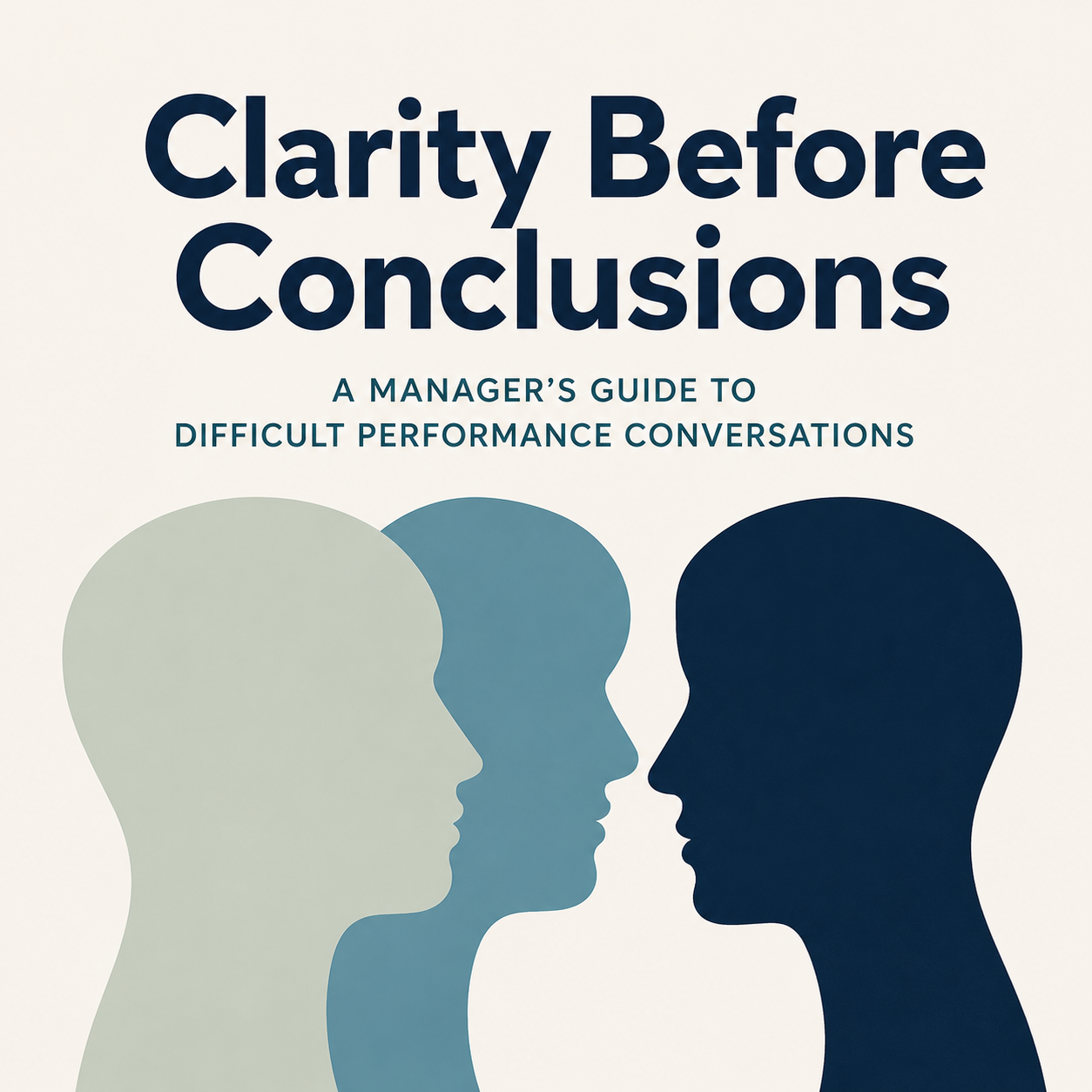
Seeing Talent Differently: Clarity Before Conclusions
Seeing Talent Differently: Clarity Before Conclusions
A Manager's Guide to Difficult Performance Conversations
Create clarity without shame. Maintain accountability without assumptions.
Description
Something isn't working.
An employee is missing deadlines. Follow-through has become inconsistent. Communication feels difficult. Their performance doesn't seem to match their capabilities. Or maybe you're seeing a pattern you know you need to address, but you're not sure what's really behind it.
As a manager, you still have to address the issue.
But before deciding someone is careless, disengaged, unmotivated, difficult, or simply "not performing," there's an important step:
Get clear about what you're actually seeing.
Seeing Talent Differently: Clarity Before Conclusions is a practical conversation-planning guide for managers who need to address performance concerns while balancing accountability, curiosity, and support.
It helps you prepare for the conversation before you have it, separating observable facts from assumptions, identifying where expectations may need greater clarity, considering barriers you may not be seeing, and determining what meaningful accountability should look like going forward.
This Guide Will Help You
- Separate observable performance issues from assumptions about attitude, motivation, or capability
- Identify questions worth asking before reaching a conclusion
- Consider whether workload, unclear expectations, communication, workflow, or other barriers may be contributing to the problem
- Define what successful performance actually looks like
- Prepare for a difficult conversation without avoiding accountability
- Ask about barriers without diagnosing or labeling an employee
- Create clear expectations, next steps, deadlines, and follow-up
- Examine whether the problem belongs entirely to the employee or whether workplace systems may be contributing
- Reflect on your own assumptions and habits as a leader
A Practical Conversation Framework
The guide walks you through a simple five-part approach:
OBSERVE
Describe what you've actually noticed without adding motive or judgment.
CLARIFY
Explain what is expected and why it matters.
ASK
Give the employee an opportunity to explain what's getting in the way.
SUPPORT
Identify appropriate resources, structure, clarification, or support that could improve the outcome.
AGREE
Establish exactly what happens next, who owns it, when it's due, and when you'll follow up.
Who Is This For?
This guide was created for:
- People managers
- New and emerging managers
- Team leaders
- Managers preparing for a difficult employee conversation
- Leadership coaches and mentors
- HR and Learning & Development professionals
- Organizations developing more thoughtful and neuroinclusive management practices
Is This a Performance Management Tool?
This guide can be particularly valuable before a performance issue escalates into formal performance management, but it is not a PIP template or HR disciplinary document.
Its purpose is to help managers make sure they've done the leadership work first.
Are expectations actually clear?
Does the employee understand what success looks like?
What facts do you have, and what assumptions have you made?
Have you asked what's getting in the way?
Is there appropriate support or structure that could improve performance?
Have you clearly established what needs to change and by when?
If performance concerns continue, your organization's normal HR and performance-management processes may still be appropriate. This guide helps you approach the conversations leading up to that point with greater clarity and intention.
What About Neurodiversity?
Seeing Talent Differently grew from my work around recognizing different ways of thinking, working, communicating, and succeeding. High capability doesn't always look like effortless organization, consistent execution, emotional detachment, or ease with every type of task.
This guide encourages managers to stay curious about what they may not be seeing.
It is not a diagnostic tool, and managers should never use it to determine whether an employee is neurodivergent or has a medical condition. Instead, it provides leadership practices that can create greater clarity and fairness for neurodivergent employees while also making you a better manager for everyone on your team.
What's Included
This 9-page digital guide includes:
- Before You Label the Problem: Reflection Worksheet
- What Might You Be Missing? manager checklist
- Expectation-clarity exercise
- Five-part difficult conversation framework
- Real-world conversation language examples
- Language to use instead of potentially shaming responses
- Accountability Without Shame checklist
- Person vs. System workplace assessment
- Follow-up planning
- Manager self-reflection prompts
The Goal
This isn't about lowering expectations.
It's about making expectations clear enough for people to meet them.
It's about replacing assumptions with better questions.
And it's about recognizing that accountability and support don't have to compete with one another.
Great managers don't avoid difficult conversations. They learn how to have better ones.
Instant Digital Download
Format: PDF
Length: 9 pages
Designed by Hart & Sewell Consulting as part of the Seeing Talent Differently leadership series.