
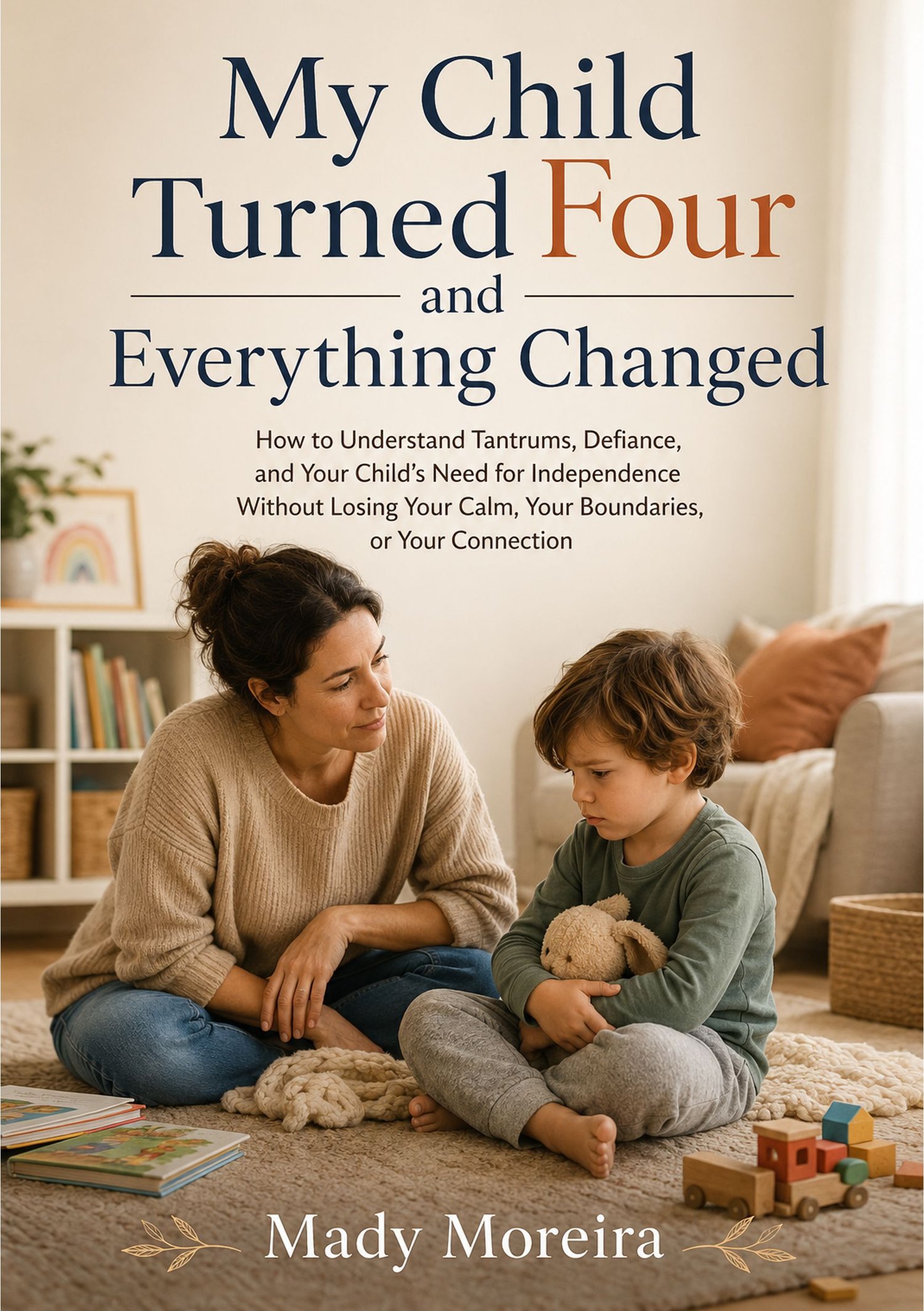
My Child Turned Four and Everything Changed
My Child Turned Four and Everything Changed
How to Understand Tantrums, Defiance, and Your Child’s Need for Independence Without Losing Your Calm, Your Boundaries, or Your Connection
A practical, realistic guide for mothers of four-year-olds who feel exhausted, confused, guilty, and unsure how to respond when everything suddenly feels harder.
Your child turned four.
And somehow, the child who once seemed easier to guide now says “no” to almost everything.
Getting dressed takes forever.
Leaving the house becomes a negotiation.
Bath time turns into a battle.
Turning off the television leads to tears.
Simple requests are met with resistance, shouting, running away, hitting, or complete refusal.
You may find yourself wondering:
“What happened to my child?”
“Why is everything suddenly so difficult?”
“Am I being too soft?”
“Am I being too harsh?”
“Why do I keep losing my patience?”
“How do I set limits without turning every day into a fight?”
This book was written for that exact moment.
Not to blame you.
Not to label your child.
Not to promise a perfect home with no tantrums.
But to help you understand what is happening, respond with more clarity, hold boundaries without constant shouting, and protect the connection with your child even on the difficult days.
This is not a book about becoming a perfect mother.
It is a book about understanding your four-year-old better so you can stop reacting in the dark.
At four, many children seem “bigger” on the outside.
They speak more.
They argue more.
They want to decide.
They want independence.
They want to do things alone.
But their ability to wait, accept frustration, control impulses, move through transitions, and manage big emotions is still developing.
That gap between what your child wants and what your child can actually handle is where many daily conflicts begin.
This book helps you see that gap more clearly.
So instead of thinking:
“He is doing this on purpose.”
“She is just being naughty.”
“I must be doing everything wrong.”
You can begin to ask:
“What is happening before the behaviour?”
“Is this a real boundary or just my preference?”
“Can my child still hear me right now?”
“What needs to be stopped immediately?”
“What can be taught later?”
“What do I need in order not to explode too?”
Inside this book, you will learn how to:
Understand why many children change so intensely around the age of four.
Recognise the difference between a tantrum, refusal, frustration, aggression, tiredness, overload, and a real need for help.
Prepare difficult transitions before they turn into battles.
Set clear limits without shouting, threatening, humiliating, or giving in from exhaustion.
Respond when your child says “I don’t want to” again and again.
Handle hitting, throwing, running away, public tantrums, sibling conflicts, and emotional explosions with more safety and less panic.
Know what to do after the tantrum, when your child is finally able to reconnect and learn.
Teach simple words your child can use instead of hitting, screaming, or throwing.
Repair after conflict without forcing empty apologies, hugs, or shame.
Understand your own breaking point as a mother and create a plan for the moments when you are the one about to explode.
Respond when other adults disagree, undermine your limits, or leave all the responsibility to you.
Recognise real progress, even when tantrums have not disappeared completely.
Know when a behaviour may need professional attention and when general parenting strategies are no longer enough.
Use a practical seven-day plan to work on one recurring conflict at a time.
This book is for you if:
Your child is around four years old and seems to have become more defiant, emotional, intense, or difficult to guide.
You feel like simple routines have become exhausting negotiations.
You want to be calm, but you often end up repeating, raising your voice, threatening, or giving in.
You are tired of advice that says “just be firm” without explaining how to be firm and connected at the same time.
You want to understand tantrums without excusing unsafe behaviour.
You want practical phrases, examples, and steps you can actually use in real family life.
You sometimes feel guilty after shouting and want to know how to repair without losing authority.
You need help distinguishing between normal developmental difficulty and signs that deserve professional guidance.
You want to raise your child with limits, respect, emotional safety, and realism.
This book is not for you if:
You are looking for a method that promises to end all tantrums immediately.
You want a rigid discipline system based on fear, punishment, or control.
You believe children should never protest, cry, resist, or express frustration.
You are looking for clinical diagnosis or personalised medical advice.
You want a perfect formula that works the same way for every child, every family, and every situation.
This guide is practical, but it is also realistic.
It does not pretend that motherhood becomes easy when you understand child development.
It helps you respond with more direction when things are hard.
What makes this book different?
Many parenting books tell you what you “should” do.
Stay calm.
Be consistent.
Validate emotions.
Set limits.
Do not shout.
But in real life, you may already know the theory.
The problem is what happens when your child is screaming, dinner is burning, another child is calling, the house is messy, you are exhausted, and your body is already close to exploding.
This book does not ignore that reality.
It speaks to the mother who wants to do better but is tired.
The mother who loves her child deeply but sometimes feels completely overwhelmed.
The mother who needs practical guidance, not judgement.
The mother who wants to understand her child without letting the child run the house.
The mother who wants to set limits without becoming harsh.
The mother who needs to know that repair is possible after difficult moments.
What you will find inside
Part I — Understanding Before Correcting
You will learn what often changes around the age of four, why behaviour is only the visible part of the problem, and why not every difficult moment should be treated as “just a tantrum”.
Part II — Preparing the Ground
You will discover how many conflicts begin before the first “no”, how routines and transitions can be made easier, and why sleep, hunger, movement, screens, and overload affect your child’s ability to cooperate.
Part III — Boundaries Without Power Struggles
You will learn how to set limits with firmness and empathy, choose realistic boundaries, reduce unnecessary battles, and respond when your child refuses to cooperate.
Part IV — During the Conflict
You will find practical guidance for emotional explosions, aggression, public tantrums, running away, throwing objects, and situations where your child can no longer listen or choose.
Part V — After the Storm
You will learn what to do once the tantrum has passed, how to reconnect, how to teach without shame, and how to repair harm in a way that is meaningful and age-appropriate.
Part VI — The Mother Is Part of the Equation Too
You will explore your own overload, your breaking point, the guilt after shouting, and the difficulty of parenting when other adults disagree, contradict your limits, or leave most of the responsibility to you.
Part VII — When It Is Necessary to Look Deeper
You will learn how to recognise when intensity, frequency, risk, loss of skills, aggression, or family exhaustion may justify professional guidance.
Practical Plan and Quick Reference Guide
You will also receive a seven-day plan to work on one recurring conflict, plus quick-reference sections and printable resources to help you apply the ideas in daily life.
You will also receive practical printable resources
The book includes worksheets and quick tools such as:
A difficult episode map
A seven-day pattern tracker
A transition planning sheet
A family boundaries worksheet
A plan for big emotions
Phrases for difficult moments
Phrases your child can learn
A repair plan
A mother’s emergency calm plan
An adult repair script
An agreement between adults
A family responsibility map
Progress indicators
A public outing preparation sheet
A summary to take to a professional appointment
A quick reference card
An emergency card for the mother
A next-step planning sheet
These resources are simple, practical, and designed to help you observe, prepare, respond, repair, and adjust without turning family life into a constant evaluation.
This book will help you replace:
“Stop crying right now.”
with:
“You can be upset. The decision stays.”
“Why are you doing this to me?”
with:
“This is hard for you, and I still need to keep you safe.”
“If you don’t stop, you’ll lose everything.”
with:
“I won’t let you throw this. I’m going to put it away for now.”
“Say sorry now.”
with:
“You did something that hurt. Now we need to repair.”
“I am a terrible mother.”
with:
“I shouted. I need to repair and prepare differently next time.”
The promise of this book
This book does not promise that your child will never have another tantrum.
It promises something more honest.
It will help you understand what may be happening beneath the behaviour, respond with clearer limits, reduce unnecessary power struggles, repair after difficult moments, and recognise progress even when family life is still imperfect.
Because the goal is not to create a child who never says “no”.
The goal is to help your child move through frustration, limits, independence, and big emotions with more safety, more language, more connection, and less harm.
And to help you do the same.
Frequently Asked Questions
Is this book only for mothers?
The book speaks directly to mothers because many mothers carry the emotional, practical, and mental load of these daily conflicts. However, fathers, grandparents, educators, and other caregivers can also benefit from the guidance.
Is this book suitable if my child is not exactly four?
Yes. The focus is the stage around age four, but many ideas may also help families with children slightly younger or older who are dealing with tantrums, defiance, transitions, frustration, and boundary-setting.
Will this book stop tantrums?
No book can honestly promise that. Tantrums are part of development for many children. This guide helps you understand them better, reduce avoidable conflicts, respond more safely, and recognise progress beyond the simple absence of crying.
Does this book replace therapy or medical advice?
No. This book is educational and practical, but it does not diagnose, assess, or treat any child. If there are concerns about development, aggression, self-injury, language, sleep, eating, safety, or family exhaustion, professional guidance should be sought.
Is this a permissive parenting book?
No. This book does not suggest letting children do whatever they want. It supports clear limits, adult responsibility, safety, repair, and respect. The difference is that boundaries are held without humiliation, fear, or unnecessary power struggles.
Is this a strict discipline book?
No. The book does not recommend smacking, shame, threats, intimidation, or emotional withdrawal. It focuses on boundaries that teach, protect, and guide.
Does the book include practical examples?
Yes. Each chapter includes real-life situations, simple explanations, practical steps, examples, common mistakes, and small actions you can apply.
For the mother who is tired of feeling lost
You do not need to choose between being loving and being firm.
You do not need to turn every “no” into a battle.
You do not need to explain everything while your child is already too upset to listen.
You do not need to ignore your own exhaustion.
You do not need to get everything right to repair what went wrong.
Your child does not need a perfect mother.
Your child needs an adult who can protect, guide, repair, and return.
This book was written to help you become that adult more often — not perfectly, but with more clarity, more confidence, and less guilt.
Start with one moment.
One routine.
One boundary.
One sentence.
One repair.
One next step.
You do not have to change everything today.
You only need to stop walking through every conflict without a map.
Get your copy of My Child Turned Four and Everything Changed and begin understanding what is really happening beneath the tantrums, defiance, and daily battles — without losing your calm, your boundaries, or your connection.