


Your Cart
Loading
Only -1 left

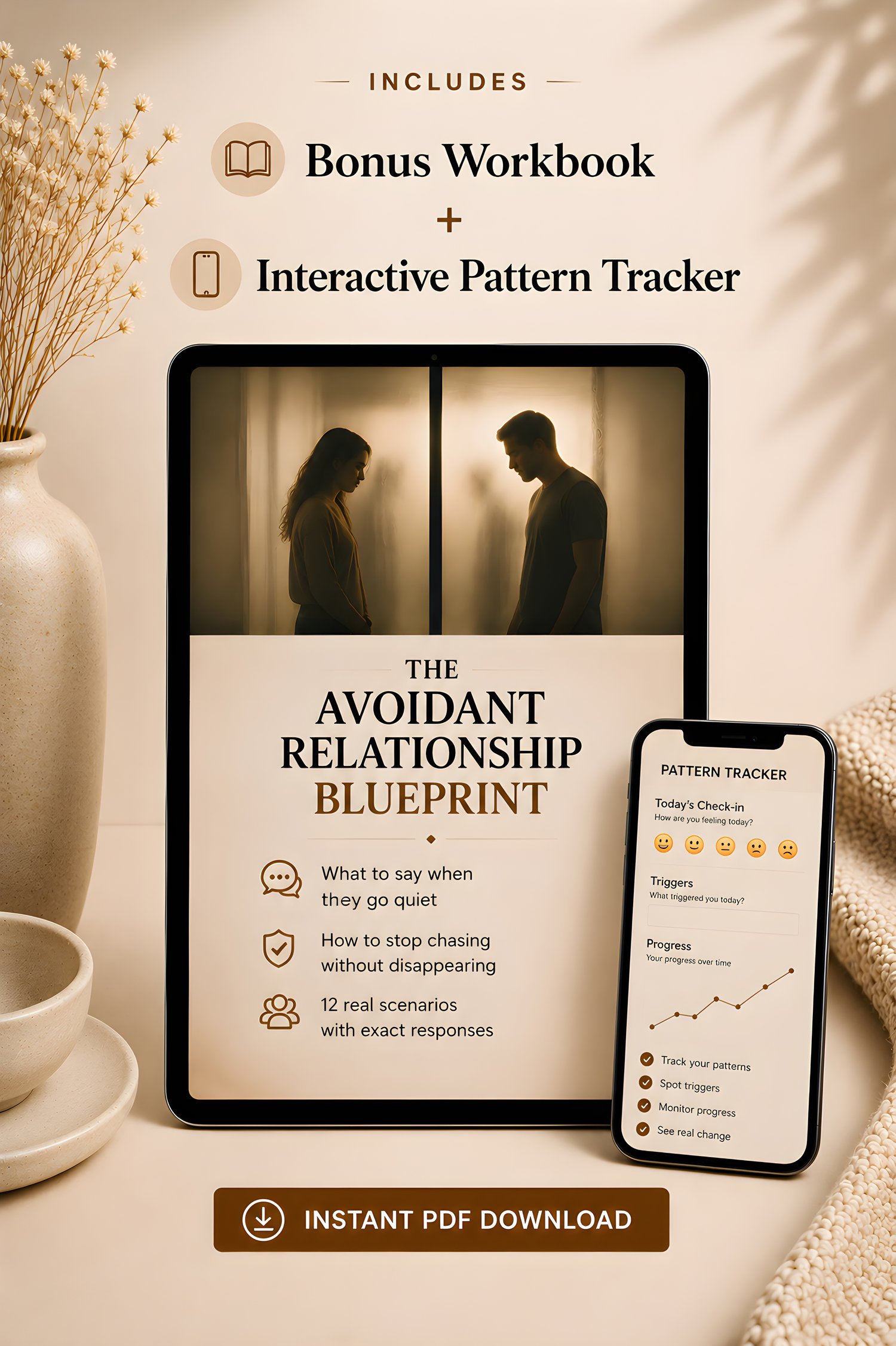
The Avoidant Relationship Blueprint. What To Say. How To Connect. When To Walk Away

On Sale
$27.00
$27.00
Added to cart

You felt something real. Then it changed.


Now you’re stuck trying to understand

what happened… and what to do next.


This guide helps you understand the pattern,

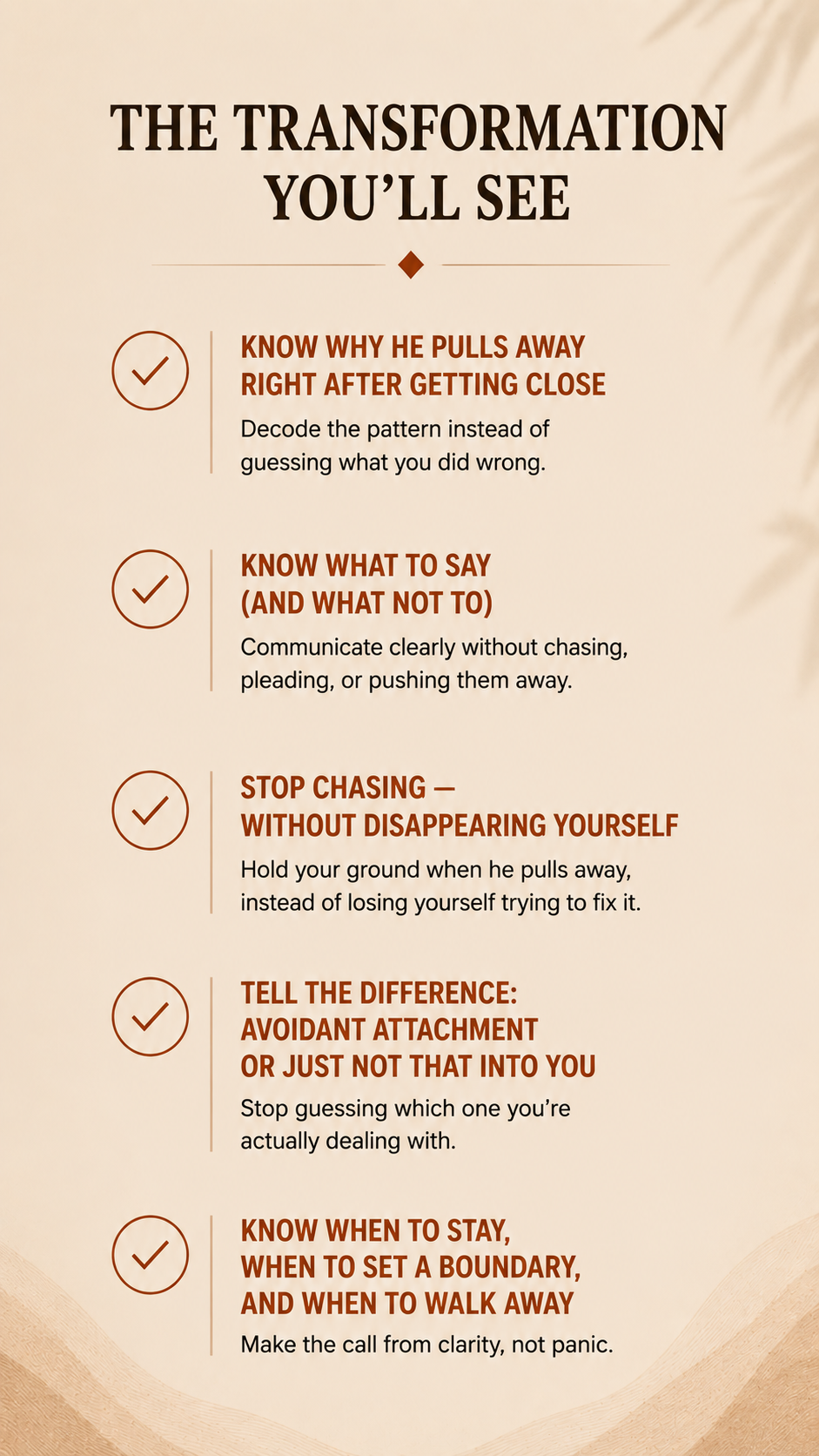
change how you respond,

and finally see if this can work.


Does this feel familiar?

πŸ’” They said β€œI need space” β€” and your whole body reacted

πŸ’” You try to act normal, but you’re checking your phone constantly

πŸ’” You spend 20 minutes writing one β€œcasual” message

πŸ’” You tell yourself to give space… but panic takes over

πŸ’” You don’t even know if you’re overreacting or something is actually wrong


Not another guide about understanding avoidants. This is the system for what to actually do β€” when he pulls away, goes silent, or comes back like nothing happened.


You will get a PDF (42MB) file

  • "I didn't even realize how tense I looked until it stopped.

    I was constantly checking my phone. Overthinking every pause, every tone, every 'I'll talk later.'

    ο»Ώ

    By Day 3 of the guide, I stopped spiraling every time he pulled away. Not because he changed β€” but because I finally knew what was happening.

    By the end of the 7 days, something unexpected happened: people around me started saying I looked… lighter. I wasn't clenching my jaw all the time. I wasn't exhausted after every interaction anymore.

    I didn't leave the relationship. But I stopped abandoning myself inside it. That alone changed everything."


    β€” Grace

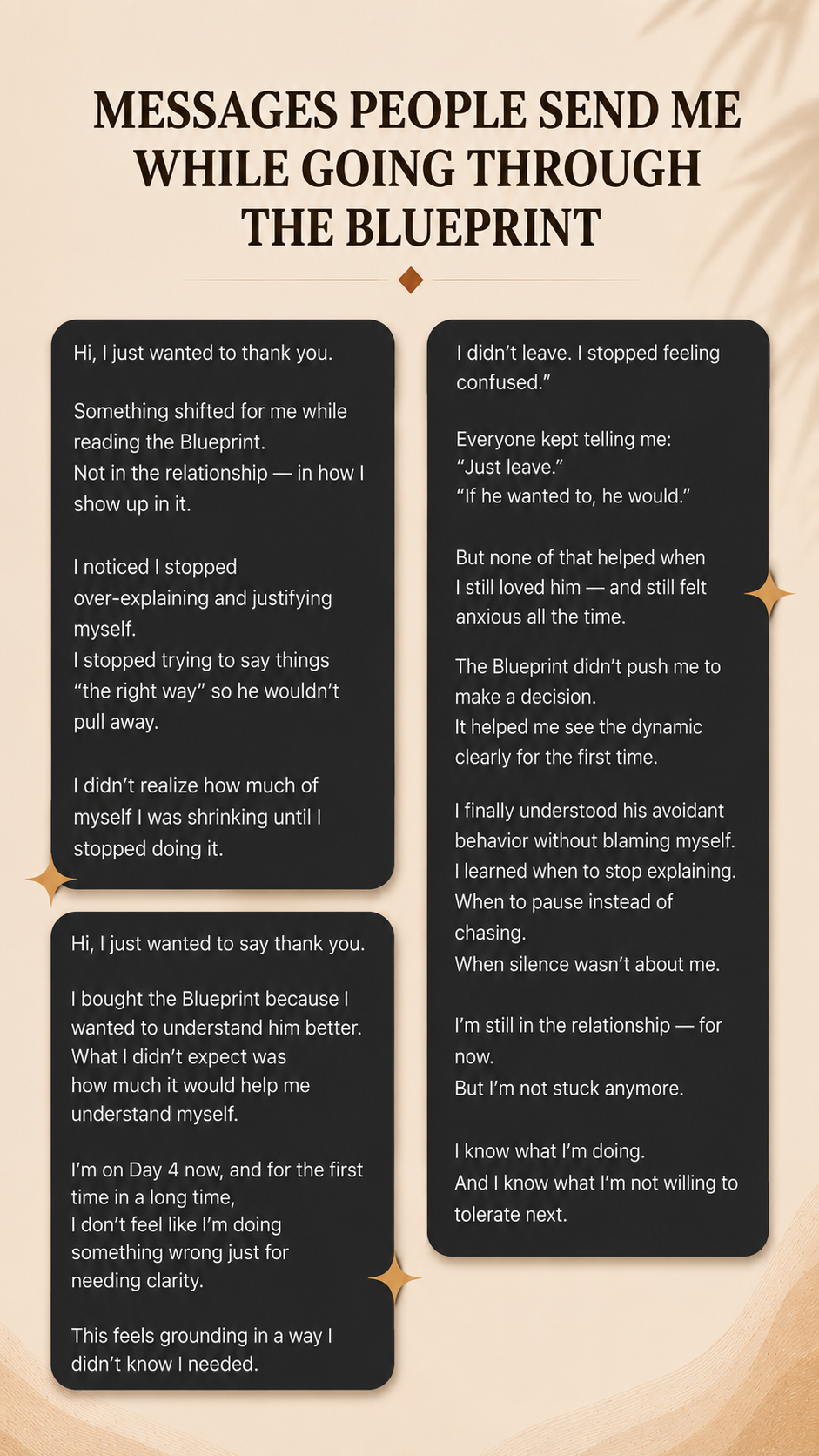
  • "I didn't leave. I stopped feeling confused.


    Everyone kept telling me: 'Just leave.' 'If he wanted to, he would.' But none of that helped when I still loved him β€” and still felt anxious all the time.


    This guide didn't push me to make a decision. It helped me see the dynamic clearly for the first time. I finally understood his avoidant behavior without blaming myself.


    I learned when to stop explaining. When to pause instead of chasing. When silence wasn't about me.

    I'm still in the relationship β€” for now.


    But I'm not stuck anymore. And I know what I'm not willing to tolerate next."


    β€” Miriam

  • "I didn't realize how much of my day was controlled by him… until it stopped.

    ο»Ώ

    Every silence felt like something was ending. I kept telling myself: 'If I just communicate better, it will fix this.' But nothing changed.

    Around Day 3, he pulled away… and I didn't immediately panic. I still felt the urge to fix it β€” but I didn't act on it.

    By the end, I wasn't calmer because he became consistent. I was calmer because I stopped reacting to every shift. I stopped trying to manage his emotions.

    I didn't suddenly become 'secure.' But I became steady. And for the first time, I felt like I wasn't losing myself in this anymore."


    β€” Elen

  • "I bought this guide for one reason: I wanted to calm down. Not to leave. Just to stop feeling like I was losing my mind every time he pulled away.

    What surprised me is how practical it felt. It didn't shame me for being anxious. It helped me spot the pattern in real time β€” and gave me words for what was happening: deactivation, overwhelm, distancing… without me turning it into a personal emergency.

    Around Day 4, something flipped: he did the same 'pull away' thing… and I didn't spiral. I still felt it in my body, but I knew what to do with it.

    I'm calmer now. I don't over-explain. And I finally understand the difference between 'he needs space' and 'this isn't meeting my needs.'"

    β€” Anna

  • "I didn't expect this much relief without anything changing on his side.

    Every interaction felt like work. Every time he needed space, I took it personally.


    I was exhausted from trying to say the 'right' thing. I was tired of feeling like one wrong move would push him away for days.


    This wasn't just 'understand avoidants.' It was: what to say. When to step back. When to stop.

    ο»Ώ

    By Day 4, he pulled away β€” and I didn't chase. Not as a tactic. I just understood it.

    I'm not constantly anxious anymore. I finally feel like I have a say in how this goes."


    β€” Laura

What actually changes when you respond differently

  • Meet Anna.

    Anna understands what’s happening.

    She knows he pulls away sometimes.

    She tries to do it right.

    Sends a calm message.

    Gives space.

    Thenβ€”

    Silence.

    Her mind starts racing.

    She checks her phone.

    Replays everything.

    She waits… then sends another message.

    Explains. Softens. Fixes.

    He pulls away further.

    Nothing changes.


  • Now meet Alex.

    Same situation.

    Same silence.

    Same urge to react.

    But this timeβ€”

    She pauses.

    Doesn’t send the second message.

    Doesn’t try to fix the moment.

    She holds her position.

    Responds intentionally β€” not emotionally.


  • This time:

    No chasing.

    No overexplaining.

    No spiral.

    And something shifts.

    Not instantly.

    But noticeably.


    Same situation.

    Different response.

    Different outcome.

    That’s what this guide changes.


How to use this blueprint:

You don't sit down and read this once.

You use it in real moments β€” when something happens and you don't know how to respond.

──────────────────

STEP 1 IDENTIFY WHICH AVOIDANT YOU'RE DEALING WITH

Chapter 1 gives you a clear assessment: Dismissive or Fearful. They look similar. What works with one backfires with the other. This one distinction changes everything you do.

STEP 2 UNDERSTAND WHAT HE'S ACTUALLY READING IN YOUR BEHAVIOR

Chapter 2 maps exactly what you're doing with good intentions β€” and what his nervous system receives instead. Most women are surprised by how differently the same action lands.

STEP 3 USE THE COMMUNICATION FRAMEWORK IN REAL SITUATIONS

Chapter 7 covers 12 specific scenarios β€” what most people do, why it backfires, and exactly what to say instead. The silence. The return. The space request. The conflict. The future conversation. Each one handled clearly.

STEP 4 TRACK WHETHER IT'S ACTUALLY MOVING

The 30-Day Reality Check tells you the difference between genuine movement and getting better at tolerating what isn't working. Three months of data gives you a clear answer.

STEP 5 DECIDE FROM CLARITY

Five questions. Observable answers. Not hope. Not fear. What has actually happened. You'll know what to do next β€” and you'll know it from a calm place.

FAQs