

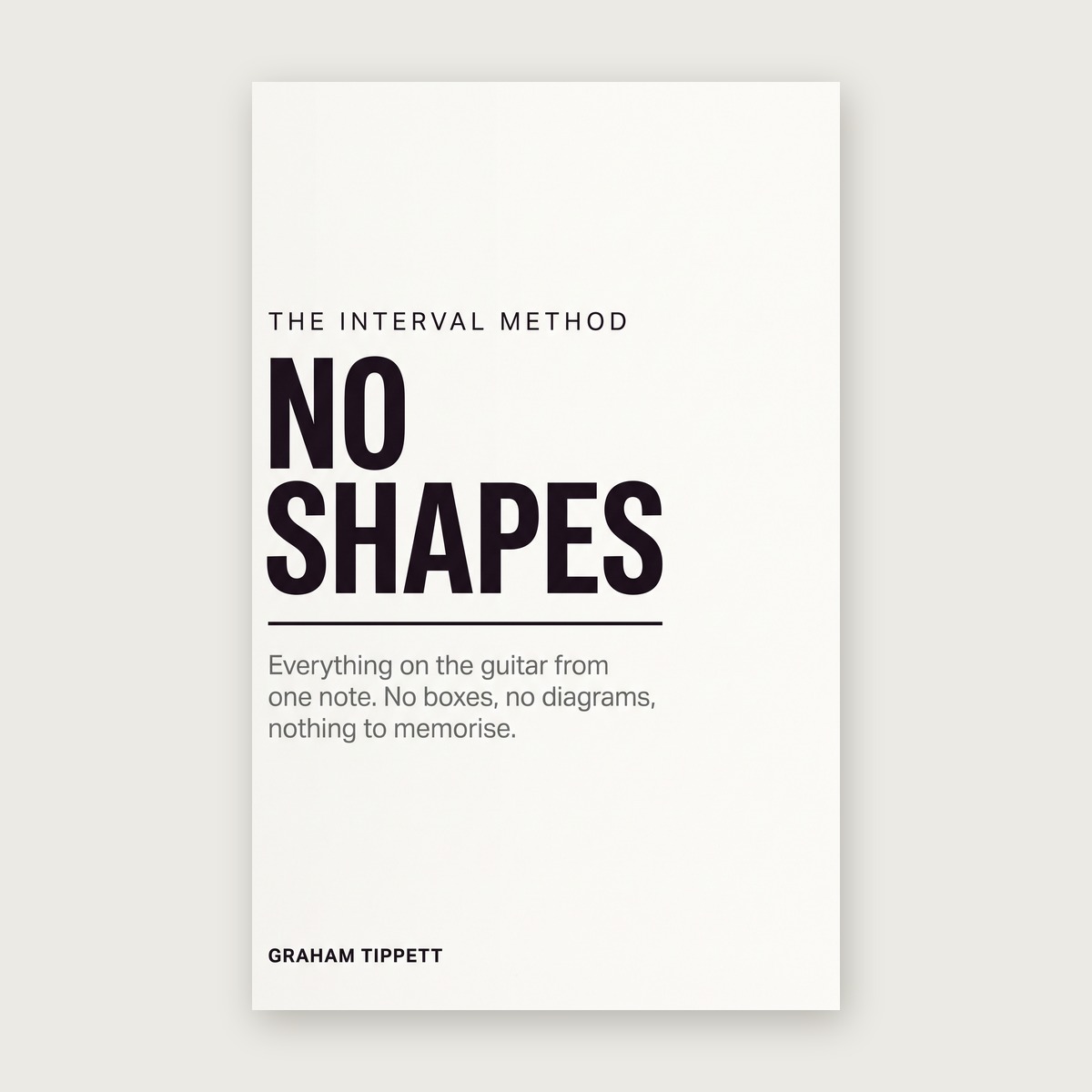
No Shapes - The Interval Method
A scale, an arpeggio and a chord are the same information at different densities.
Boxes exist because we treat them as three separate libraries of shapes to memorise. Organise everything by intervals from a root instead and they collapse into one thing.
That's what this book does. There are no fretboard diagrams in it, and only one thing to memorise.
The whole system
- Find any root anywhere on the neck — two strings up, two frets up, plus one correction crossing the B string
- Read the map — three rows covering every interval relative to that root
- Apply a formula — major is 1-3-5, dominant seventh is 1-3-5-b7, and so on
Play a formula simultaneously and it's a chord. Sequentially and it's an arpeggio. Fill the gaps and it's a scale. Any key, from any note, without a single memorised shape.
What's inside
- Why shapes fail, and what a box actually is
- Finding any root — the one thing in the book you memorise
- The map, read upwards and downwards, with the drills that make it automatic
- Formulas for chords and scales as numbers
- Building things — one formula, three densities, plus the two-note shortcut
- Improvising by targeting: roots, fifths, thirds, sevenths, then filling
- A thirty-day plan
- Troubleshooting for when it goes wrong
Before you buy
There are no fretboard diagrams. Not one. That isn't an oversight — a diagram of an interval map defeats the purpose of an interval map. If you want pictures of where to put your fingers, this is the wrong book.
It's short. A pocket manual for the music stand, not a course to work through. If the fretboard really does reduce to one shape, one map and a list of formulas, a two-hundred-page book would contradict the claim.
You'll play worse for about a month. Computing an interval live is nothing like recalling a picture. That's in the book too, because it's where most people quit.
Who it's for
Players who can already get around the guitar and suspect their improvising is more retrieval than invention.
If you bought Wayne Krantz's An Improviser's OS or Mick Goodrick's The Advancing Guitarist and never finished either, this is the book that gives you a way in.
It's stand-alone. You don't need anything else I've written, though it does assume you know what an interval is.
One test, if you want to know whether you need this: play a phrase you like, then play it somewhere else on the neck. If it survives the move, you know a phrase. If it doesn't, you knew a fingering.