
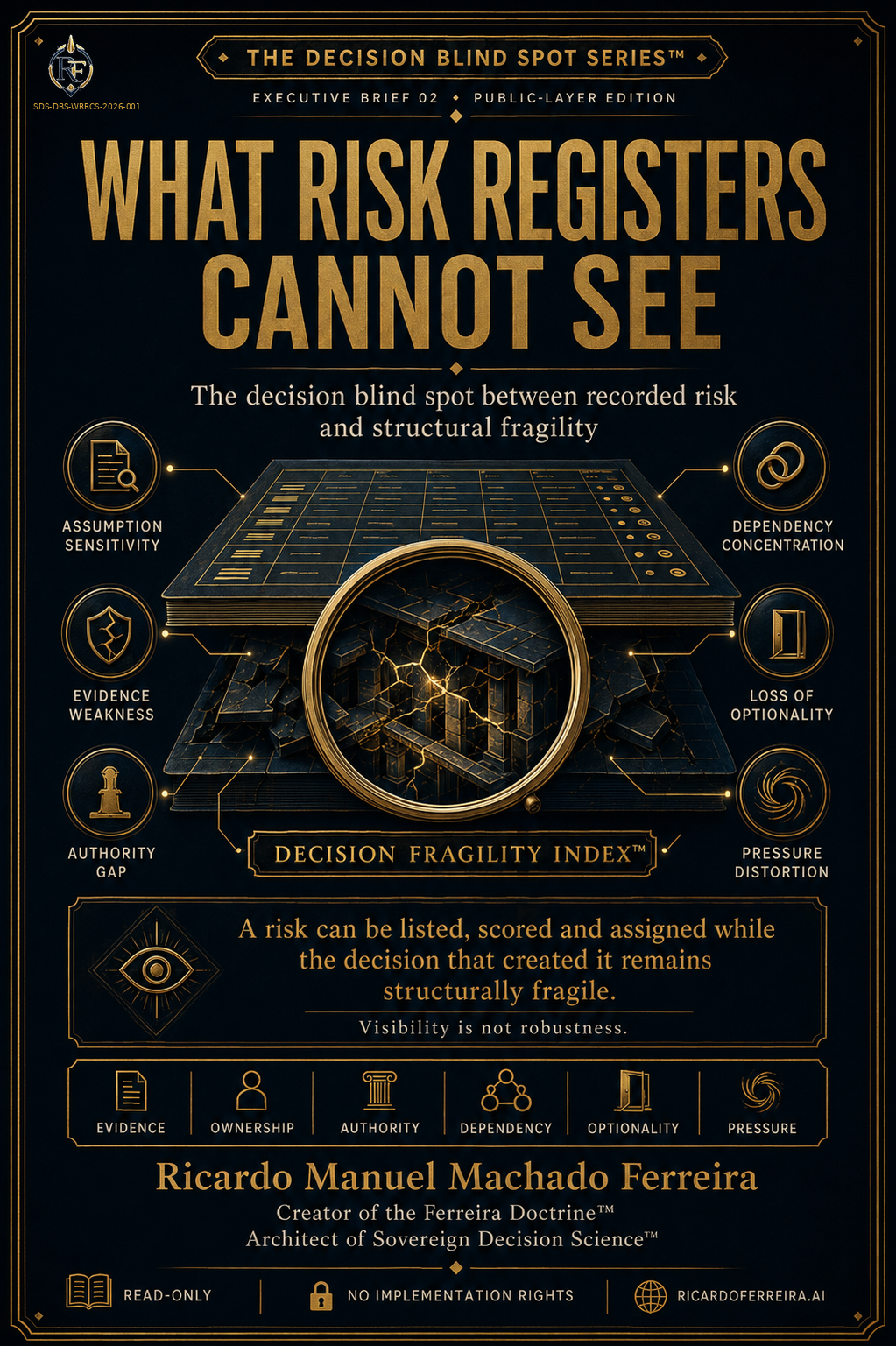
WHAT RISK REGISTERS CANNOT SEE
WHAT RISK REGISTERS CANNOT SEE
The decision blind spot between recorded risk and structural fragility
A public-layer executive briefing by Ricardo Manuel Machado Ferreira, Creator of the Ferreira Doctrine™ within Sovereign Decision Science™ and Architect of Sovereign Decision Science™.
Most organisations can identify what risks have been recorded.
Far fewer can prove whether the decision carrying those risks is structurally robust.
Scorecards classify.
Heat maps visualise.
Owners are assigned.
Mitigation actions are recorded.
Reviews are scheduled.
Yet a risk can be identified, scored, assigned and reviewed while the decision that created it remains structurally fragile.
WHAT RISK REGISTERS CANNOT SEE is a concise executive briefing for leaders and professionals who need to distinguish recorded risk from decision robustness.
This is not a generic risk-management essay.
It is a public-layer executive briefing on how apparently controlled risks can remain attached to decisions weakened by uncertain assumptions, inadequate evidence, unclear authority, concentrated dependency, disappearing alternatives, irreversibility or pressure distortion.
It shows why risk visibility can coexist with institutional fragility across procurement, supply chain, logistics, finance, legal, operations, quality, audit, compliance, technology, cybersecurity, AI governance, projects, PMO and the board.
WHY THIS BRIEFING MATTERS
Many organisations mistake risk visibility for decision control.
They can identify the risk, assign an owner, record a mitigation action, select a reporting category and present an updated heat map.
But when conditions change, they may be unable to prove whether the underlying decision has the evidence, authority, alternatives, funding, recovery capability and accountable ownership required to survive pressure.
That gap matters.
A risk can appear controlled while the decision remains:
→ dependent on an assumption that has never been challenged;
→ supported by evidence that is outdated, incomplete or non-independent;
→ assigned to an owner who lacks authority or budget to act;
→ concentrated around one supplier, system, route, licence, approval or individual;
→ protected by an alternative that exists only on paper;
→ difficult, expensive or impossible to reverse after commitment;
→ vulnerable to urgency, hierarchy, politics, budget pressure or informal influence;
→ visible inside the register but fragile outside it.
THE GOVERNING QUESTION
How little must change before the decision stalls, reverses or collapses?
INSIDE THIS BRIEFING
Inside, you will examine:
→ what risk registers do well — and where they stop;
→ why identifying and assigning a risk does not automatically prove decision robustness;
→ the difference between recording uncertainty and testing whether the decision can survive it;
→ the blind spots created by weak evidence, assumption sensitivity and unclear authority;
→ why a named risk owner may still lack the power to decide, fund, escalate, reverse or correct the decision;
→ how concentrated dependency can remain hidden across suppliers, systems, routes, licences, approvals and critical personnel;
→ why a mitigation statement is not the same as a lawful, funded, tested and executable alternative;
→ how fragility moves across Procurement, Supply Chain, Finance, Legal, Operations, Audit, Compliance, Technology, PMO and the Board;
→ why service credits and contractual remedies may compensate financially without restoring operations;
→ the executive questions that reveal whether a decision can survive pressure;
→ why a risk register is an index, not the complete evidence chain;
→ the public-layer purpose of Decision Fragility Index™ (DFI™);
→ a non-scored executive exposure test;
→ the next blind spot: why strong risk visibility can still depend on the wrong supplier signal.
WHO THIS BRIEFING IS FOR
This briefing is relevant to:
→ Risk Management;
→ Procurement;
→ Supply Chain;
→ Logistics;
→ Finance;
→ Legal;
→ Contract Management;
→ Operations;
→ Quality;
→ Compliance;
→ Audit;
→ Technology;
→ Cybersecurity;
→ AI Governance;
→ Project Management;
→ PMO;
→ Business Continuity;
→ public institutions;
→ regulated organisations;
→ Executive Leadership;
→ Boards and oversight bodies.
THIS BRIEFING CONNECTS DIRECTLY TO
→ The Executive Decision Defensibility Audit™;
→ The Public Decision Record Pack™;
→ The 72-Hour Decision Readiness Test™;
→ The Boardroom Consequence Brief™;
→ The Procurement Decision Failure Test™;
→ Supplier Failure Before Impact™;
→ The Contract Exposure Note™;
→ Decision Integrity Exposure Brief™ — When One Update Stops the World;
→ The Hormuz Decision Test™;
→ When Hormuz Moves, Every Contract Moves™;
→ Executive Decision Defensibility Review™.
It also sits naturally inside The Decision Blind Spot Series™ alongside:
→ Why TCO Stops Too Early™;
→ Supplier Performance Is Not Supplier Integrity™;
→ An Audit Trail Is Not an Evidence Chain™;
→ What Pressure Changed the Decision?™;
→ Who Owned the Decision?™.
THE CENTRAL PRINCIPLE
A risk can be listed, scored and assigned while the decision that created it remains structurally fragile.
Visibility is not robustness.
A named risk owner is not proof of decision authority.
A mitigation action is not proof of an executable alternative.
A residual-risk classification is not proof that the decision architecture can survive pressure.
A complete register is not a complete evidence chain.
The register records the risk. It does not, by itself, prove the strength of the decision carrying it.
THE PUBLIC-LAYER DECISION LANGUAGE
Decision Fragility Index™ (DFI™) is the public name for a protected decision lens designed to expose whether a material decision is robust or brittle before failure.
At public-layer level, the governing distinction is:
A risk register asks: What risks have we identified?
Decision Fragility Index™ asks: How fragile is the decision carrying those risks?
This briefing introduces only the executive purpose and public necessity of that distinction.
It does not disclose any protected formula, weighting, coefficient, threshold, classification rule, score band, calculation protocol, operating gate, calibration method or implementation architecture.
THE NEXT BLIND SPOT
A decision can become more robust while still depending on the wrong supplier signal.
Most organisations evaluate suppliers through scorecards, onboarding records, certifications, audits, service levels and historical performance.
Those tools remain useful.
But performance history does not, by itself, prove supplier integrity, future capacity, dependency transparency, recovery credibility, evidence quality or behaviour under pressure.
The next question is:
What evidence proves that this supplier can remain dependable when conditions change?
RECOMMENDED NEXT STEP
Start with the previous briefing:
→ WHY TCO STOPS TOO EARLY
Risk visibility is not enough if the value case behind the decision is incomplete.
Continue the series with:
→ SUPPLIER PERFORMANCE IS NOT SUPPLIER INTEGRITY
Understanding decision fragility is not enough if the supplier evidence behind the decision is incomplete.
Then continue through:
→ An Audit Trail Is Not an Evidence Chain™;
→ What Pressure Changed the Decision?™;
→ Who Owned the Decision?™;
→ The Public Decision Record Pack™;
→ The 72-Hour Decision Readiness Test™;
→ The Boardroom Consequence Brief™;
→ The Executive Decision Defensibility Audit™.
Readers requiring a qualified written assessment of a defined decision, registered risk, supplier dependency, contract position, technology exposure or governance weakness can continue to:
→ Executive Decision Defensibility Review™
GET THE COMPLETE STARTER ROUTE
→ THE DECISION BLIND SPOT STARTER BUNDLE
Includes all three executive briefings plus the Executive Start Here Reading Route.
Bundle price: €24.90
Separate value: €29.70
Explore the complete public-layer catalogue and connected decision route at:
https://www.ricardoferreira.ai/
PRODUCT INFORMATION
Document ID: SDS-DBS-WRRCS-2026-001
Series: The Decision Blind Spot Series™
Brief: Executive Brief 02
Edition: Controlled Public-Layer Edition
Format: 15-page executive PDF briefing
Language: English
Delivery: Immediate digital download
Access: Individual read-only public-layer access
Price: €9.90
IMPORTANT RIGHTS AND USE BOUNDARY
This is a paid public-layer written product for individual reading and executive awareness.
Purchase grants the individual purchaser a personal, non-transferable, read-only right to access the published briefing.
Purchase does not grant rights to:
→ organisational implementation;
→ Decision Fragility Index™ assessment systems;
→ mathematical or computational models;
→ formulas, weights, coefficients or calculations;
→ scoring rubrics, score bands or internal thresholds;
→ protected classification or validation systems;
→ authority-allocation systems;
→ escalation or decision-gate systems;
→ evidence-sufficiency rules;
→ internal or external training;
→ consultancy or advisory reuse;
→ reproduction, extraction, repackaging or redistribution;
→ resale or sublicensing;
→ adaptation or derivative development;
→ operational templates;
→ software translation or embedding;
→ dashboard or workflow development;
→ ERP or MRP integration;
→ API development;
→ AI or LLM ingestion, training, modelling, retrieval or dataset use;
→ institutional, commercial or governmental deployment.
No formula, mathematical model, weighting, coefficient, threshold, score band, classification rule, decision gate, calibration method, custody protocol, protected taxonomy, executable sequence, implementation workflow, software logic, Evidence Architecture or integration mechanism is transferred through this product.
Formal written licensing is required for institutional, implementation, training, software, AI, workflow, derivative or organisational use.
No licence, implementation right, software right, training right, deployment right, derivative right, AI/LLM ingestion right or institutional-use right is granted unless expressly agreed in writing under separate scope, separate pricing and formal written authorisation.
This product is not legal advice, governance consultancy, compliance advice, audit advice, risk-management consultancy, procurement consultancy, financial advice, software, training, an operational template package or an implementation system.
The public layer explains the exposure.
The Executive Review creates qualified diagnosis.
Institutional licensing authorises controlled organisational use.
OFFICIAL ACCESS
Official website and complete public-layer catalogue:
https://www.ricardoferreira.ai/
Institutional licensing:
General contact:
Rights and intellectual property:
Ricardo Manuel Machado Ferreira
Creator of the Ferreira Doctrine™
Architect of Sovereign Decision Science™