
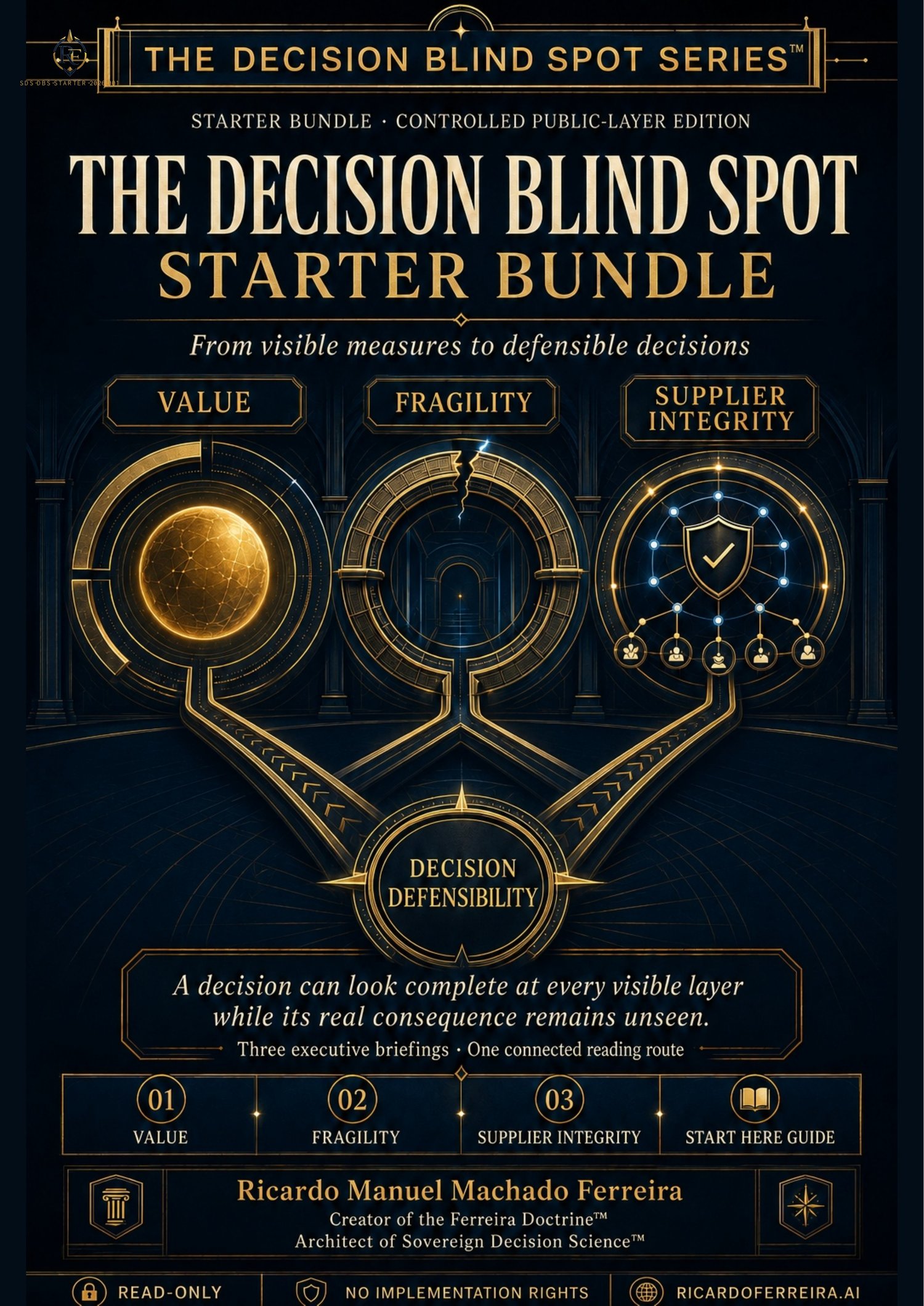
The Decision Blind Spot Starter Bundle
THE DECISION BLIND SPOT STARTER BUNDLE
From visible measures to defensible decisions
A connected public-layer executive reading route by Ricardo Manuel Machado Ferreira, Creator of the Ferreira Doctrine™ and Architect of Sovereign Decision Science™.
Most organisations assess material decisions through separate management tools.
TCO and business cases assess value.
Risk registers and heat maps organise uncertainty.
Supplier scorecards and audits measure performance.
Each tool is useful.
Each improves visibility.
But each can stop before the real consequence of the decision becomes visible.
A cost model may appear complete while dependency remains outside its boundary.
A risk may be identified, scored and assigned while the decision carrying it remains structurally fragile.
A supplier may meet targets, pass audits and hold valid certifications while future dependability remains unproven.
THE DECISION BLIND SPOT STARTER BUNDLE connects three executive briefings and one Start Here guide into a single decision route:
value → fragility → supplier integrity.
This is not a generic collection of management essays.
It is a controlled public-layer route showing how familiar management tools can produce apparently complete answers while leaving the integrated decision exposed across Procurement, Supply Chain, Finance, Legal, Operations, Risk, Audit, Technology and the Board.
WHY THIS BUNDLE MATTERS
Many organisations evaluate different parts of the same decision in different systems.
Procurement records price and savings.
Finance reviews the business case.
Risk records threats and mitigations.
Legal reviews obligations and remedies.
Operations inherits continuity consequences.
Supplier Management monitors historical performance.
Audit reviews the resulting record.
But no single tool may reveal whether the full decision remains defensible.
That gap matters.
A material decision can become:
→ financially attractive but operationally dangerous;
→ approved without a credible recovery path;
→ supported by a broader value case but dependent on fragile assumptions;
→ assigned to a risk owner who lacks authority to correct it;
→ protected by contractual remedies that cannot restore operations;
→ dependent on a supplier whose capacity is declared but not independently evidenced;
→ supported by documents that no longer reflect current operating conditions;
→ acceptable inside one function while transferring consequence to several others;
→ easy to approve but difficult to defend after impact.
THE GOVERNING QUESTION
Can leadership prove that value, decision robustness and supplier dependability remain coherent as one connected decision?
THE THREE CONNECTED QUESTIONS
VALUE
What value remains after dependency, disruption, recovery and executive scrutiny are included?
FRAGILITY
How little must change before the decision stalls, reverses or collapses?
SUPPLIER INTEGRITY
What evidence proves that the supplier can remain dependable when conditions change?
A decision is not strengthened by answering only one of these questions.
The exposure frequently exists in the connection between them.
INCLUDED IN THIS BUNDLE
START HERE — THE EXECUTIVE READING ROUTE
A structured guide connecting the three briefings into one continuous executive route.
The guide explains:
→ why the briefings should be read in sequence;
→ how incomplete value can lead to decision fragility;
→ how a less fragile decision can still depend on incomplete supplier evidence;
→ how to apply all three briefings to one material supplier, contract, technology, outsourcing or continuity decision;
→ the cross-functional questions each function should carry through the route;
→ a non-scored executive review sheet;
→ how decision language changes across value, fragility and supplier integrity;
→ where the next blind spot begins: evidence custody.
1. WHY TCO STOPS TOO EARLY
The decision blind spot between cost and consequence
Total Cost of Ownership improved decision-making by moving attention beyond purchase price.
But calling a calculation “total” can cause leadership to stop asking what remains outside its boundary.
Inside this briefing, you will examine:
→ what TCO captures well — and where it may stop;
→ where excluded costs reappear across the organisation;
→ dependency, continuity, recovery and loss of optionality;
→ why contractual remedies may compensate without restoring operations;
→ how declared savings can coexist with enterprise-level loss;
→ the difference between calculating cost and governing value;
→ the executive questions that can change the award decision;
→ what each function must see before a decision is called value;
→ why a spreadsheet cannot become the complete decision record;
→ a non-scored executive exposure test;
→ the public-layer purpose of Total Value Ownership™.
TCO can show what ownership costs. It cannot, by itself, prove what the decision will cost when dependency, disruption and scrutiny arrive.
2. WHAT RISK REGISTERS CANNOT SEE
The decision blind spot between recorded risk and structural fragility
Risk registers create visibility, common language, named ownership and a mechanism for review.
But a risk can remain correctly recorded while the decision carrying it becomes increasingly brittle.
Inside this briefing, you will examine:
→ what risk registers do well — and where they stop;
→ the difference between risk visibility and decision robustness;
→ assumption sensitivity, evidence weakness and ownership ambiguity;
→ why a named risk owner may lack the authority or funding required to act;
→ dependency concentration and loss of executable alternatives;
→ how pressure, urgency, hierarchy or budget constraints can distort the decision;
→ why a mitigation may depend on the same point of failure as the original exposure;
→ how fragility transfers across Procurement, Finance, Legal, Operations, Technology, PMO and the Board;
→ why a risk register is an index rather than the complete evidence chain;
→ a non-scored executive exposure test;
→ the public-layer purpose of Decision Fragility Index™.
A risk can be listed, assigned and reviewed while the decision that created it remains structurally fragile.
3. SUPPLIER PERFORMANCE IS NOT SUPPLIER INTEGRITY
The decision blind spot between historical delivery and future dependability
Supplier scorecards, certifications, audits and service levels create valuable performance visibility.
But historical performance does not automatically prove current capacity, recovery capability, evidence reliability or behaviour under pressure.
Inside this briefing, you will examine:
→ what supplier-performance systems capture — and what they may leave unseen;
→ why historical delivery does not guarantee future dependability;
→ the difference between reported capacity and capacity that is genuinely available;
→ hidden dependencies involving sub-suppliers, sites, systems, routes, licences and critical personnel;
→ how financial or operational stress may change supplier behaviour;
→ why certifications and audits may provide assurance without proving recovery capability;
→ evidence currency, traceability and independent support;
→ the contract-operational gap between compensation and restoration;
→ the questions scorecards cannot answer alone;
→ the public-layer supplier-integrity domains leadership must be able to see;
→ a non-scored executive exposure test;
→ the public-layer purpose of Supplier Integrity Passport™.
A supplier can meet every visible target while the dependency still rests on capacity, evidence and behaviour that have never been tested under pressure.
THE CONNECTED DECISION ROUTE
The sequence is deliberate.
First: test the value boundary.
Identify what cost, dependency or consequence remains outside the current TCO or business case.
Second: test the decision structure.
Determine how little must change before assumptions, authority, alternatives or recovery conditions stop holding.
Third: test the supplier evidence.
Determine whether the supplier remains dependable for the exact decision being made now.
A broader value case can still rest on a fragile decision.
A less fragile decision can still depend on an incomplete supplier signal.
The three layers must therefore be governed together.
WHAT YOU RECEIVE
→ one 54-page integrated executive PDF;
→ the complete Start Here Executive Reading Route;
→ WHY TCO STOPS TOO EARLY;
→ WHAT RISK REGISTERS CANNOT SEE;
→ SUPPLIER PERFORMANCE IS NOT SUPPLIER INTEGRITY;
→ one connected route from value to fragility to supplier integrity;
→ cross-functional executive questions;
→ three qualitative, non-scored exposure screens;
→ controlled public-layer introductions to Total Value Ownership™, Decision Fragility Index™ and Supplier Integrity Passport™;
→ internal PDF navigation for immediate access to every briefing.
WHO THIS BUNDLE IS FOR
This bundle is relevant to:
→ Procurement;
→ Supply Chain;
→ Supplier Management;
→ Category Management;
→ Finance;
→ Legal;
→ Contract Management;
→ Operations;
→ Logistics;
→ Quality;
→ Risk;
→ Compliance;
→ Audit;
→ Technology;
→ Cybersecurity;
→ AI Governance;
→ Project Management;
→ PMO;
→ Sustainability and ESG;
→ public institutions;
→ regulated organisations;
→ CEOs, CFOs and COOs;
→ Executive Leadership;
→ the Board.
THIS BUNDLE CONNECTS DIRECTLY TO
→ The Executive Decision Defensibility Audit;
→ The Executive Decision Defensibility Review;
→ The Public Decision Record Pack;
→ The 72-Hour Decision Readiness Test™;
→ The Boardroom Consequence Brief;
→ The Procurement Decision Failure Test™;
→ Supplier Failure Before Impact;
→ The Contract Exposure Note™;
→ Decision Integrity Exposure Brief™ — When One Update Stops the World;
→ The Shift Series™;
→ Sovereign Decision Science™ institutional licensing.
The three briefings are also available separately:
→ WHY TCO STOPS TOO EARLY
→ WHAT RISK REGISTERS CANNOT SEE
→ SUPPLIER PERFORMANCE IS NOT SUPPLIER INTEGRITY
THE CENTRAL PRINCIPLE
A decision can look complete at every visible layer while its real consequence remains unseen.
Price is not complete value.
TCO is not the entire consequence.
Recorded risk is not decision robustness.
A named risk owner is not always an authorised decision owner.
A mitigation statement is not an executable alternative.
Historical performance is not future dependability.
A supplier scorecard is not proof of current capacity.
An audit is not proof that critical evidence remains current.
Visible control is not automatically a defensible decision.
THE NEXT BLIND SPOT
Even strong value analysis, lower decision fragility and credible supplier evidence can fail if the evidence chain cannot be reconstructed.
Documents may exist while provenance, timing, change history, decision relevance, pressure and custody remain impossible to prove.
The next question is:
Can the organisation prove what evidence was relied upon, when it was valid, what changed and who accepted the remaining exposure?
Continue with:
→ AN AUDIT TRAIL IS NOT AN EVIDENCE CHAIN
RECOMMENDED READING ROUTE
Begin with:
→ START HERE — THE EXECUTIVE READING ROUTE
Continue in sequence:
→ 1. WHY TCO STOPS TOO EARLY
→ 2. WHAT RISK REGISTERS CANNOT SEE
→ 3. SUPPLIER PERFORMANCE IS NOT SUPPLIER INTEGRITY
Apply the three questions to the same material supplier, contract, outsourcing, technology, infrastructure or continuity decision.
Readers requiring a qualified written assessment of a defined decision, supplier dependency, contract position, technology exposure or governance concern can continue to:
→ Executive Decision Defensibility Review
PRODUCT INFORMATION
Document ID: SDS-DBS-STARTER-2026-001
Version: 1.0
Series: The Decision Blind Spot Series™
Product: The Decision Blind Spot Starter Bundle
Edition: Controlled Public-Layer Edition
Format: 54-page integrated executive PDF
Included: Start Here guide plus three complete executive briefings
Language: English
Delivery: Immediate digital download
Access: Individual, non-transferable, read-only public-layer access
Bundle price: €24.90
Separate value: €29.70
You save: €4.80
IMPORTANT RIGHTS AND USE BOUNDARY
This is a paid controlled public-layer written product for individual reading and executive awareness.
Purchase grants the individual purchaser a personal, non-transferable, read-only right to access the published bundle.
Purchase does not grant rights to:
→ organisational implementation;
→ Total Value Ownership™ implementation;
→ Decision Fragility Index™ implementation;
→ Supplier Integrity Passport™ implementation;
→ supplier-integrity assessment systems;
→ decision-scoring or classification systems;
→ evidence-validation systems;
→ internal or external training;
→ consultancy or advisory reuse;
→ reproduction, extraction, repackaging or redistribution;
→ resale or sublicensing;
→ adaptation or derivative development;
→ operational templates;
→ software translation or embedding;
→ dashboard or workflow development;
→ ERP or MRP integration;
→ API development;
→ AI or LLM ingestion, training, modelling, retrieval or dataset use;
→ institutional, commercial or governmental deployment.
No formula, mathematical model, weighting, coefficient, threshold, score band, classification rule, decision gate, calibration method, protected taxonomy, executable sequence, implementation workflow, software logic, protected architecture or integration mechanism is transferred through this product.
Formal written licensing is required for institutional, implementation, training, software, AI, workflow, derivative or organisational use.
No licence, implementation right, software right, training right, deployment right, derivative right, AI/LLM ingestion right or institutional-use right is granted unless expressly agreed in writing under separate scope, separate pricing and formal written authorisation.
This product is not legal advice, financial advice, procurement consultancy, supplier-risk consultancy, governance consultancy, compliance advice, audit advice, investment advice, software, training, an operational template package or an implementation system.
The public layer explains the exposure.
The Executive Review creates qualified diagnosis.
Institutional licensing authorises controlled organisational use.
OFFICIAL ACCESS
Official website:
https://www.ricardoferreira.ai/
Institutional licensing:
General contact:
Rights and intellectual property:
Ricardo Manuel Machado Ferreira
Creator of the Ferreira Doctrine™
Architect of Sovereign Decision Science™