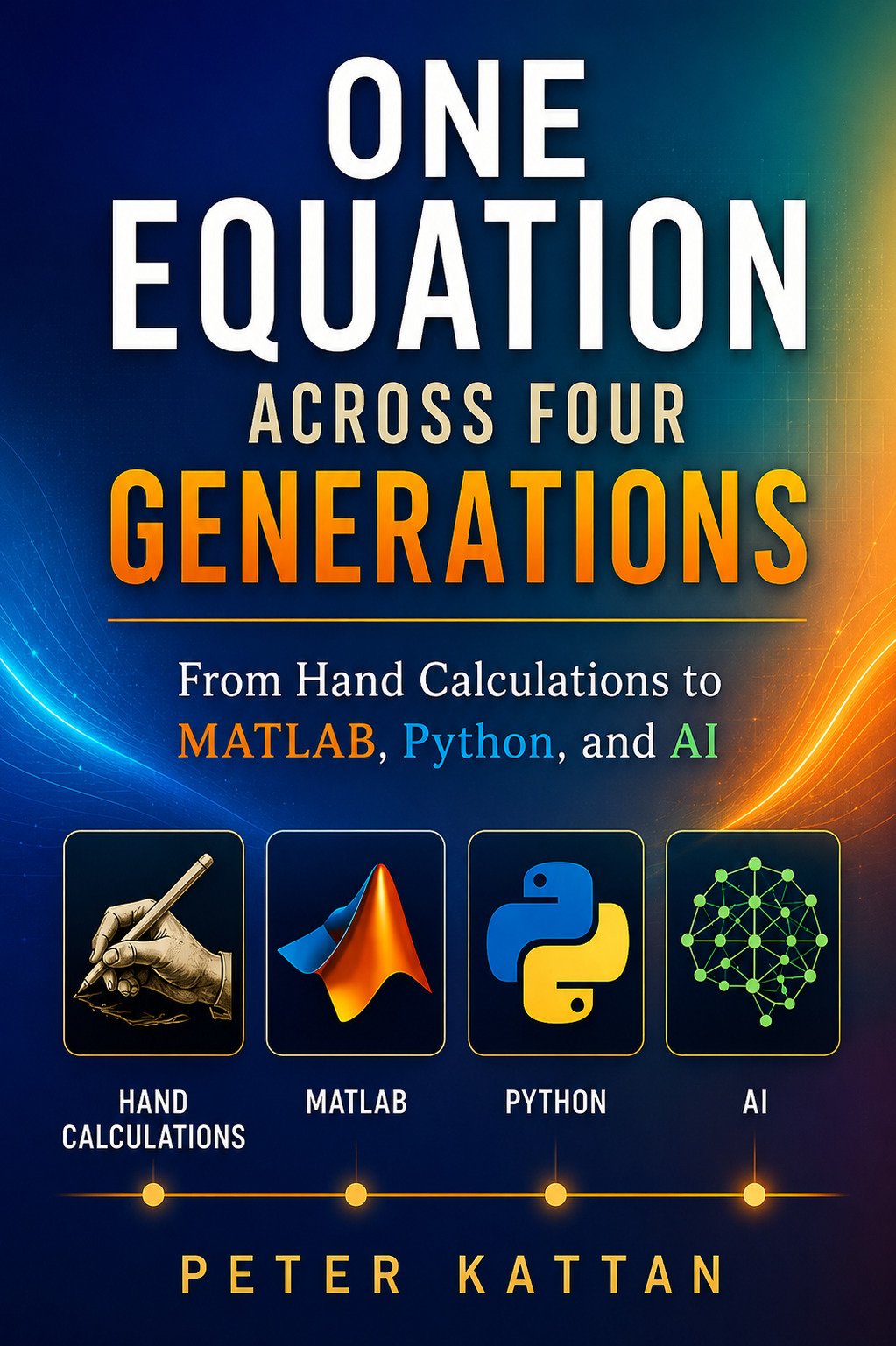
One Equation Across Four Generations: From Hand Calculations to MATLAB, Python, and AI
One Equation Across Four Generations
From Hand Calculations to MATLAB, Python, and AI
By Peter I. Kattan
One equation. Four generations of computational tools. More than a century of mathematical progress.
How would an engineer solve a nonlinear equation in 1906?
How would we solve the same equation today using MATLAB, Python, WolframAlpha, or artificial intelligence?
One Equation Across Four Generations takes one nonlinear cubic equation and follows its solution through four generations of computational practice—from graph paper and hand calculations to modern numerical software and AI.
What You’ll Explore
The journey begins with the classical approach: graphical estimation, Regula Falsi, and Newton’s approximation rule.
The same problem is then solved using MATLAB, including fzero and roots.
Next comes Python, using tools from SciPy, NumPy, and SymPy.
Finally, the equation enters the modern era with WolframAlpha and artificial intelligence, showing how natural-language interaction, explanation, and code generation are changing mathematical problem solving.
Four Generations
Generation 1 — Hand Calculations
Graphical methods • Regula Falsi • Newton’s Method
Generation 2 — MATLAB
fzero • roots • numerical computation
Generation 3 — Python
SciPy • NumPy • SymPy
Generation 4 — WolframAlpha & AI
Natural-language problem solving • explanations • code generation
Same Equation. Same Mathematics. Different Tools.
The most important lesson is not that modern software has made classical mathematics obsolete.
It has automated and extended it.
Hand calculations reveal the mathematical structure of the problem. Modern computational tools provide speed and precision. The strongest approach combines both: understanding the mathematics while taking advantage of modern computation.
Who Is This For?
Ideal for:
- Engineering and mathematics students
- Practicing engineers
- MATLAB users
- Python beginners
- Numerical methods students
- Mathematics and engineering educators
- Readers interested in AI and scientific computing
- Anyone curious about how computation evolved from pencil and paper to artificial intelligence
What You’ll Learn
By the end of this short book, you will understand how the same numerical problem can be approached using radically different generations of technology—and why the mathematics underneath them remains fundamentally connected.
You will see the progression from manual calculation → numerical software → conversational AI, while learning why understanding the underlying algorithm still matters.
The comparison demonstrates that every approach ultimately addresses the same mathematical problem; what changes is the amount of work performed by the human and the degree of automation provided by the computational tool.
What’s Included
38-page PDF digital book
Topics include graphical estimation, Regula Falsi, Newton’s method, MATLAB, Python, SciPy, NumPy, SymPy, WolframAlpha, artificial intelligence, comparison of the four approaches, lessons from the comparison, and concluding remarks.
Format: PDF
Author: Peter I. Kattan
Publisher: Book Bound Press
Published: 2026
From Graph Paper to Artificial Intelligence
An engineer in 1906 could solve the equation using hand calculations and classical numerical methods.
Today, the same answer can be obtained almost instantly using MATLAB, Python, WolframAlpha, or AI.
The tools changed. The mathematics endured.
Get your copy today and explore more than a century of computational progress through one equation.
Peter I. Kattan
Petra Books | Book Bound Press