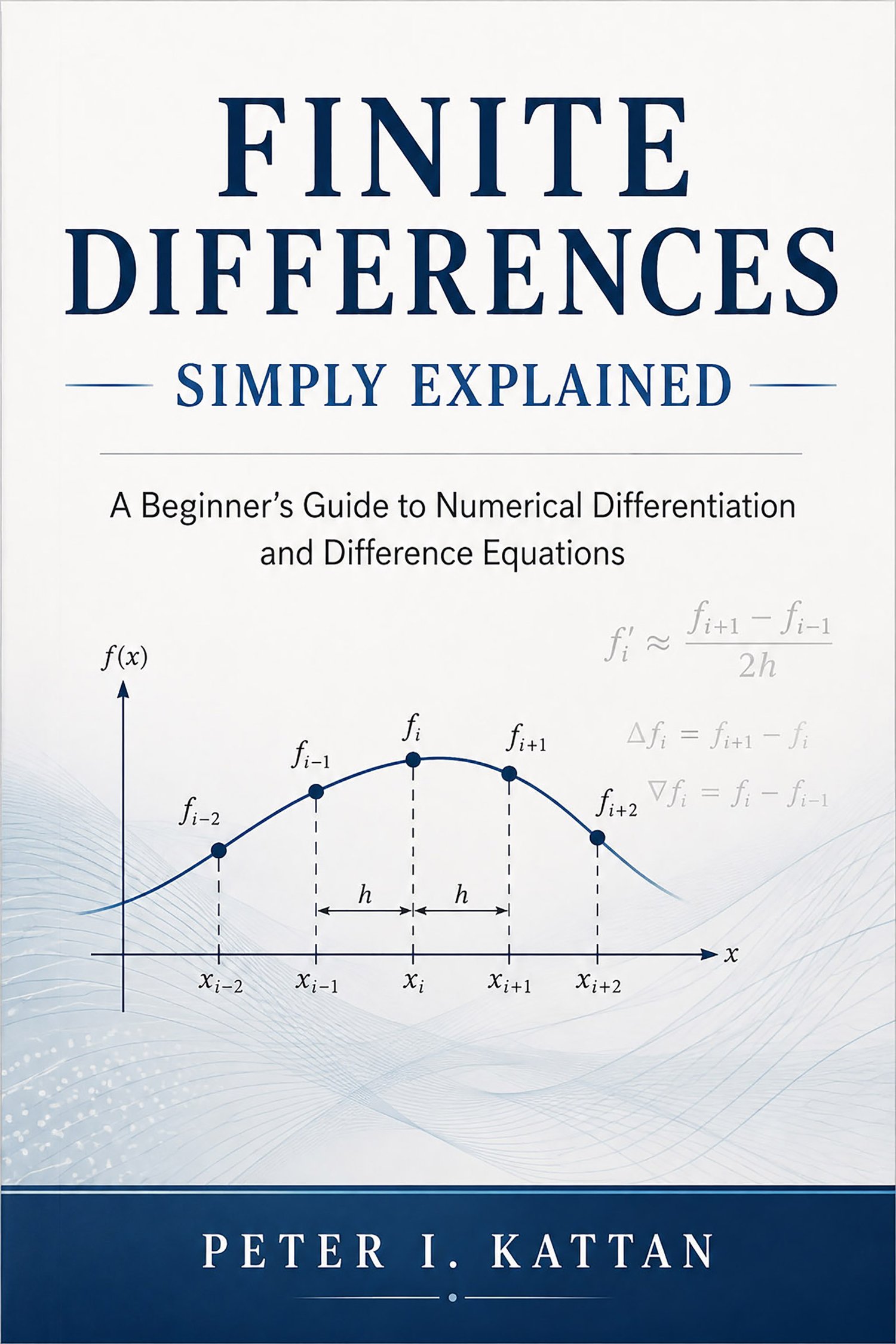
Finite Differences Simply Explained: A Beginner's Guide to Numerical Differentiation and Difference Equations
Finite Differences Simply Explained
A Beginner’s Guide to Numerical Differentiation and Difference Equations
Learn finite differences through clear explanations, simple formulas, practical engineering examples, exercises, and fully worked solutions.
By Peter I. Kattan
Suggested button:
Get the Book
Optional supporting line beneath the button:
Instant digital access after purchase.
The title is designed as an introductory guide to numerical differentiation and difference equations for students, engineers, scientists, and beginners.
2. Short Product Introduction
Finite differences are among the simplest and most useful tools in numerical analysis. They allow us to estimate derivatives and changes using values measured at discrete points.
This book explains the subject in an accessible, step-by-step manner. It begins with the meaning of a numerical difference and gradually introduces forward, backward, and central difference formulas.
No advanced mathematical background is required. The explanations rely mainly on elementary algebra, practical interpretation, and clearly organized examples.
3. Main Benefits Section
What You Will Learn
By studying this book, you will learn how to:
- Understand the basic meaning of finite differences
- Work with equally spaced numerical data
- Calculate forward and backward differences
- Apply the central-difference approximation
- Estimate first and second derivatives
- Interpret numerical slopes and curvatures
- Select an appropriate difference formula
- Apply finite differences to engineering problems
- Recognize the advantages and limitations of the method
- Build a foundation for more advanced numerical methods
The book introduces finite differences as a way of replacing derivatives with changes between neighboring numerical values.
4. Who This Book Is For
A Practical Guide for Beginners and Professionals
This book is suitable for:
- Engineering students
- Mathematics and science students
- Practicing engineers
- Researchers working with numerical data
- MATLAB and numerical-methods learners
- Teachers seeking introductory examples
- Independent learners reviewing numerical differentiation
It is particularly useful for readers who find conventional numerical-analysis textbooks too theoretical or difficult to follow.
5. What Is Included
A Complete Learning Package
The book contains:
Clear Introductory Lessons
The opening chapters explain:
- What a numerical difference means
- Why equal spacing is important
- Forward differences
- Backward differences
- Central differences
- The connection between differences and derivatives
- Second differences and curvature
Worked Engineering Examples
The book includes practical examples involving:
- Vehicle velocity
- Temperature gradients in metal bars
- Beam-deflection slopes
- Heat flow through walls
- Elevator acceleration
- Road curvature
The examples demonstrate how the same simple formulas can be applied in mechanics, heat transfer, transportation, and engineering measurement problems.
Student Exercises
Ten practice exercises help readers develop confidence in calculating differences and approximating derivatives.
Detailed Solutions
Each exercise is followed by a complete, step-by-step solution so that readers can check their work and understand the calculation process.
Summary of Answers
A compact answer section allows readers to review their final numerical results quickly.
References and Further Reading
The book provides a carefully selected bibliography covering introductory numerical analysis, finite-difference methods, engineering applications, and MATLAB-based numerical methods.
6. Why Finite Differences Matter
A Simple Idea Behind Powerful Engineering Software
Finite differences are used in many areas of science and engineering, including:
- Structural analysis
- Heat conduction
- Fluid mechanics
- Wave propagation
- Groundwater flow
- Diffusion problems
- Electromagnetics
- Image processing
- Financial mathematics
- Weather prediction
Many professional engineering programs repeatedly apply finite-difference calculations over thousands or millions of grid points. Learning the elementary formulas therefore provides an important foundation for understanding computational engineering.
7. Sample Learning Journey
Start with a Table of Values
Suppose the temperature of a metal rod is known only at several measured positions.
You may not have an exact equation describing the temperature. However, finite differences allow you to estimate how rapidly the temperature changes between neighboring points.
Progress to Numerical Derivatives
The book then shows how forward, backward, and central differences approximate the slope of a curve.
Apply the Method
You will use these formulas to estimate quantities such as:
- Velocity
- Acceleration
- Temperature gradient
- Beam slope
- Curvature
Practice Independently
Exercises and detailed solutions reinforce each concept and provide a structured path from introductory arithmetic to practical engineering calculations.
8. Key Features
Why Readers Will Find This Book Useful
- Written in simple, accessible language
- Requires only elementary algebra
- Explains formulas through physical meaning
- Includes engineering and scientific applications
- Provides fully worked numerical examples
- Contains ten exercises with detailed solutions
- Suitable for self-study or classroom use
- Introduces concepts used in FDM and FVM
- Includes a professional reference list
- Organized for quick learning and revision
9. Book Contents
Inside the Book
- Introduction
- What Does “Difference” Mean?
- Equal Spacing
- The Forward Difference
- The Backward Difference
- The Central Difference
- Finite Differences and Derivatives
- Example
- Second Differences
- Applications
- Advantages
- Limitations
- Summary
- Suggested Further Reading
- Fully Worked Engineering Examples
- Exercises
- Detailed Solutions to the Exercises
- Summary of Answers
- References
- About the Author
The book combines introductory theory, practical examples, exercises, complete solutions, references, and author information in one volume.
10. About the Author
Peter I. Kattan
Peter I. Kattan is an engineer, educator, and author with extensive experience in engineering analysis, computational methods, numerical techniques, and materials modeling.
He has written numerous engineering and MATLAB books, including MATLAB for Beginners: A Gentle Approach. His work emphasizes making difficult engineering subjects understandable through clear explanations, structured presentations, and practical examples.
11. Purchase Section
Build a Strong Foundation in Numerical Methods
Finite differences are simple to learn, easy to program, and widely used in engineering and scientific computation.
This book provides a practical starting point for anyone who wants to understand numerical differentiation without being overwhelmed by advanced theory.
Suggested purchase button:
Buy Finite Differences Simply Explained
Supporting text:
Download the digital edition and begin learning immediately.
12. Optional Guarantee or Reassurance Section
Learn at Your Own Pace
The book is organized into short, manageable sections. Readers can study the chapters in order or use the book as a quick reference when reviewing a particular finite-difference formula.
Every major concept is supported by explanations, examples, exercises, or solutions.
13. Frequently Asked Questions
Do I need advanced calculus?
No. Only a basic understanding of algebra and the general idea of a derivative is helpful.
Is this book suitable for beginners?
Yes. The book begins with the basic meaning of a numerical difference and develops the subject gradually.
Does the book include engineering applications?
Yes. Examples include motion, temperature gradients, heat transfer, beam deflection, acceleration, and highway curvature.
Are solutions included?
Yes. The book contains detailed, step-by-step solutions to all ten exercises.
Does the book include programming code?
The primary focus is on understanding and manually applying finite-difference formulas. The concepts provide a foundation for later implementation in MATLAB, Python, or other programming languages.
What format will I receive?
State the exact format you plan to upload to Gumroad, such as:
You will receive the complete book as a downloadable PDF file.
14. Final Call to Action
Make Numerical Differentiation Easier to Understand
Learn how simple differences between neighboring values can be used to estimate slopes, gradients, velocities, accelerations, and curvatures.
Start with the fundamentals and progress through practical engineering examples and guided exercises.
Get the Book Today