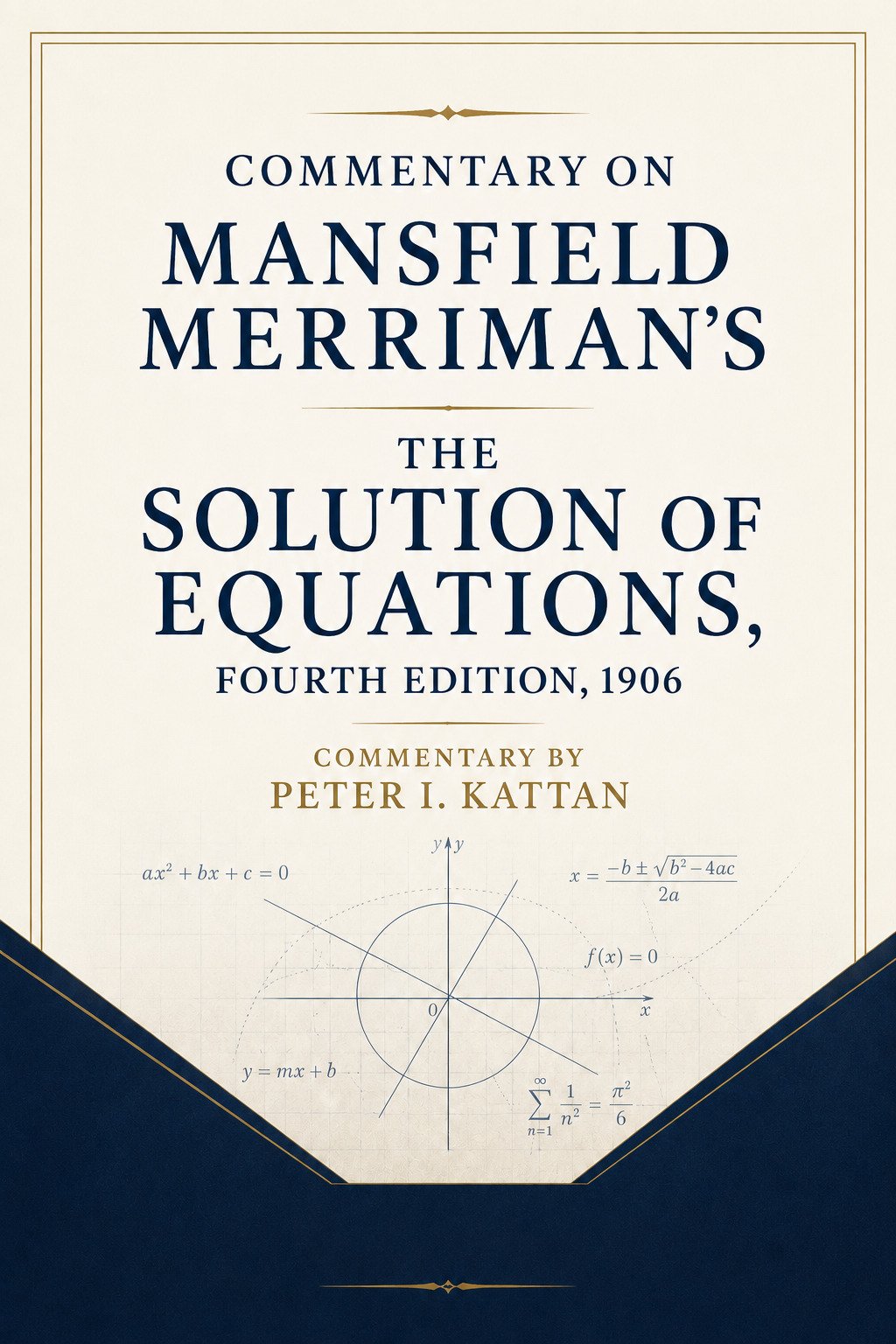
Commentary on Mansfield Merriman’s The Solution of Equations, Fourth Edition, 1906.
Commentary on Mansfield Merriman’s The Solution of Equations, Fourth Edition, 1906
From Classical Numerical Methods to MATLAB, Python, WolframAlpha, and Artificial Intelligence
Commentary by Peter I. Kattan
The mathematics of 1906 meets the computational world of 2026.
More than a century ago, engineers solved nonlinear equations using graph paper, logarithm tables, hand calculations, and carefully constructed numerical approximations.
Today, MATLAB, Python, WolframAlpha, and artificial intelligence can perform many of these calculations almost instantly.
But an intriguing question remains:
Has the mathematics actually changed?
Commentary on Mansfield Merriman’s The Solution of Equations, Fourth Edition, 1906 revisits a classic work of numerical mathematics and reveals how its fundamental ideas continue to live inside modern scientific and engineering computation.
Why Read a Mathematics Book from 1906?
Because technology changes much faster than mathematics.
Merriman wrote before electronic computers, calculators, MATLAB, Python, or AI existed. Yet his book discusses numerical ideas—including Newton’s method, Regula Falsi, graphical estimation, Horner’s method, and root bracketing—that remain important in numerical analysis today.
This commentary brings those ideas into the twenty-first century.
Rather than treating Merriman’s work merely as a historical curiosity, Peter I. Kattan examines it from the perspective of a modern engineer and computational practitioner.
What You'll Discover
Classical Numerical Methods
Explore the foundations of equation solving, including:
- Graphical solution of equations
- Regula Falsi (False Position)
- Newton’s approximation rule
- Separation of roots
- Numerical algebraic equations
- Transcendental equations
- Classical algebraic solutions
- Horner’s method
- Engineering applications
The book follows Merriman’s progression from visualizing equations and bracketing roots to increasingly sophisticated numerical techniques.
From Hand Computation to Artificial Intelligence
The commentary then asks what happened to these classical methods as computation evolved.
The journey progresses through:
1906
Graph paper • Hand calculations • Numerical tables
Modern Computing
MATLAB • Python • NumPy • SciPy • SymPy
Computational Mathematics
Mathematica • Maple • WolframAlpha
The AI Era
Natural-language mathematical problem solving • Code generation • Explanation • Verification
The book explains how AI represents another stage in the evolution of computational mathematics rather than a replacement for its mathematical foundations.
Special Appendix
Solving the Same Nonlinear Equation Across Four Generations
One of the book's most distinctive features is an extended practical appendix.
A single nonlinear cubic equation is solved using:
1. Graphical and hand-calculation methods representative of Merriman's era
2. MATLAB
3. Python
4. WolframAlpha and artificial intelligence
This provides a direct comparison of more than a century of computational practice while demonstrating that the underlying mathematical principles remain remarkably stable.
Who Is This Book For?
This book is particularly suitable for engineering students, mathematics students, practicing engineers, numerical methods students, MATLAB and Python users, educators, historians of mathematics, and readers interested in scientific computing and artificial intelligence.
No specialized historical knowledge is required. The commentary is written to make the ideas accessible while preserving their mathematical and engineering significance.
Why This Book Is Different
This is not simply a reprint of an old mathematics book.
It is a modern commentary on the evolution of computational thinking.
Merriman's original methods are examined in the context of the tools engineers and scientists use today.
The central message is simple:
The tools have changed dramatically. The mathematics has endured.
Modern software can hide sophisticated numerical procedures behind a single command. Understanding the ideas underneath those commands helps engineers and students evaluate results rather than treating computational software as a black box.
Inside the Book
The commentary covers the historical setting, why Merriman's book still matters, graphical equation solving, Regula Falsi, Newton's method, separation of roots, algebraic and transcendental equations, classical solutions, engineering applications, historical legacy, the transition from hand computation to AI, personal reflections, and an extensive comparative appendix.
Format: PDF
Length: 73 pages
Commentary: Peter I. Kattan
Publisher: Book Bound Press
Edition: First Edition
Publication: 2026
Discover the Mathematical Ideas Behind Modern Computation
Before MATLAB, Python, WolframAlpha, and AI, there were mathematicians and engineers developing the algorithms that made modern computation possible.
Travel back to 1906—and discover how surprisingly modern the mathematics still is.
Get your copy today.
Peter I. Kattan
Petra Books | Book Bound Press