
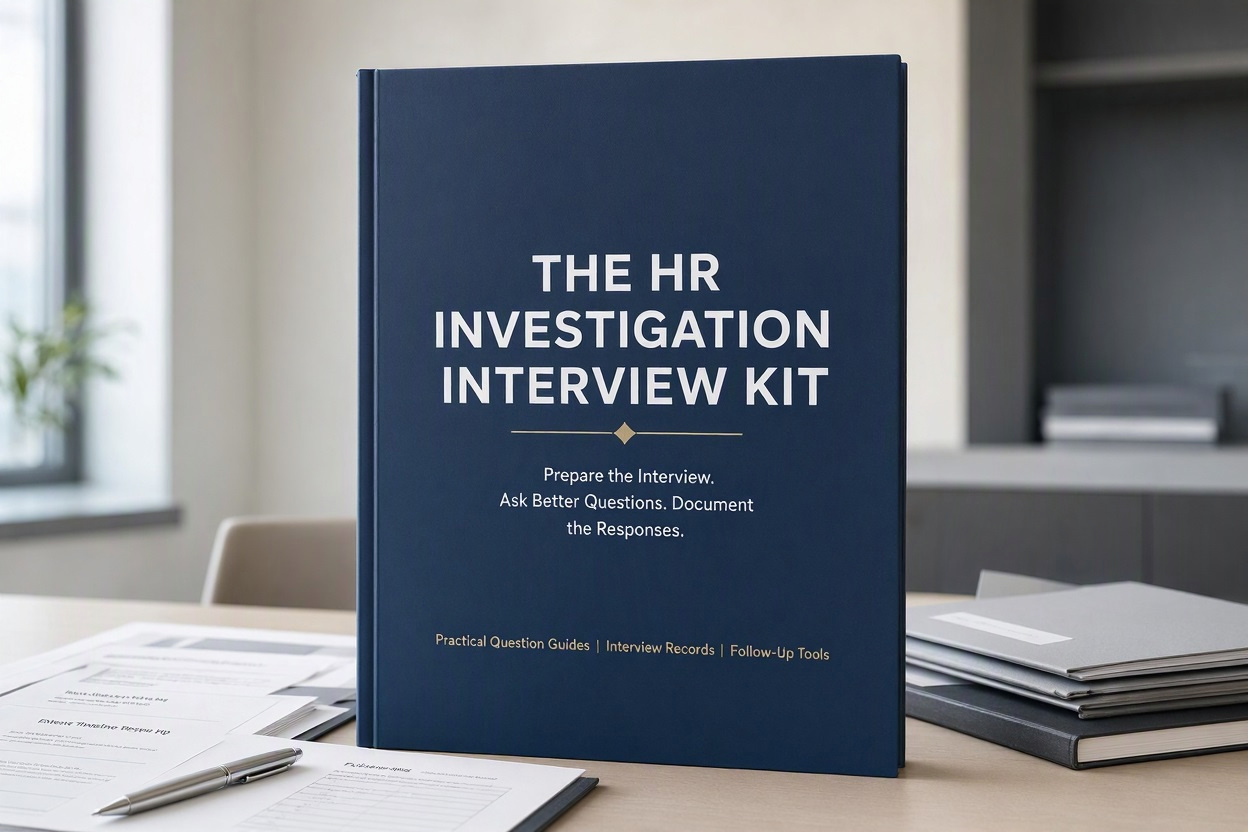
THE HR INVESTIGATION INTERVIEW KIT
Prepare the Interview. Ask Better Questions. Document the Responses.
A workplace investigation interview is too important to conduct by improvisation alone.
What should you ask first?
How do you encourage someone to explain what happened in their own words?
How do you ask follow-up questions without leading the interviewee?
What should you do when accounts differ, details are unclear, or new information emerges?
How do you record responses accurately without mixing facts, opinions, and assumptions?
And how do you make sure the interview produces useful information rather than a confusing collection of notes?
For HR professionals, workplace investigators, and managers assigned to investigate employee concerns, these are real challenges.
An interview that lacks structure can overlook important details. Poorly framed questions can influence responses. Incomplete notes can make later review more difficult. Rushed follow-up can leave unanswered questions.
THE HR INVESTIGATION INTERVIEW KIT is a practical resource designed to help you prepare, structure, document, and review workplace investigation interviews more systematically.
Use the templates, question guides, checklists, and recording tools to support a consistent process while adapting each interview to the circumstances of the case.
WHAT'S INSIDE THE KIT?
1. Investigation Interview Preparation Checklist
Prepare for the interview by identifying its purpose, the issues to explore, relevant records, participants, practical arrangements, and any necessary procedural or safeguarding considerations.
2. Workplace Investigation Interview Plan
Organise the interview into key topics, questions, information to verify, documents to review, and follow-up points requiring clarification.
3. Interview Opening Script
A practical starting point for explaining the interview's purpose, the interviewer's role, the process, note-taking arrangements, and the importance of accurate information.
4. Witness Interview Question Guide
Structured prompts to help witnesses describe what they personally observed, heard, or experienced, including dates, locations, people present, relevant events, and possible supporting information.
5. Complainant Interview Question Guide
Prompts for exploring the complaint, the sequence of events, the impact described, relevant context, available records, potential witnesses, and any immediate concerns requiring attention.
6. Respondent Interview Question Guide
A structured guide for presenting relevant allegations or issues fairly, seeking the individual's account, exploring disputed details, and recording responses without assuming that an allegation has been established.
7. Open-Ended and Follow-Up Question Bank
A practical collection of neutral questions designed to encourage detailed accounts, clarify timelines, explore inconsistencies, and identify information that may need further verification.
8. Interview Notes and Response Record Template
A structured record for documenting questions, responses, relevant dates, clarifications, supporting information mentioned, and follow-up items.
9. Timeline and Event Sequence Worksheet
Organise events chronologically, identify gaps in the sequence, and record which details require confirmation.
10. Evidence and Information Follow-Up Tracker
Track documents requested, people to contact, unanswered questions, responsible persons, target dates, and the status of outstanding enquiries.
11. Interview Closing Checklist
Check whether the interviewee has additional relevant information, whether any points require clarification, what supporting information may be available, and what follow-up arrangements need to be recorded.
12. Interviewer Bias and Question Quality Checklist
Review questions for assumptions, leading language, unnecessary repetition, ambiguity, and wording that may unfairly suggest a preferred answer.
13. Conflicting Accounts and Clarification Guide
A structured approach to identifying differences between accounts, separating confirmed details from disputed points, and developing fair follow-up questions without presuming dishonesty.
14. Interview Review and Quality-Control Checklist
Review the record for completeness, clarity, accurate attribution, unanswered questions, outstanding evidence, and the need for further enquiries.
15. Investigation Interview Action and Handover Record
Capture key follow-up actions, unresolved questions, referrals, responsible persons, deadlines, and the information needed for the next stage of the investigation.
WHO IS THIS KIT FOR?
- HR managers and HR executives
- Employee relations professionals
- HR business partners and HR generalists
- Workplace investigators
- Managers assigned to conduct internal fact-finding interviews
- Organisations seeking a more consistent approach to investigation interviews
It is especially useful for professionals who need a practical interview structure but still need the flexibility to respond to the facts and circumstances of each case.
THE INTERVIEW CHALLENGES THIS KIT HELPS YOU ADDRESS
“I don't know what questions to ask.”
Use structured interview plans and question guides to prepare relevant topics and follow-up prompts.
“I don't want to lead the interviewee.”
Use open-ended questioning guidance and a question-quality checklist to help keep questions neutral and clear.
“The accounts do not match.”
Use the timeline worksheet and conflicting-accounts guide to identify differences, unanswered questions, and matters requiring further verification.
“My notes are incomplete or difficult to follow.”
Use the interview record template to organise questions, responses, relevant details, and follow-up items.
“We finished the interview, but important questions remain.”
Use the follow-up tracker and action record to identify outstanding enquiries, assign responsibility, and track progress.
“How do I know whether the interview record is ready for review?”
Use the quality-control checklist to identify omissions, unclear wording, and issues that may need to be clarified.
WHY A STRUCTURED INTERVIEW MATTERS
A workplace investigation interview is a fact-finding activity. Its purpose is to gather relevant information, not to force an admission, prove a preferred theory, or confirm an assumption.
A structured process can help the interviewer remain focused, ask clearer questions, distinguish direct observations from second-hand information, record responses accurately, and identify what still needs to be checked.
The kit supports that process. It does not replace impartial judgement, appropriate training, a fair investigation procedure, or specialist advice when needed.
IMPORTANT INFORMATION
This kit provides general templates and guidance for workplace investigation interviews. It is not legal advice and does not guarantee that an investigation will be fair, complete, or legally compliant.
Adapt the materials to the circumstances of the case, applicable employment requirements, organisational procedures, and any relevant representation or support arrangements. Serious allegations or complex matters may require a trained investigator or specialist advice.
Maintain appropriate confidentiality and restrict access to investigation records. Record responses accurately, distinguish direct observations from assumptions or second-hand information, and do not alter records to create a misleading account. Follow applicable data protection and record-retention requirements.
MAKE YOUR NEXT INVESTIGATION INTERVIEW MORE STRUCTURED
You cannot predict every answer an interviewee will give. You can prepare a better process for asking questions, recording responses, and following up on the information gathered.
Get THE HR INVESTIGATION INTERVIEW KIT and bring greater structure to your workplace investigation interviews.