

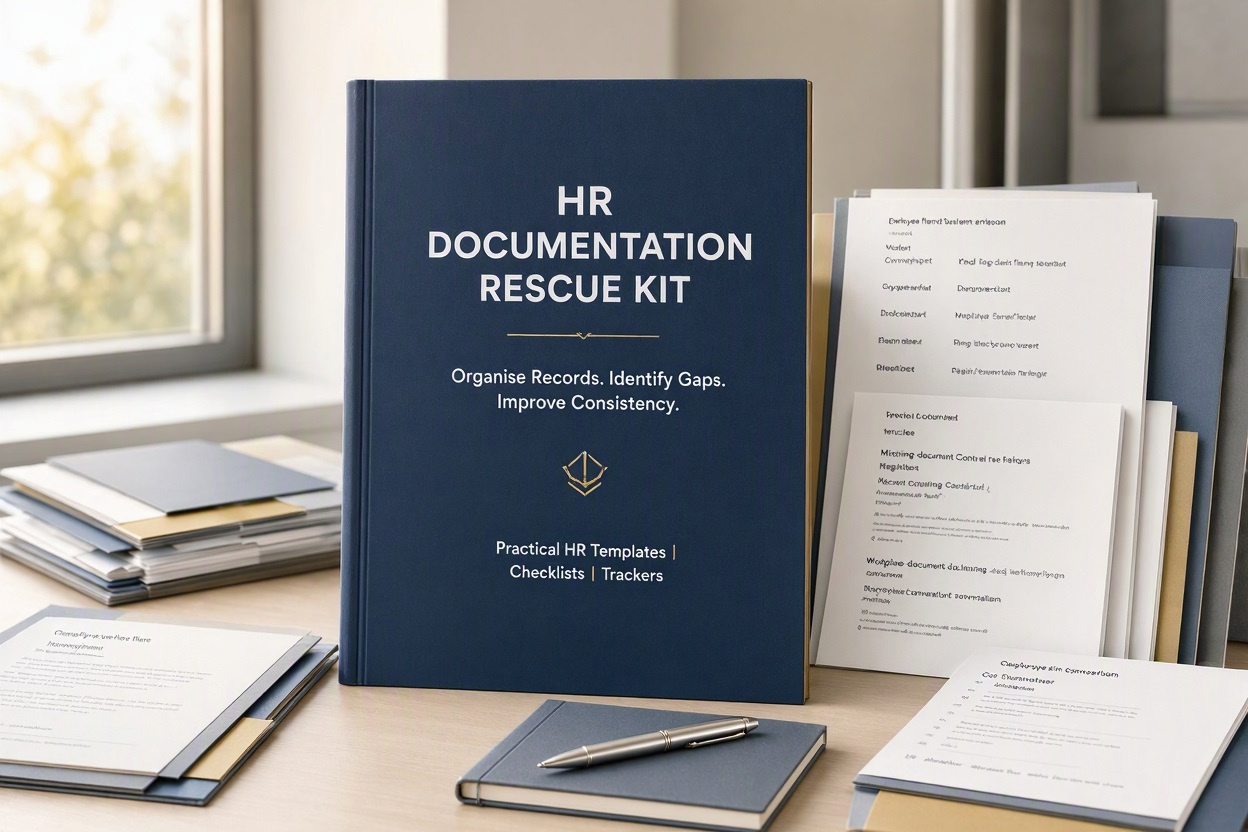
HR DOCUMENTATION RESCUE KIT
Practical Tools to Organise HR Records, Improve Documentation and Reduce Avoidable Gaps
Missing records. Incomplete forms. Unclear notes. Inconsistent letters. Outstanding signatures. Employee files that are difficult to follow.
Sound familiar?
HR documentation can become a serious headache when information is scattered across emails, spreadsheets, shared folders, handwritten notes, and individual employee files.
A manager may ask for a record that nobody can locate. A document may be missing a date or approval. An employee conversation may have taken place, but the notes are incomplete. A form may have been completed differently by different departments.
And when HR needs to review what happened, the information is not always as clear or complete as it should be.
The HR Documentation Rescue Kit is designed to help you bring greater structure, consistency, and control to everyday HR documentation.
Instead of repeatedly creating documents from scratch, use practical templates, checklists, trackers, and guidance to identify documentation gaps, organise information, record relevant events, and follow up on outstanding actions.
WHAT'S INSIDE THE KIT?
1. HR Documentation Audit Checklist
Review key documentation categories, identify missing or incomplete records, and create a practical list of corrective actions.
2. Employee File Completeness Checklist
Check whether essential employee records are present, appropriately completed, and stored according to your organisation's requirements.
3. Missing Document Tracker
Record outstanding documents, the person responsible for providing them, follow-up dates, current status, and next actions.
4. HR Document Control Register
Maintain a structured record of important HR documents, including document identifiers, versions, owners, approval status, review dates, and storage references.
5. Employee Conversation Record Template
Document relevant workplace conversations with space for the date, participants, main points discussed, employee comments, agreed actions, and follow-up arrangements.
6. HR Incident and Event Record
Capture relevant facts about a workplace event, including dates, people involved, information gathered, supporting records, and outstanding questions.
7. HR Letter and Document Quality Checklist
Check names, dates, factual accuracy, consistency, tone, attachments, approvals, and other important details before a document is finalised.
8. HR Follow-Up and Action Tracker
Track outstanding documentation requests, promised actions, responsible parties, deadlines, and completion status.
9. HR Record-Keeping Procedure Guide
Use a practical framework to establish how HR records should be created, checked, named, stored, updated, accessed, and retained under your organisation's policies and applicable requirements.
10. Documentation Gap and Corrective Action Planner
Turn findings from a documentation review into a prioritised action plan with assigned responsibilities, target dates, and completion checks.
11. HR Documentation Mistakes and Fixes Guide
Recognise common documentation problems, understand why they matter, and identify practical improvements to record quality and consistency.
12. HR Documentation Rescue Action Plan
Follow a step-by-step process to assess the current situation, identify urgent gaps, prioritise corrections, assign ownership, and monitor progress.
WHO SHOULD USE THIS KIT?
- HR managers and HR executives
- HR generalists and HR administrators
- Employee relations professionals
- SME owners and business managers handling HR records
- Managers responsible for employee documentation
- Organisations looking to improve the consistency of everyday HR processes
WHAT PROBLEMS CAN IT HELP YOU ADDRESS?
When employee files are incomplete: Use checklists and trackers to identify gaps and follow up systematically.
When records are difficult to locate: Establish clearer document references, naming practices, and control registers.
When documentation varies between departments: Introduce shared templates and quality checks.
When conversations are not properly recorded: Use structured records to capture relevant facts, employee comments, agreed actions, and follow-up dates.
When HR cannot tell what is still outstanding: Use action trackers to identify responsibilities, deadlines, and next steps.
When the organisation needs to improve its documentation process: Use the audit checklist and corrective action planner to establish priorities.
WHY THIS KIT IS PRACTICAL
It focuses on the work HR actually needs to do:
- Identify missing and incomplete documentation.
- Record workplace events and conversations more systematically.
- Check important details before finalising documents.
- Track outstanding requests and follow-up actions.
- Improve consistency across routine HR records.
- Turn documentation gaps into manageable corrective actions.
The goal is not to create paperwork for its own sake. It is to make relevant records clearer, easier to manage, and more useful when HR needs to refer to them.
IMPORTANT INFORMATION
This kit provides general HR documentation resources and practical guidance. It is not legal advice and does not guarantee legal or regulatory compliance. The records required by an organisation depend on its activities, policies, jurisdiction, and applicable requirements.
Adapt the resources to your organisation's procedures. Apply appropriate access controls, confidentiality safeguards, data protection practices, and record-retention rules. Do not create, backdate, or alter records to give a misleading impression of events. Corrections should be transparent and follow your organisation's approved procedures.
RESCUE YOUR HR DOCUMENTATION PROCESS
You do not need to wait until a missing document or incomplete record becomes a bigger problem before improving the process.
Start identifying the gaps. Organize the records. Track the outstanding actions. Introduce a more consistent approach.
Get the HR Documentation Rescue Kit and give your HR documentation process a practical starting point for improvement.