

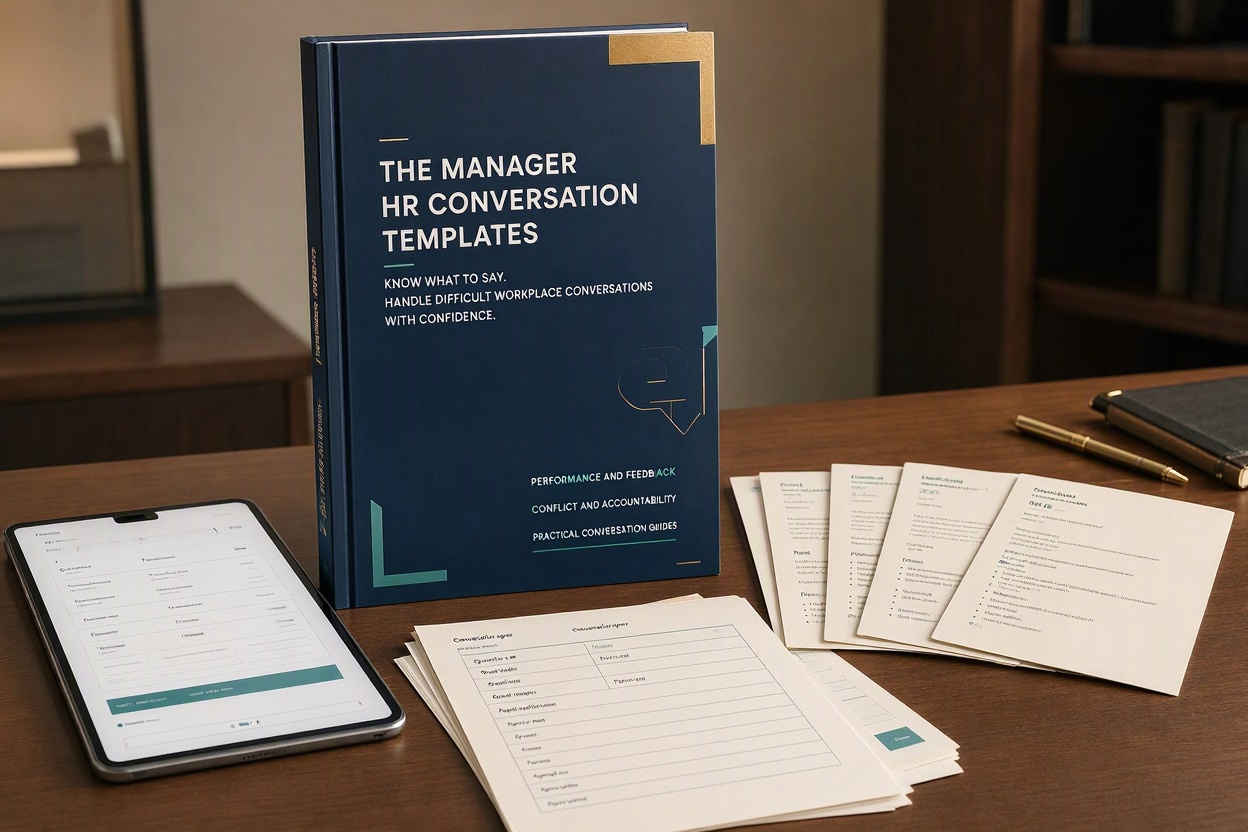
THE MANAGER HR CONVERSATION TEMPLATES
Know What to Say. Handle Difficult Workplace Conversations with Greater Confidence.
The conversation you keep postponing may be the conversation your team needs you to have.
An employee repeatedly arrives late.
A capable team member is missing deadlines.
Someone reacts defensively whenever feedback is given.
Two colleagues are in conflict, and the tension is affecting the rest of the team.
A manager knows the problem needs to be addressed. But knowing what to say, how to say it and how to respond when the conversation becomes uncomfortable is another matter.
Say too little, and the issue remains unresolved.
Sound too aggressive, and the employee may become defensive.
Avoid the conversation, and the behaviour may continue.
THE MANAGER HR CONVERSATION TEMPLATES is a practical collection of ready-to-adapt conversation guides designed to help managers prepare for everyday employee issues, communicate expectations clearly and move difficult discussions towards constructive next steps.
Instead of starting from a blank page, managers can use structured wording, conversation prompts and follow-up templates to prepare for situations they may otherwise struggle to handle.
WHAT THIS TOOLKIT HELPS MANAGERS DO
- Prepare for difficult employee conversations before emotions take over.
- Address performance gaps without turning feedback into a personal attack.
- Discuss lateness, attendance, missed deadlines and accountability.
- Respond more constructively when employees become defensive or disagree.
- Clarify expectations, responsibilities and required improvements.
- Handle workplace tension and interpersonal conflict more systematically.
- Give feedback that is specific, respectful and actionable.
- Agree on practical next steps and follow-up dates.
- Keep appropriate records of important workplace discussions.
- Recognise when a matter requires HR guidance or formal escalation.
WHAT'S INCLUDED
1. Performance and Accountability Conversation Templates
Prepare for conversations about missed targets, inconsistent work, repeated errors, poor-quality output and failure to meet agreed responsibilities.
Includes structured opening statements, evidence-based discussion prompts, expectation-setting language and improvement commitments.
2. Attendance and Reliability Conversation Templates
Address recurring lateness, attendance concerns, missed shifts and reliability issues without relying on vague accusations or emotionally charged language.
Includes prompts for exploring relevant circumstances, clarifying expectations and agreeing on appropriate next steps.
3. Feedback and Behaviour Conversation Templates
Prepare for conversations about inappropriate workplace behaviour, communication problems, unprofessional conduct and feedback that an employee may find difficult to hear.
Includes practical wording for describing observed behaviour, explaining its impact and inviting the employee's perspective.
4. Defensive Employee Response Templates
What happens when an employee says, “That is not my fault,” “Everyone else does it,” or “You are picking on me”?
Use structured response prompts to keep the conversation calm, acknowledge the employee's perspective and return to the specific workplace issue.
5. Workplace Conflict Conversation Templates
Prepare for disagreements between colleagues, recurring friction, communication breakdowns and concerns about working relationships.
Includes prompts to clarify what happened, hear different perspectives, identify practical changes and agree on future working arrangements.
6. Expectations and Accountability Templates
Use practical conversation structures to clarify who is responsible for what, what needs to change, what support may be appropriate and when progress will be reviewed.
7. Coaching and Development Conversation Templates
Help employees reflect on performance, identify obstacles, explore possible solutions and take responsibility for agreed development actions.
8. Sensitive Employee Conversation Templates
Prepare for discussions involving employee concerns, personal difficulties affecting work, requests for support and situations that require discretion.
These templates provide a starting point for respectful conversations while reminding managers to involve HR where appropriate.
9. Conversation Follow-Up and Documentation Templates
Turn verbal discussions into clear action points.
Record the issue discussed, the employee's perspective, agreed expectations, support offered, responsibilities and review dates.
10. Manager Preparation and Conversation Planning Tools
Before the meeting, clarify the purpose of the conversation, the facts that need to be discussed, the outcome sought and the questions that need to be asked.
These planning tools help managers prepare rather than walk into a difficult discussion and improvise.
WHO IS THIS FOR?
- Supervisors and team leaders
- Line managers and department heads
- HR managers and HR executives supporting managers
- Small business owners managing employees directly
- Newly promoted managers learning to handle people issues
- Experienced managers who want a more consistent approach to employee conversations
WHY THESE TEMPLATES MATTER
Managers are not expected to have perfect words for every difficult situation. But they do need a practical way to prepare, listen, communicate expectations and follow through.
A structured conversation can help reduce misunderstandings, keep attention on observable behaviour and clarify what needs to happen next.
These templates are not scripts to read mechanically. They are adaptable guides that help managers communicate naturally while remaining clear, respectful and focused on the issue.
They are also not a substitute for company policy, formal HR procedures or professional advice. Serious allegations, harassment, discrimination, safety concerns, grievances and potentially disciplinary matters should be handled through the appropriate organisational process.
STOP GUESSING WHAT TO SAY
You do not need to wait until a workplace issue becomes a bigger problem before preparing for the conversation.
Prepare your opening. Ask better questions. Listen to the employee's perspective. Clarify expectations. Agree on next steps.
THE MANAGER HR CONVERSATION TEMPLATES gives you practical starting points for the employee conversations managers cannot afford to keep avoiding.