5 Things That Accidentally Make Demand Avoidance Worse (And What to Do Instead) — Free Guide + Interactive Companion Tool
Simple, research-backed shifts for school staff supporting PDA learners. No blame, just better tools. Includes a free interactive companion tool.
If you work with a PDA learner, you've probably noticed something that feels deeply puzzling: the more you push, the more they resist. Praise can backfire. Rewards don't land. Even gentle encouragement can trigger a shutdown.
This isn't a failure of effort. It's a mismatch between standard classroom strategies and a nervous system that experiences ordinary demands as a genuine threat.
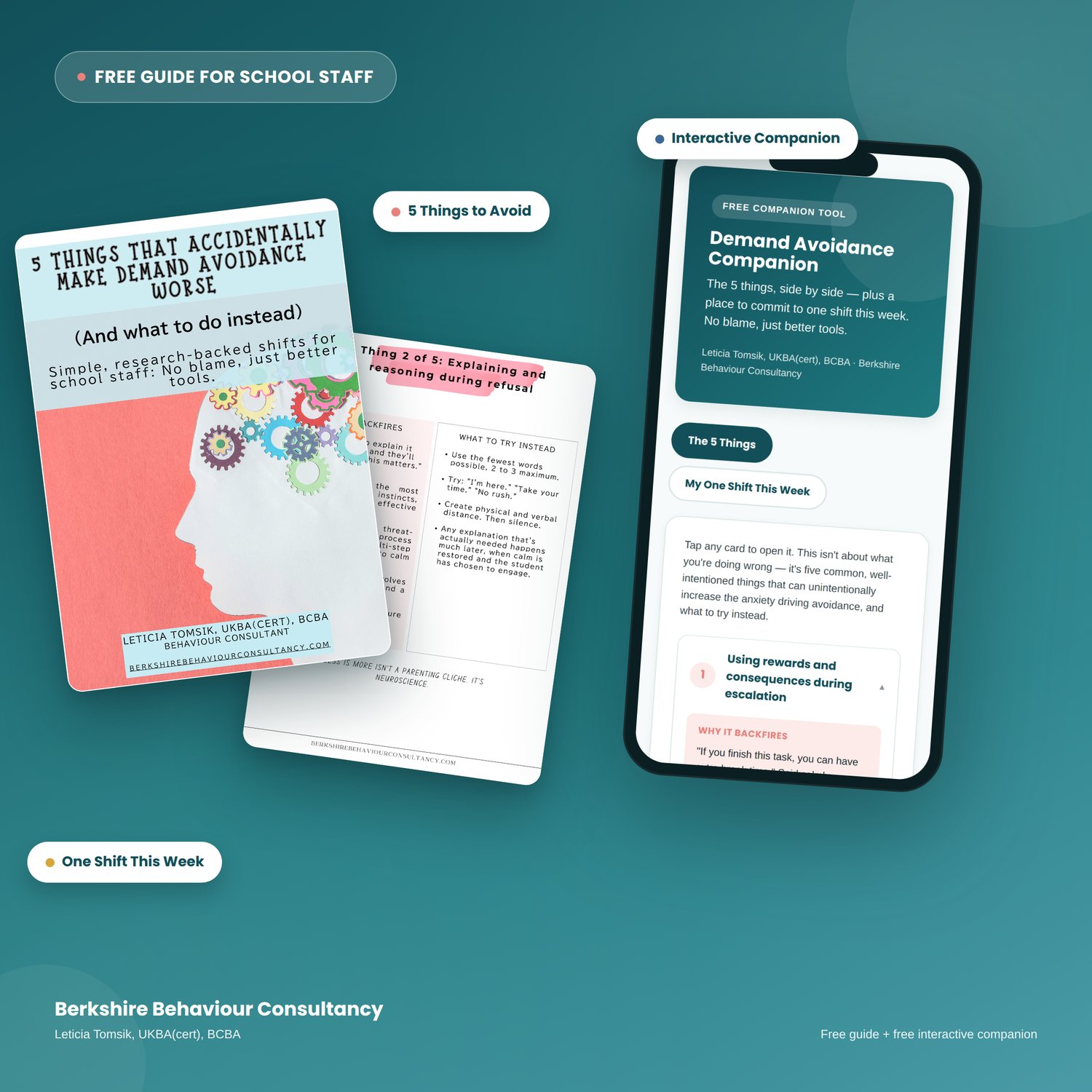
5 Things That Accidentally Make Demand Avoidance Worse isn't about what you're doing wrong. It's about five very common, very well-intentioned things that can unintentionally increase the anxiety driving the avoidance — and what to try instead. Small shifts. Real difference.
The 5 things covered
- Using rewards and consequences during escalation — why the thinking brain goes offline in survival mode, and how to remove pressure instead
- Explaining and reasoning during refusal — why more words mean more pressure, and what to say instead (hint: almost nothing)
- Giving instructions as instructions — how the frame of a direct command triggers avoidance before the content even registers, with real classroom phrase swaps
- Treating the opt-out as the problem — why blocking an exit escalates rather than resolves, and how to build a better one before it's needed
- Forgetting that your nervous system is part of the intervention — why your physiological state communicates with theirs before any words are spoken, and the 3-second reset to use before a difficult interaction
Each "thing" includes a clear "why it backfires" explanation grounded in what's actually happening in the nervous system, and a practical "what to try instead" — plus a short pull-quote to keep in mind.
Plus, a free interactive companion tool
This guide comes with a browser-based tool you can save straight to your phone — no login, no app store, nothing to install:
- The 5 Things — each one as an expandable card, why it backfires and what to try instead side by side, exactly as they appear in the guide
- My One Shift This Week — the guide's own advice, made actionable: pick just one shift to focus on (not three, not five — one), with an optional note on how it's going. Change your mind any time; nothing here is fixed
Who this is for
SENCOs, teaching assistants, pastoral leads, and any school staff supporting a PDA or demand-avoidant learner, whether or not a formal diagnosis is in place. Built for the moments where you're already trying hard and just need to know what to adjust.
A note on approach
Pick the one thing that resonated most and try something different with it this week. That's all. Small changes, applied consistently, make a real difference — you don't need to overhaul everything at once, and you're not starting from a place of doing it wrong.