


GC-MS Course: Columns, Inlets, EI Spectra and Troubleshooting (44 Animated Video Lessons + Companion Book)
GC-MS Course
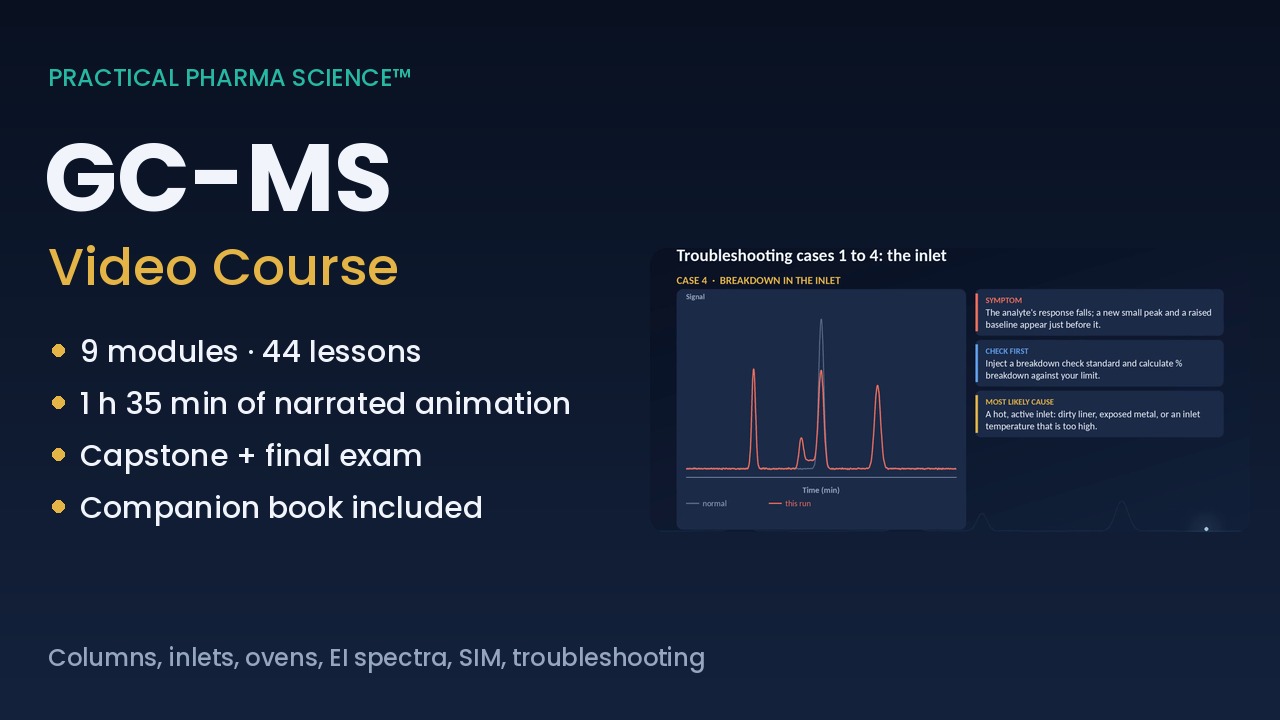
9 modules, 44 lessons, 1 h 35 min of video
Most GC problems start in the inlet. Most analysts change the column first!
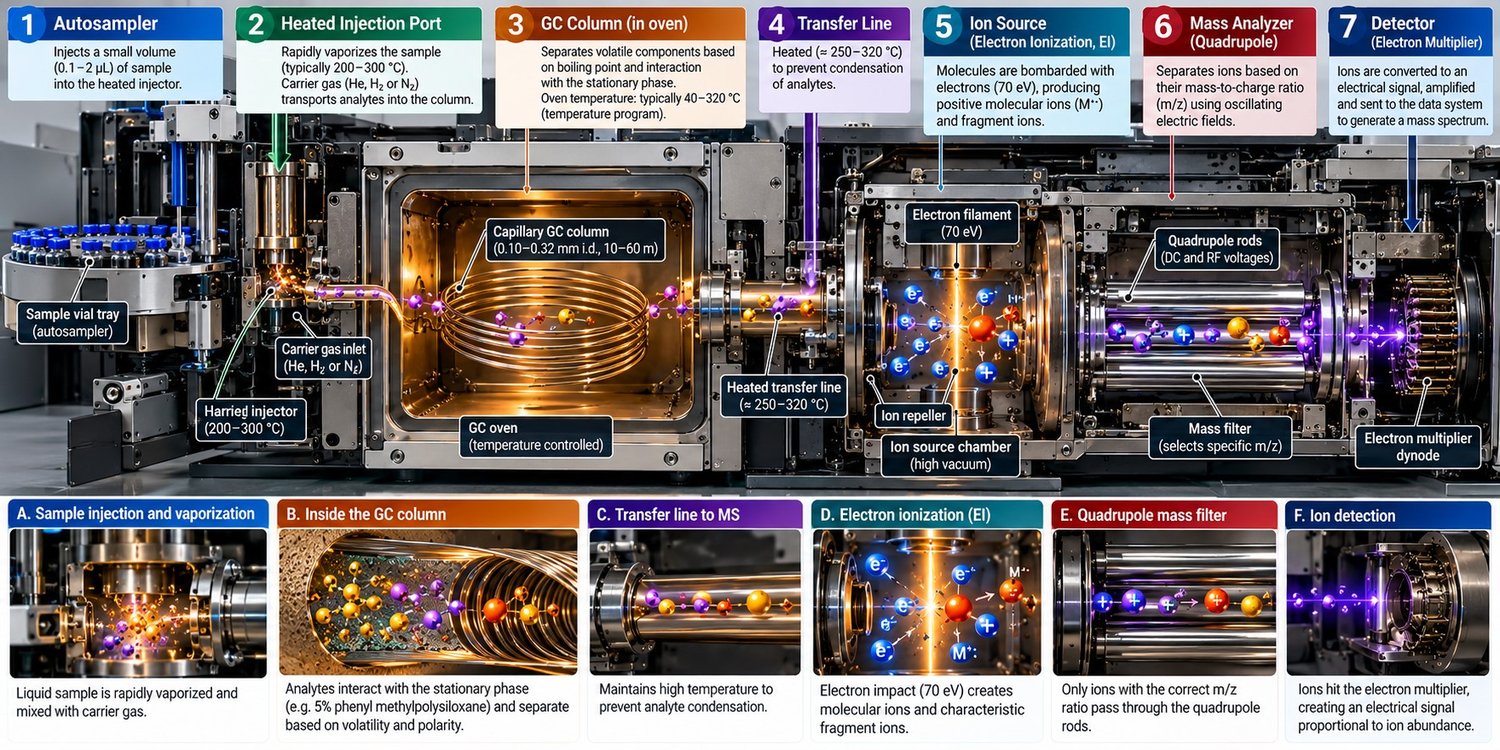
This course explains GC-MS the way you need it at the instrument: what happens to your sample from the syringe to the detector, and what to change when the data looks wrong.
It is 44 short, narrated, animated lessons. You watch the vapour cloud expand in the liner and backflash when it does not fit, a temperature programme pull compounds apart, electrons fragment a molecule at 70 eV, and isotope patterns build up from chlorine and bromine.
It covers the instrument end to end, carrier gases including the move from helium to hydrogen, stationary phases and column dimensions, retention indices, split and splitless injection, liners and inlet maintenance, headspace and SPME, temperature programming, EI spectra and library searching, chemical ionisation, SIM versus full scan, internal standards and calibration, derivatisation, validation, system suitability, and eight troubleshooting cases. It ends with a capstone and a final exam with model answers.
Who it is for: analysts running residual solvents, impurities, extractables and leachables, environmental or forensic GC-MS, and LC analysts who have inherited a GC.
What you get
- 44 narrated, animated lessons, 1 h 35 min in total, 1080p, yours to keep once you buy it
- 9 modules, from the instrument to validation and troubleshooting
- 8 troubleshooting cases: inlet, column, flow and source
- Capstone project, final exam and model answers
- Companion book (PDF): every lesson in print, with figures
Free preview: watch Module 8 - Lesson 8.3, Troubleshooting cases 1 to 4: the inlet, before you buy.
Note: the hands-on lessons demonstrate Practical Pharma Science tools and templates. Those tools are not included in the course; several are free at practicalpharmascience.com/tools and the rest are sold separately.
Course contents: 9 modules, 44 lessons, 1 h 35 min of video
Module 1 · How GC-MS works (5 lessons, 13 min)
- 1.1 The GC-MS instrument, end to end
- 1.2 What GC-MS can and cannot analyse
- 1.3 Carrier gases: helium, hydrogen, nitrogen
- 1.4 Vacuum, the interface and tuning
- 1.5 Reading a GC-MS dataset
Module 2 · GC columns (5 lessons, 11 min)
- 2.1 Stationary phases
- 2.2 Selectivity: like dissolves like
- 2.3 Column dimensions: length, diameter, film
- 2.4 Retention indices
- 2.5 Column bleed and column care
Module 3 · Inlets and injection (5 lessons, 10 min)
- 3.1 Split and splitless injection
- 3.2 Split ratio and how much reaches the column
- 3.3 Backflash: when the vapour does not fit
- 3.4 Liners, septa and inlet maintenance
- 3.5 Headspace, PTV and other injection modes
Module 4 · Temperature programming (5 lessons, 9 min)
- 4.1 Why programme the oven
- 4.2 The scouting programme
- 4.3 Ramp rate: speed against resolution
- 4.4 Initial temperature, holds and the end of the run
- 4.5 Building a multi-ramp method
Module 5 · EI and spectrum interpretation (5 lessons, 11 min)
- 5.1 Electron ionisation at 70 eV
- 5.2 Isotope patterns
- 5.3 Reading fragments
- 5.4 Library searching
- 5.5 Chemical ionisation
Module 6 · Acquisition and quantitation (5 lessons, 10 min)
- 6.1 Full scan or SIM
- 6.2 Dwell time, cycle time and points per peak
- 6.3 Choosing target and qualifier ions
- 6.4 Internal standards
- 6.5 Calibration and the matrix effect in GC
Module 7 · Sample prep and derivatisation (5 lessons, 10 min)
- 7.1 Liquid extraction for GC
- 7.2 Static headspace
- 7.3 Solid phase microextraction
- 7.4 Derivatisation
- 7.5 Choosing a route and controlling contamination
Module 8 · Validation and troubleshooting (5 lessons, 12 min)
- 8.1 Validating a GC-MS method
- 8.2 System suitability for GC-MS
- 8.3 Troubleshooting cases 1 to 4: the inlet
- 8.4 Troubleshooting cases 5 to 8: column, flow and source
- 8.5 A troubleshooting routine
Module 9 · Capstone (4 lessons, 8 min)
- 9.1 The capstone brief
- 9.2 Finding 1: resolution on the new column lot
- 9.3 Findings 2 and 3: precision and recovery
- 9.4 Your capstone, the final exam and the course wrap-up
Expand Your Learning
YouTube Channel: Watch step by step educational videos at YouTube/@PracticalPharmaScience.