
Why Autistic Children May Grind Their Teeth: The Sensory Science
Why Autistic Children May Grind Their Teeth: The Sensory Science
Proprioceptive & Periodontal Mechanoreception — Educational Infographic (Printable, A2)
You will receive the printable unwatermarked version of this infographic
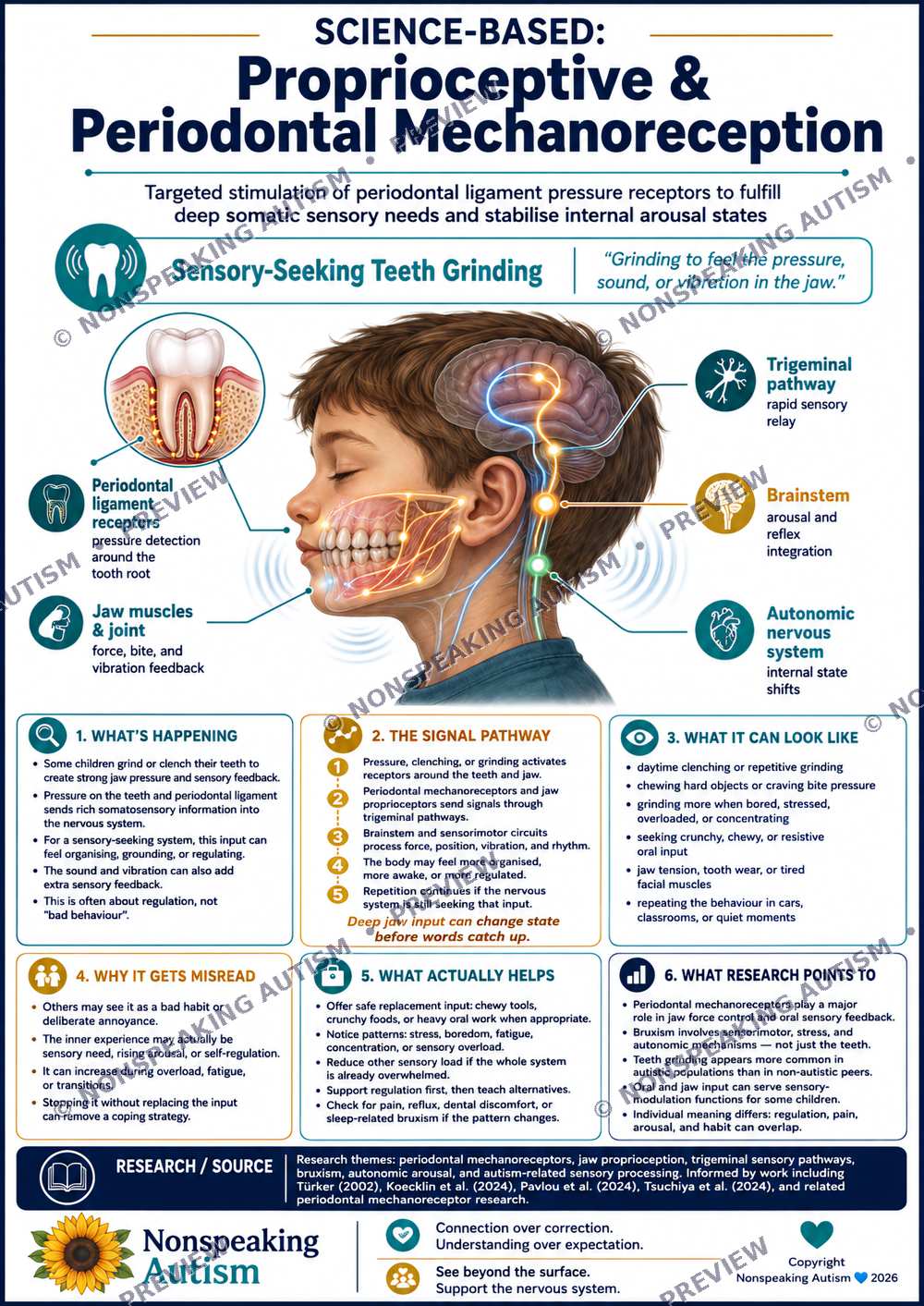
A detailed, research-grounded visual explaining sensory-seeking teeth grinding — targeted stimulation of periodontal ligament pressure receptors to fulfil deep somatic sensory needs and stabilise internal arousal states.
This infographic covers:
- Anatomical detail: periodontal ligament receptors (pressure detection around the tooth root), jaw muscles & joint (force, bite, vibration feedback), trigeminal pathway (rapid sensory relay), brainstem (arousal and reflex integration), autonomic nervous system (internal state shifts)
- What's happening: pressure on the teeth and periodontal ligament sends rich somatosensory information into the nervous system — for a sensory-seeking system, this input can feel organising, grounding, or regulating
- The signal pathway: pressure/clenching/grinding activates receptors → periodontal mechanoreceptors and jaw proprioceptors send signals through trigeminal pathways → brainstem processes force/position/vibration/rhythm → the body may feel more organised, awake, or regulated
- What it can look like: daytime clenching, chewing hard objects, grinding more when bored/stressed/concentrating, seeking crunchy/chewy/resistive oral input
- Why it gets misread: others may see it as a bad habit, but the inner experience may be sensory need or self-regulation — stopping it without replacing the input can remove a coping strategy
- What actually helps: offer safe replacement input (chewy tools, crunchy foods), notice patterns, support regulation first then teach alternatives, check for pain or dental discomfort if the pattern changes
- Grounded in peer-reviewed research (Türker 2002; Koecklin et al. 2024; Pavlou et al. 2024; Tsuchiya et al. 2024)
What you get:
- High-resolution PDF, print-ready and scalable up to A2 (420 × 594mm)
- Instant digital download
Perfect for: SEND and clinical training, therapy rooms, staff CPD, parent carer forums, and personal understanding.
For personal, classroom, and professional educational use. Not for resale or redistribution.
© Nonspeaking Autism
Disclaimer:
This resource is intended for educational and informational purposes only. It is designed to support understanding of autism, sensory processing, nervous system regulation, and behaviour from a neurodevelopmental perspective.
The information provided is not medical, psychological, therapeutic, or legal advice and should not be used as a substitute for assessment, diagnosis, or treatment by a qualified healthcare professional.
Every autistic person is unique. Strategies and supports should always be tailored to the individual's needs, strengths, and circumstances.
If a child displays a sudden change in behaviour, severe distress, signs of illness, injury, or behaviours that place themselves or others at risk, seek appropriate medical advice or emergency assistance where necessary.
While every effort has been made to ensure the information is accurate and reflects current understanding, knowledge in autism and neuroscience continues to evolve.
This resource is for the purchaser's personal, educational, or professional use only. It may not be copied, redistributed, resold, edited, shared publicly, or reproduced in whole or in part without prior written permission.
© Nonspeaking Autism 💙