
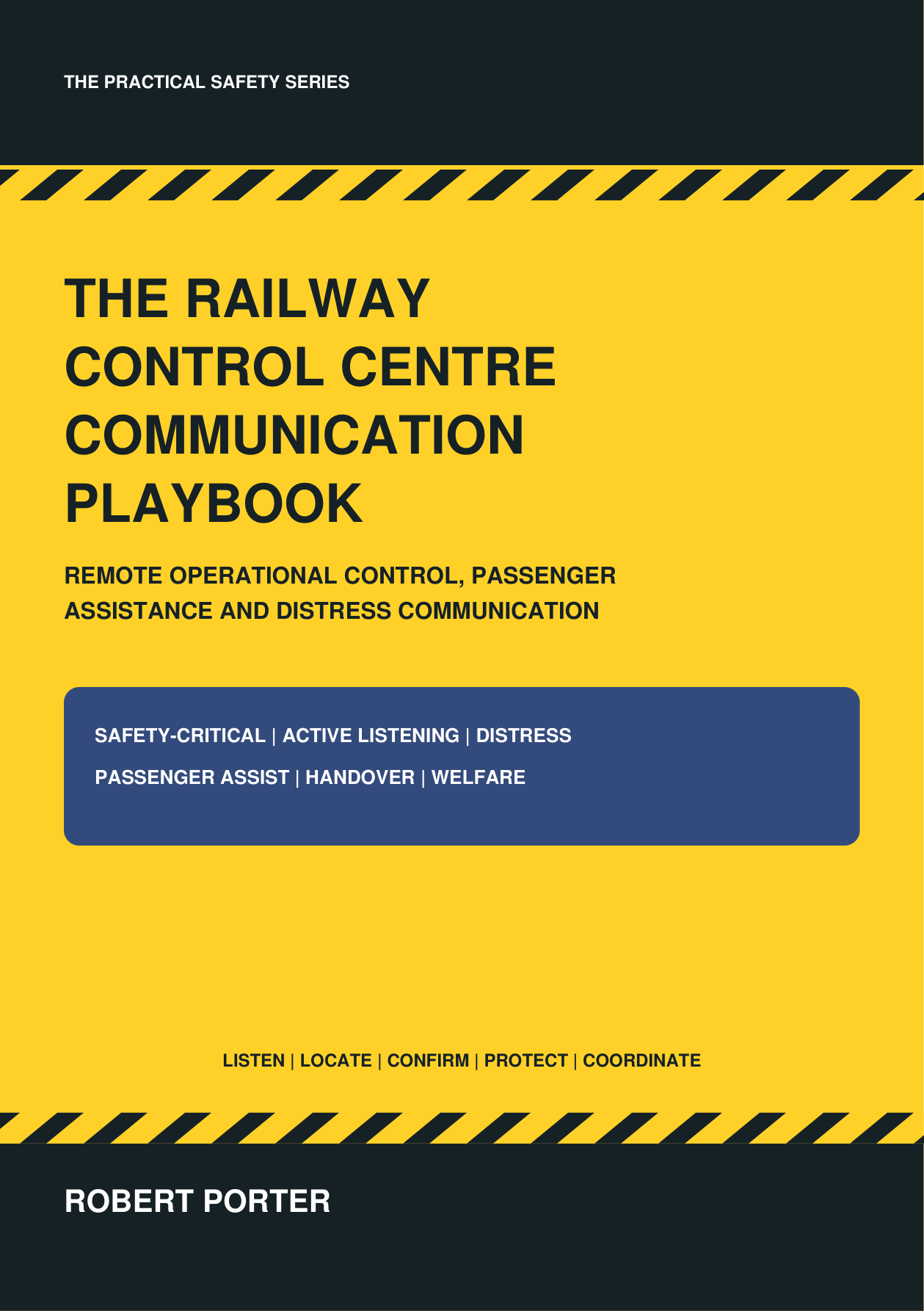
The Railway Control Centre Safety-Critical Communication, Passenger Assistance and Remote Incident Management
LISTEN | LOCATE | CONFIRM | PROTECT | COORDINATE
When a railway controller answers a call, they may have no direct view of the person, location or danger being described.
They must build a reliable picture through another person’s words.
The Railway Control Centre Communication Playbook is a comprehensive guide to remote operational control, passenger assistance and distress communication across the UK railway.
Written by Robert Porter, an experienced railway operational leader, the book explains how controllers can combine human communication with operational discipline when they cannot rely on face-to-face contact.
It covers:
• Railway operating and route control centres
• Train operating company control
• Station, security and CCTV control rooms
• Passenger assistance and customer contact centres
• Remote situational awareness
• Exact railway-location confirmation
• Active listening and structured questioning
• Validation without confirming unsupported facts
• Communication with frightened or distressed people
• Suicide and self-harm concerns
• Safety-critical communication protocols
• Accurate, brief and clear messages
• Read-back and hear-back
• Phonetic alphabet and critical numbers
• Passenger Assist bookings and handovers
• Turn-up-and-go assistance
• Assistance failures and passenger recovery
• Accessible communication
• Safeguarding children and vulnerable adults
• Aggressive and abusive callers
• Staff reporting errors, uncertainty or fatigue
• Incident and multi-agency coordination
• Decision logs and operational handovers
• Telephony, CCTV and help-point failures
• Business continuity and manual fallbacks
• GDPR, call recording and special-category information
• Control-room workload and fatigue
• Controller welfare after traumatic calls
• Simulation, competence, coaching and assurance
The book addresses one of the most difficult aspects of remote control work: knowing when to use formal operational language and when the person needs space, empathy and validation before they can provide useful information.
A movement-risk message may need to be short, standardised and closed-loop. A distressed passenger may need a calm voice, one question at a time and reassurance that they are being heard.
Both conversations must eventually establish the same essentials:
Where is the person?
What is happening now?
Is anyone in immediate danger?
What action is being taken?
Who owns the next step?
Has the handover been accepted?
The book also deals directly with language that can make difficult situations worse. Phrases such as “calm down,” “do not worry” and “you will be fine” can sound dismissive or create false reassurance.
Instead, controllers learn how to say:
“I can hear that this has been frightening.”
“Thank you for telling me.”
“I’m taking what you have said seriously.”
“Tell me exactly where you are.”
“I’m arranging help. Keep talking to me.”
“Let me repeat back what I have understood.”
There are no magic phrases that automatically make someone safe.
Words can reduce distress, preserve connection and produce better information, but safety still requires accurate location, competent intervention, emergency escalation and confirmed handover.
Every major subject includes a practical simulation page. The book also contains quick-reference control cards for emergency calls, distressed passengers, suicide concerns, Passenger Assist failures, safeguarding, aggressive callers, staff uncertainty, system failures and controller welfare.
This is an operational guide for railway controllers, passenger assistance teams, station control staff, customer contact centres, control-room supervisors, competence managers and anyone required to coordinate a response from a distance.
Hear the person. Confirm the risk. Coordinate the safe response.