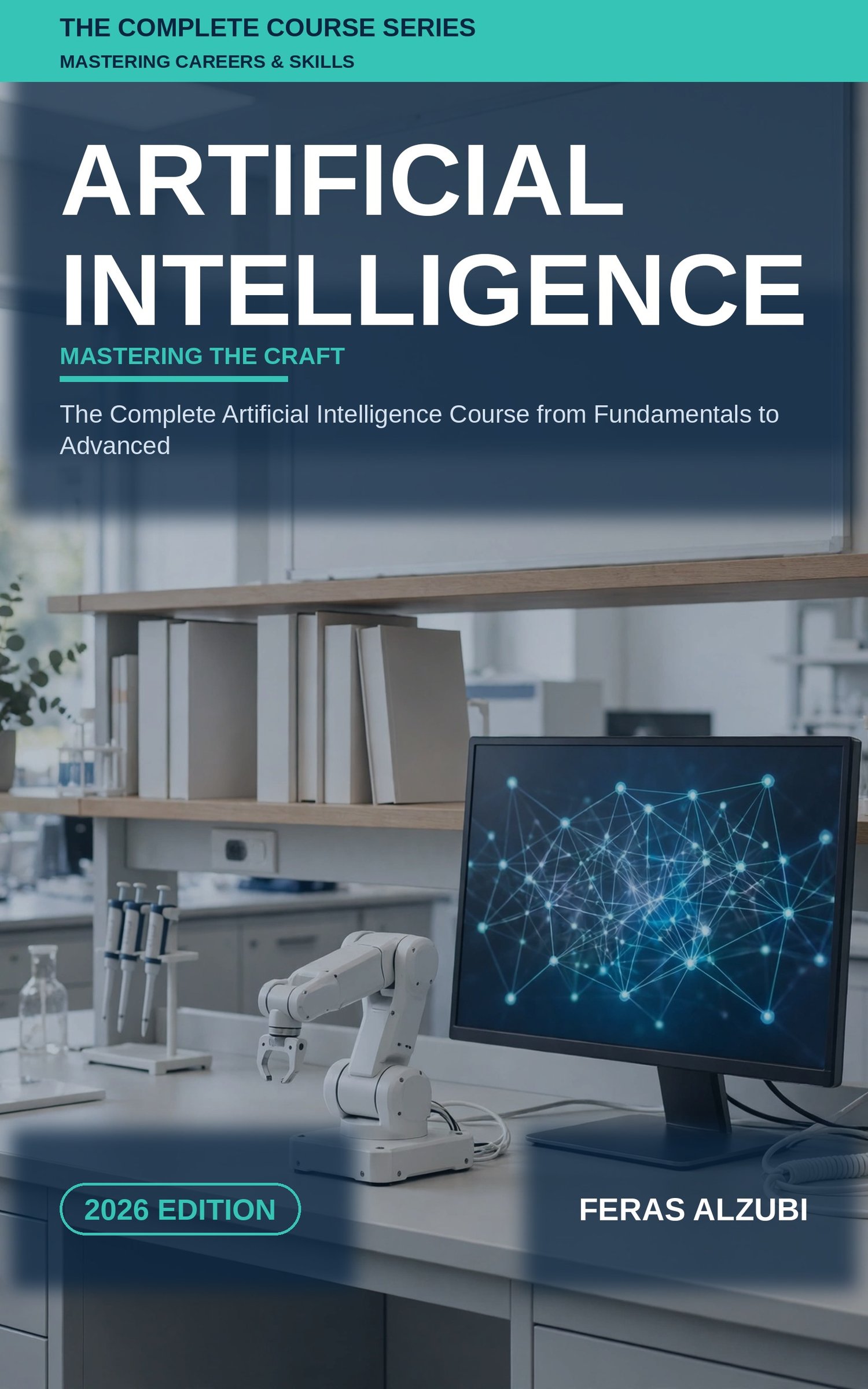
Artificial Intelligence: Mastering the Craft
Artificial Intelligence: Mastering the Craft
What this book teaches. The complete knowledge of the artificial intelligence major, taught A to Z in curriculum order — the way an accredited degree program builds it. This is the major book for Artificial Intelligence, Classification of Instructional Programs code 11.0102, and it follows the CIP definition strand by strand: symbolic inference and representation become the chapters on logic, knowledge representation, search, and reasoning under uncertainty; human learning and reasoning become the long central arc on machine learning, neural networks, and reinforcement learning, together with the planning and decision making that turn learned knowledge into action; the computer modeling of human motor control and motion becomes the robotics chapter, where perception and action close into a loop. The book opens with the field and the major, then builds the mathematical foundations — logic, probability, linear algebra, and the calculus and optimisation intuition everything later needs — and the computing foundations of programs, data structures, algorithms, and complexity. From there: intelligent agents and search; knowledge representation and logic; reasoning under uncertainty, including Bayesian networks; planning and decision making, from classical planning to Markov decision processes; the foundations of machine learning; supervised and unsupervised learning; neural networks and deep learning from the perceptron to backpropagation; deep architectures for vision, sequence, and attention, including the transformer; reinforcement learning; natural language processing from the classical pipeline to embeddings; language models and generative AI; computer vision; and robotics and embodied intelligence. It closes with evaluation and scientific practice, ethics, safety, and society, and a final chapter on the major itself — its curriculum, its research life, graduate study, and careers. The mathematics is taught in plain notation, built up at the moment each chapter first requires it, so no reader needs to arrive already fluent. This book teaches the knowledge of the artificial intelligence major completely. It confers no degree and no college credit — degrees are granted by accredited institutions — and a reader who completes it will hold the knowledge the major teaches, far better prepared for the credential if they choose to earn one.
Who it is for. Prospective students of artificial intelligence and computer science who want to see the whole major before they commit to it, or who want to arrive at their first semester already knowing the shape of the territory. Current students who want a single coherent account that ties their separate courses together — the connections between probability and Bayesian networks, between search and planning, and between optimisation and neural network training. Self-taught learners who want the whole discipline and not fragments of it — not a single technique, library, or fashionable model, but the complete, ordered knowledge a curriculum gives, including the foundations fashionable material usually skips. And working technologists who learned parts of this field on the job and want to formalise what practice taught them partially. No enrolment, permission, or prior credentials are needed — only patience, because a whole discipline cannot be absorbed in an afternoon, and the book is organised to reward steady, sequential work.
What's inside (every count verified against the actual book):
Complete course — 20 chapters in five parts, foundations to the discipline itself
340 practice questions — every answer explained, right and wrong
40-question diagnostic — scored by domain, with a routing worksheet
240 chapter questions — a 12-question check closes every chapter
60-question final review — ranging over all twenty chapters
40 labeled figures — diagrams of the field's core ideas, two in every chapter
150-term glossary · 8 cheat sheets · 3 study plans — the 2-week sprint, the 6-week standard plan, and the 12-week deep-study plan
29 tables — comparisons, summaries and decision guides throughout
Every one of the 340 questions is original, written for this book, and every explained answer tells you why the right answer is right and why each wrong answer is wrong. The book's facts rest on verified sources, listed in a Sources & Verification Note at the back of the book. Nothing in the twenty chapters depends on another book: this volume is complete and self-contained, and where a subject also has a specialist trade depth beyond the curriculum, the book says so and points onward — it never leaves a gap in the major itself.
Read the first chapter free — the sample on this page is Chapter 1 of this book, exactly as it appears in the full edition.
From the Mastering Careers & Skills library — complete A-to-Z professional teaching books for careers, trades, and certifications.
This book is an independent teaching work. The Classification of Instructional Programs and its code 11.0102 definition are named as the public curriculum reference they are; this book is not published by, endorsed by, or affiliated with any university, the National Center for Education Statistics, or any product maker. It teaches the major's knowledge completely; degrees and college credit are granted by accredited institutions.
Refunds: Please read the free sample chapter before you buy. This is a digital ebook, delivered instantly by download. If the file is defective, or you cannot open or download it and we cannot fix the problem, you will receive a full refund — email us within 14 days of purchase. Because the book is delivered instantly as a downloadable file, all other sales are final.
How to read this book (EPUB format): After checkout, download the EPUB file, then open it in any free ebook reader app. On iPhone or iPad: Apple Books — it is already on your device. On Android phones and tablets: Google Play Books (free: https://play.google.com/store/apps/details?id=com.google.android.apps.books) — upload the file in the app — or ReadEra (free). On a Windows or Mac computer: Thorium Reader (free: https://thorium.edrlab.org) or Adobe Digital Editions (free). On Kindle: use Amazon's free Send to Kindle (https://www.amazon.com/sendtokindle) to add the file to your Kindle library.