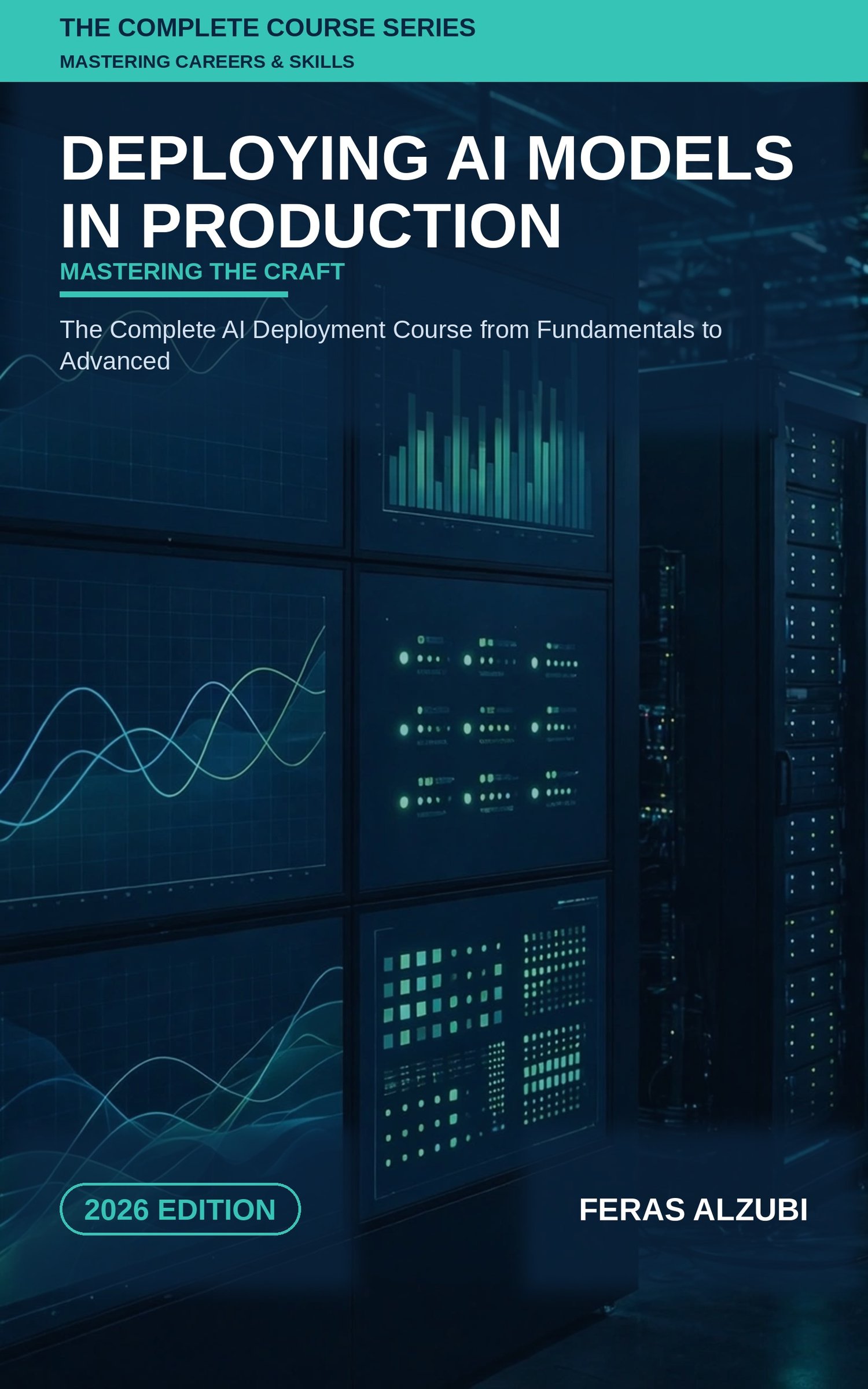
Deploying AI Models in Production: Mastering the Craft
Deploying AI Models in Production: Mastering the Craft — A Complete Course
What this book teaches. The complete run side of machine learning and AI — everything that happens after a model works, taught A to Z as one continuous discipline. It begins where model building ends: why production is a different country from the notebook, the system that surrounds the model, and the serving contract — inputs, outputs, latency and availability budgets, error semantics — that every later decision depends on. Then the craft of getting a model out safely: packaging the model and its pipeline as one versioned bundle, choosing between batch, online, streaming, and edge infrastructure, translating release patterns to models, and running canary and shadow releases with explicit promotion and abort rules. Then the disciplines that keep a live model honest: feature serving with point-in-time correctness and the cures for training-serving skew, scaling arithmetic for throughput, batching, and caching, model APIs with versioning, timeouts, and fallbacks, and the two halves of monitoring — inputs and drift before labels exist, then predictions, delayed performance, and business signals after. Then the operating disciplines: alerting that stays actionable, an on-call rota that stays human, retraining systems with honest triggers, and experimentation with guardrails. Then survival: the failure-mode taxonomy, the first hour of an incident, rollback and rehearsed fallbacks, graceful degradation, security and abuse at design level, and the unit economics of serving. The book closes with the deployment program — inventory, ownership, runbooks, and a published readiness rubric run as a program — and a capstone that traces one model's whole production life, from contract to incident to retraining to verdict. Every chapter works the same way — core ideas taught one at a time with diagrams, a worked example on an invented system with every given stated up front, decision tables, and a twelve-question check — so you learn the judgment, not just the vocabulary.
Who it is for. The engineers and technical leads who keep models alive: machine learning engineers moving models from notebook to service, software and platform engineers who own serving infrastructure, site reliability engineers on call for model-backed systems, data scientists handing a model over and staying responsible for what happens next, and engineering managers building a deployment program. The book assumes you have a model that works, or are responsible for one that is about to work; model-training depth is cross-referenced, not duplicated, so the whole book stays on the run side. Platforms and tools are taught as categories and patterns — a container platform, a feature store, a model registry — never as one vendor's configuration manual, so the discipline transfers to whatever stack you run.
What's inside (every count verified against the actual book):
Complete course — 20 chapters in five parts, foundations to capstone
340 practice questions — every answer explained, right and wrong
40-question diagnostic — scored by domain, with a routing worksheet
240 chapter questions — a 12-question check closes every chapter
60-question final review — three questions per chapter, with routed re-study
40 labeled figures — serving diagrams, release flows, monitoring stacks and fallback ladders, two in every chapter
150-term glossary · 8 cheat sheets · 3 study plans — the two-week intensive, the six-week part-time, and the team platform plan
Capstone — one model's production life traced end to end, contract to verdict
Every one of the 340 questions is original, written for this book, and every explained answer tells you why the right answer is right and why each wrong answer is wrong. The framework material rests on published research — Sculley and colleagues on the hidden technical debt of ML systems, Breck and colleagues on the ML Test Score readiness rubric, and Sato, Wider, and Windheuser on continuous delivery for machine learning — listed in a Sources & Verification Note at the back of the book, and the book states its fences plainly: no vendor benchmarks or invented statistics, every number inside a worked example with stated givens you can check yourself, and security taught at design level only.
Read the first chapter free — the sample on this page is Chapter 1 of this book, exactly as it appears in the full edition.
From the Mastering Careers & Skills library — complete A-to-Z professional teaching books for careers, trades, and certifications.
An independent teaching work. Platforms and tools are taught as categories and patterns; trademarked names belong to their respective owners, and their appearance does not imply affiliation or endorsement.
Refunds: Please read the free sample chapter before you buy. This is a digital ebook, delivered instantly by download. If the file is defective, or you cannot open or download it and we cannot fix the problem, you will receive a full refund — email us within 14 days of purchase. Because the book is delivered instantly as a downloadable file, all other sales are final.
How to read this book (EPUB format): After checkout, download the EPUB file, then open it in any free ebook reader app. On iPhone or iPad: Apple Books — it is already on your device. On Android phones and tablets: Google Play Books (free: https://play.google.com/store/apps/details?id=com.google.android.apps.books) — upload the file in the app — or ReadEra (free). On a Windows or Mac computer: Thorium Reader (free: https://thorium.edrlab.org) or Adobe Digital Editions (free). On Kindle: use Amazon's free Send to Kindle (https://www.amazon.com/sendtokindle) to add the file to your Kindle library.