



Steady Pitch, a vocal range test, a pitch monitor and a trainer, one price
One price, once. There is nothing to buy inside, no subscription, no account, and no second till waiting for you after the first.
AND NOW A VOCAL RANGE TEST, IN THE SAME PURCHASE
Sing down as low as you can, then up as high as you can. It names both ends of your range, how wide it is in octaves, and which of the six voice types it sits closest to. It ignores a single stray frame and asks for about a fifth of a second of steady pitch, so a detector hiccup does not become your top note. A slow slide can still leave a mark on the way past, which is a limit I would rather state here than have you find. And when your voice goes below what the detector can honestly read, it says so instead of printing a flattering guess.
AND A TONE DEAF TEST THAT LISTENS INSTEAD OF ASKING
Every other test with that name plays two notes and asks whether they differ, which measures your hearing and then tells almost everyone they are fine. This one plays a note, listens while you sing it back, and reports how many cents off you landed, six times over. It separates being consistently flat, which is one problem, from being scattered, which is a different one, and those two need different practice. It does not diagnose amusia, and the page says so, because a microphone cannot reach that.
You get three HTML files, the trainer, the range test and the tone deaf test. Double click either one and it opens in your browser. It runs with the internet switched off, and nothing you sing leaves your machine because there is nothing to send it to. Copy it to another computer, keep it on a memory stick, open it in three years. There is no server that can go away and no login that can lock you out of something you have already paid for.
I am labouring this point because it is what people write about most when a practice tool disappoints them. Pay to get in, pay again inside for what you actually wanted, and one day it stops recognising what you bought.
IT FITS YOUR VOICE, NOT THREE BROAD BOXES
Choose bass, baritone, tenor, alto, mezzo, soprano or child, and the whole course transposes to your range. Seven, not three, and every one of the thirty exercises moves with you.
Concert pitch is yours to set. If your ensemble tunes to 442, tell it so. A trainer locked to 440 would call you eight cents sharp on every single note, forever, and blame you for it.
WHAT YOU DO
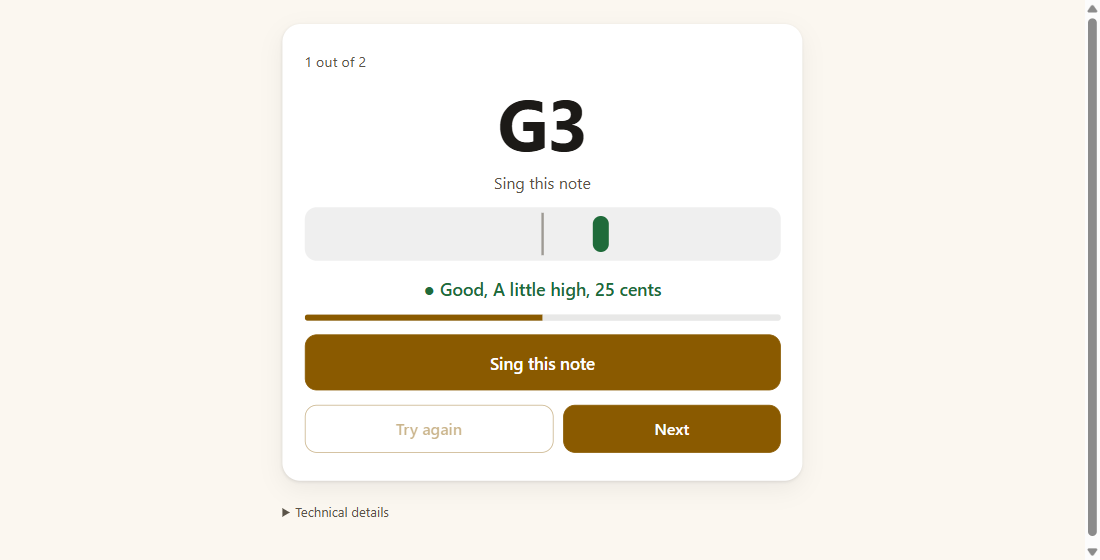
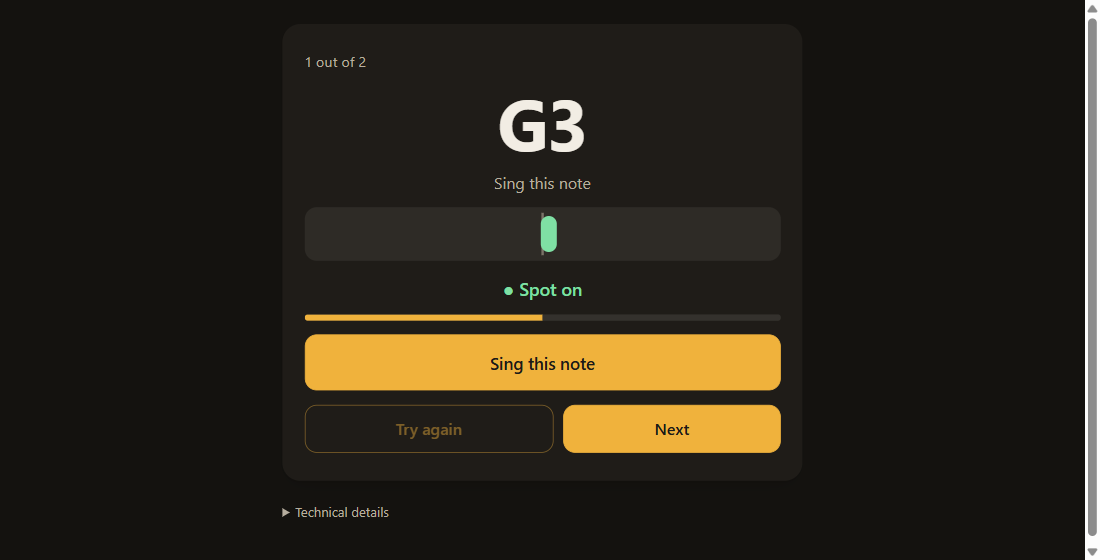
Pick your range. Sing or play what the screen shows. Watch the marker settle and see your error in cents, the unit real musicians use.
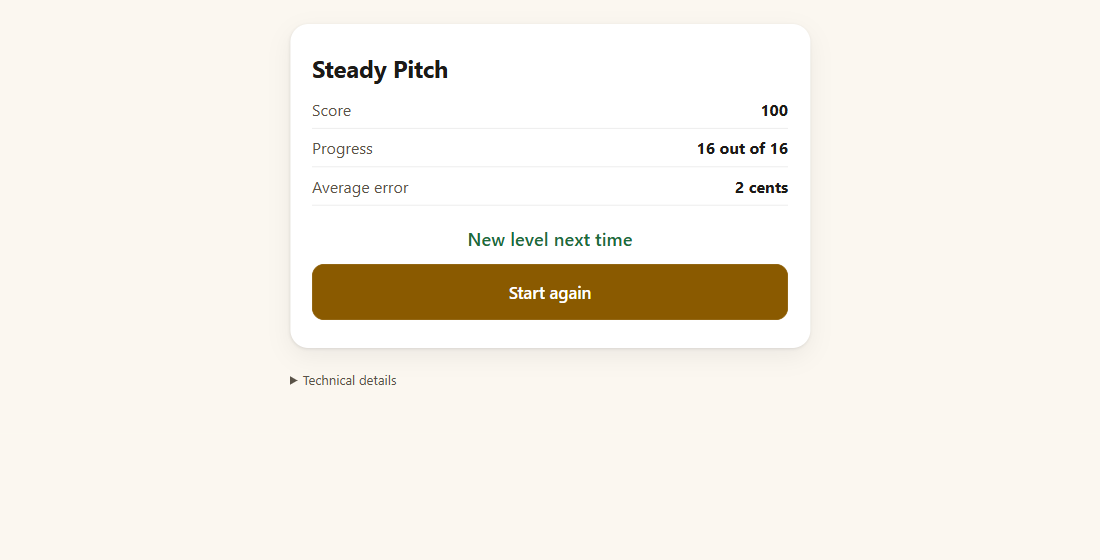
Thirty exercises, six levels, in the order voices actually learn. Level 1 gives you two notes and asks you to sing them until they are solid. Level 2 adds one note. By level 4 you have the full five note scale with no half steps, so nothing is out of reach yet. Half steps arrive at level 5, once you can hold a note, because they are the hardest thing to sing in tune and there is no reason to fail at them on day one. Level 6 opens up to leaps, arpeggios and the octave. That order is not mine, it is the sequence music teachers have used for eighty years, and it works because it never asks for two new difficulties at once.
Tolerance is generous at first and tightens as you improve. A beginner is not told they are wrong for being fifteen cents off, because they are not wrong, they are learning.
AND IT ACTUALLY HEARS YOU
This is the part I would rather you check than believe, which is why the free file exists.
Pitch detection on the human voice is harder than on a guitar string. The voice carries strong harmonics that fool simple detectors into hearing the wrong octave, and every singer slides a little into a note before settling on it. Steady Pitch ignores the slide and grades the part you actually held, and it knows which note the exercise asked for, so it can never report you an octave away.
Measured on recordings of real singers, not synthetic tones. Across forty tracks, twenty nine singers and nine languages, it read the sung pitch correctly on 93.1 percent of the 23,192 voiced frames. On a second and unrelated set of seventy seven sung notes, all seventy seven verdicts were right.
Test material from the open vocadito dataset, used under CC BY 4.0, and from the vocobox human voice dataset, used under the MIT licence.
IT ALSO LISTENS TO INSTRUMENTS
Play instead of sing and the same engine grades you. On a real piano at full sampling rate, forty seven notes, zero errors. On guitar through a microphone, 98.8 percent on isolated sustained notes. Across fourteen orchestral instruments, 98.5 percent, between C2 and C6.
Those last two carry their conditions on purpose. Isolated sustained notes were 5.5 percent of the notes in that recording set, and below 65 Hz the engine tells you it cannot hear rather than guessing. I would rather you know where it stops than discover it mid practice.
USABLE WITHOUT LOOKING AT THE SCREEN
Every verdict is spoken in plain words, with no symbols a screen reader would mangle. Guidance is audio and haptic and it goes quiet when you are in tune, so silence means you are right. A pitch trainer should be fully usable by a musician who cannot see, and this one is.
Six languages, and four ways of naming notes, including movable do and the German H. If you were taught do re mi, you are not forced into C D E.
TRY IT FIRST
The free file on this same store is not a teaser. Same engine, same accuracy, same six languages, same accessibility. It holds level 1, five exercises. What you pay for here is the other five levels, plus the range test as a file of your own. The range test is also free to use on the website, and I would rather say so than let you find out afterwards.
FOR TEACHERS
If you teach voice, choir or musicianship, this is the thing you can hand a student for the week between lessons. It grades the one thing you cannot check when you are not in the room. Send them the free file, it opens in their browser with nothing to install and no account to make.
WHAT IT NEEDS
A microphone, and a browser from the last few years. It asks for the microphone once, when you start, and the light goes out when you leave.