
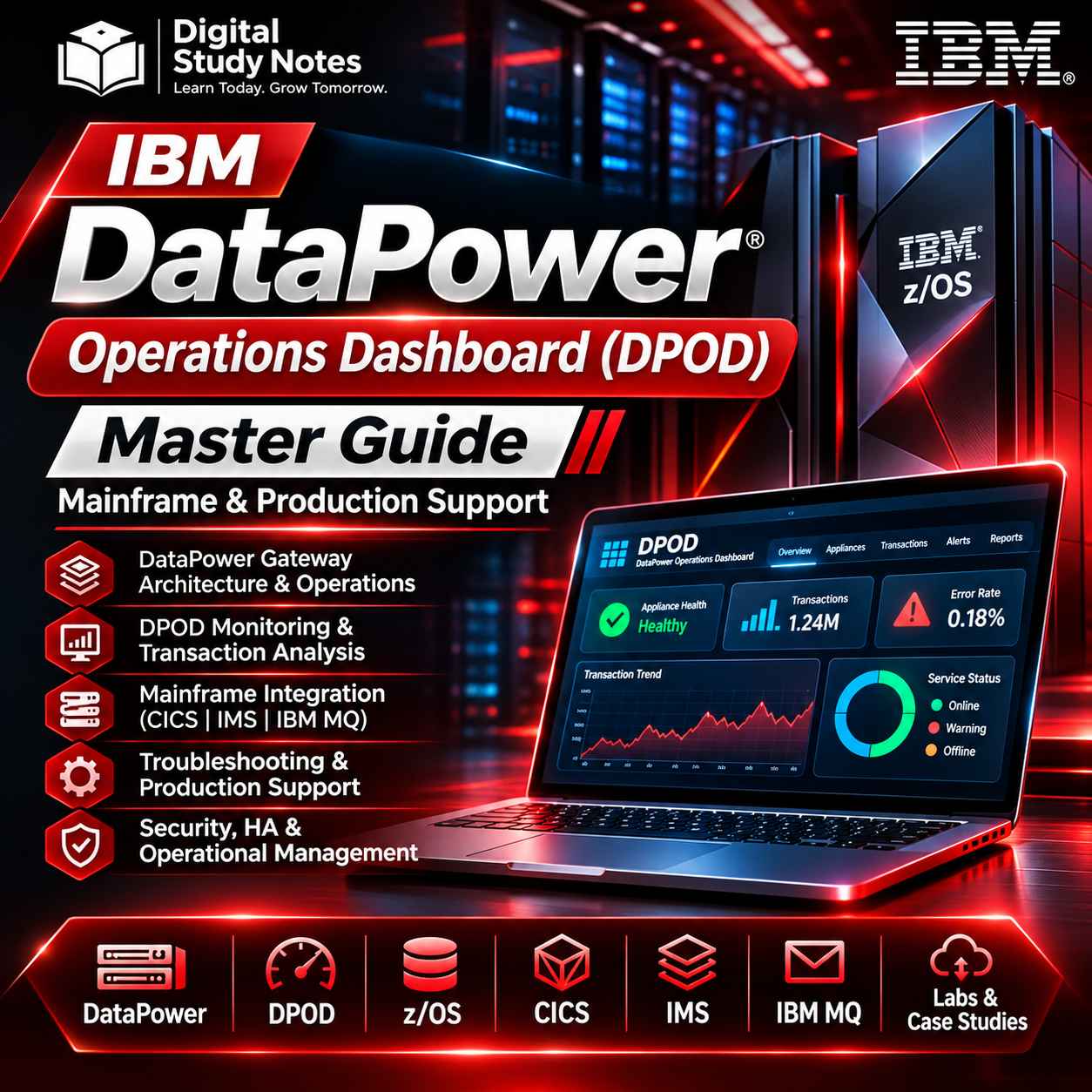
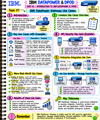
IBM DataPower Operations Dashboard (DPOD) — Master Guide | Mainframe & Production Support
IBM DataPower Operations Dashboard (DPOD)
MASTER GUIDE — IBM MAINFRAME & PRODUCTION SUPPORT
A Professional Learning Guide to IBM DataPower Gateway Operations, DPOD Monitoring, Mainframe Integration, and Enterprise Middleware Support.
About This Book
IBM DataPower Gateway plays an important role in enterprise application integration, secure communication, API management, and backend connectivity. Understanding how DataPower operates and how its environment is monitored is an important skill for middleware and production support professionals.
The IBM DataPower Operations Dashboard (DPOD) — Master Guide by Digital Study Notes is designed to help readers develop a structured understanding of IBM DataPower Gateway, DPOD monitoring, transaction analysis, mainframe connectivity, and production operations.
This guide combines foundational concepts with architecture explanations, operational monitoring subjects, troubleshooting scenarios, security concepts, and practical learning exercises.
It also introduces important IBM mainframe technologies, including z/OS, CICS, IMS, and IBM MQ, to help readers understand how DataPower communicates with enterprise backend systems.
Whether you are beginning your journey in middleware operations or strengthening your knowledge for an enterprise production support role, this guide provides a structured reference for understanding these technologies and their operational responsibilities.
WHAT YOU WILL LEARN
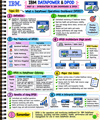
PART 01 — IBM DataPower and DPOD Fundamentals
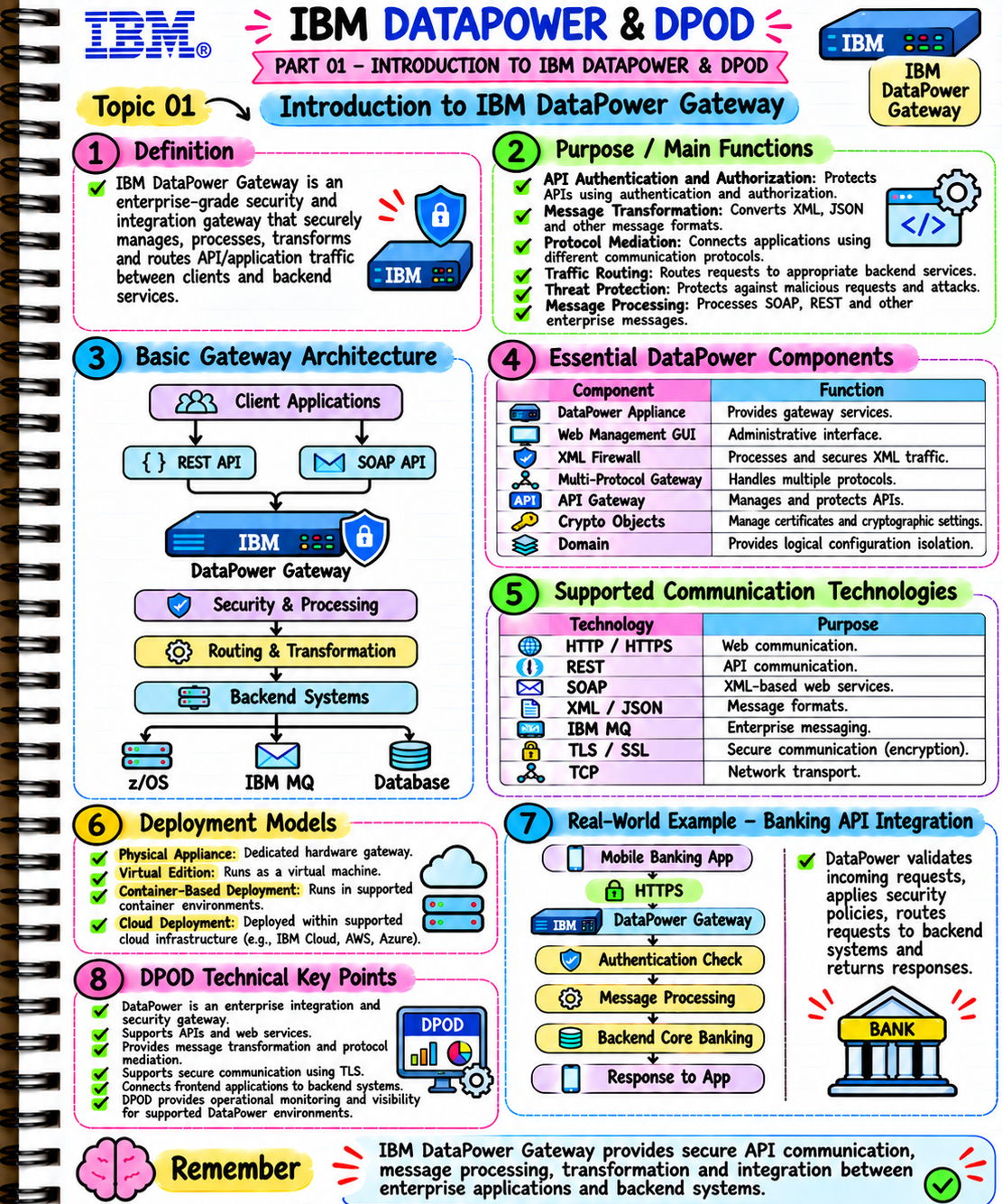
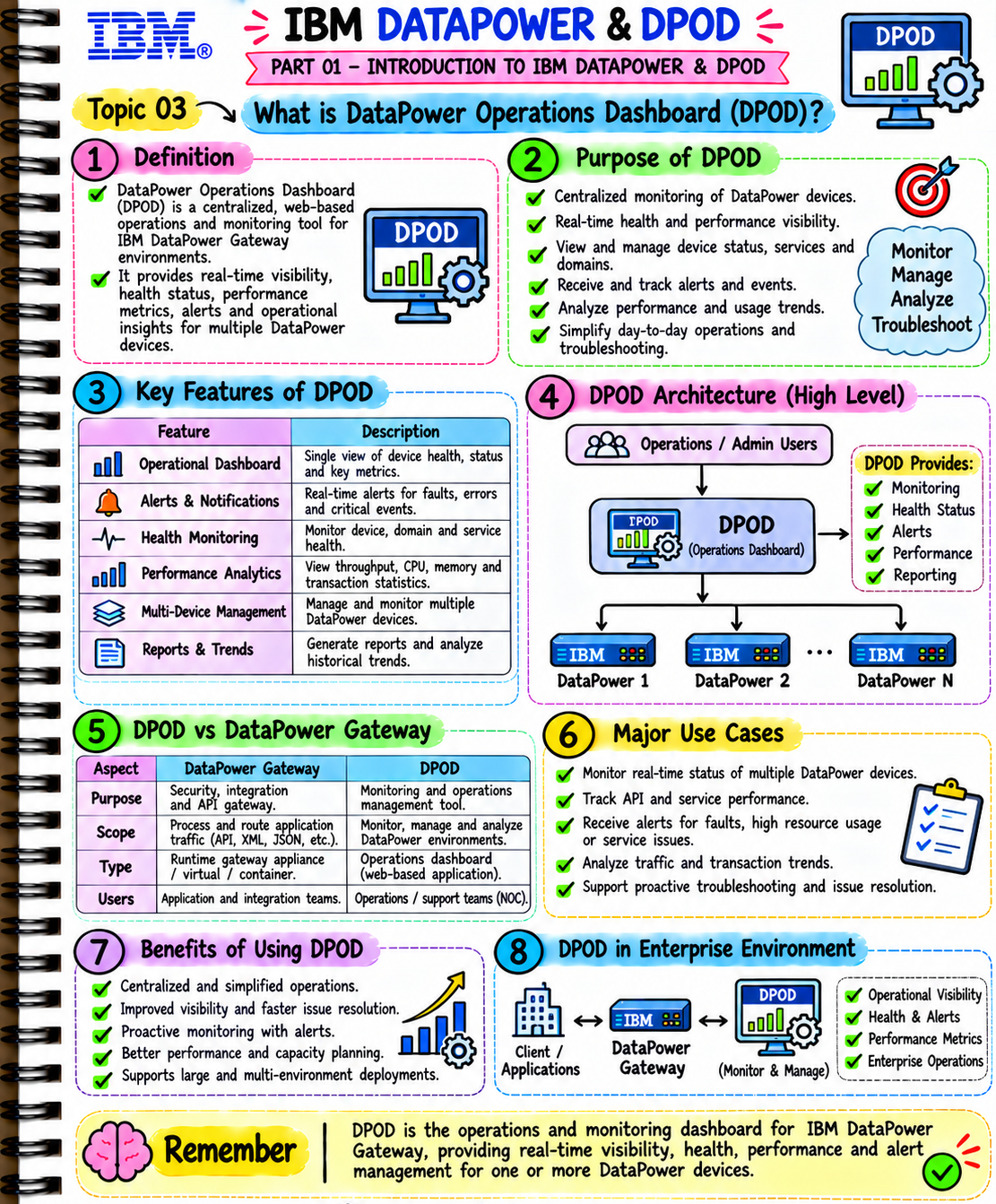
Build a foundation in IBM DataPower Gateway and DataPower Operations Dashboard.
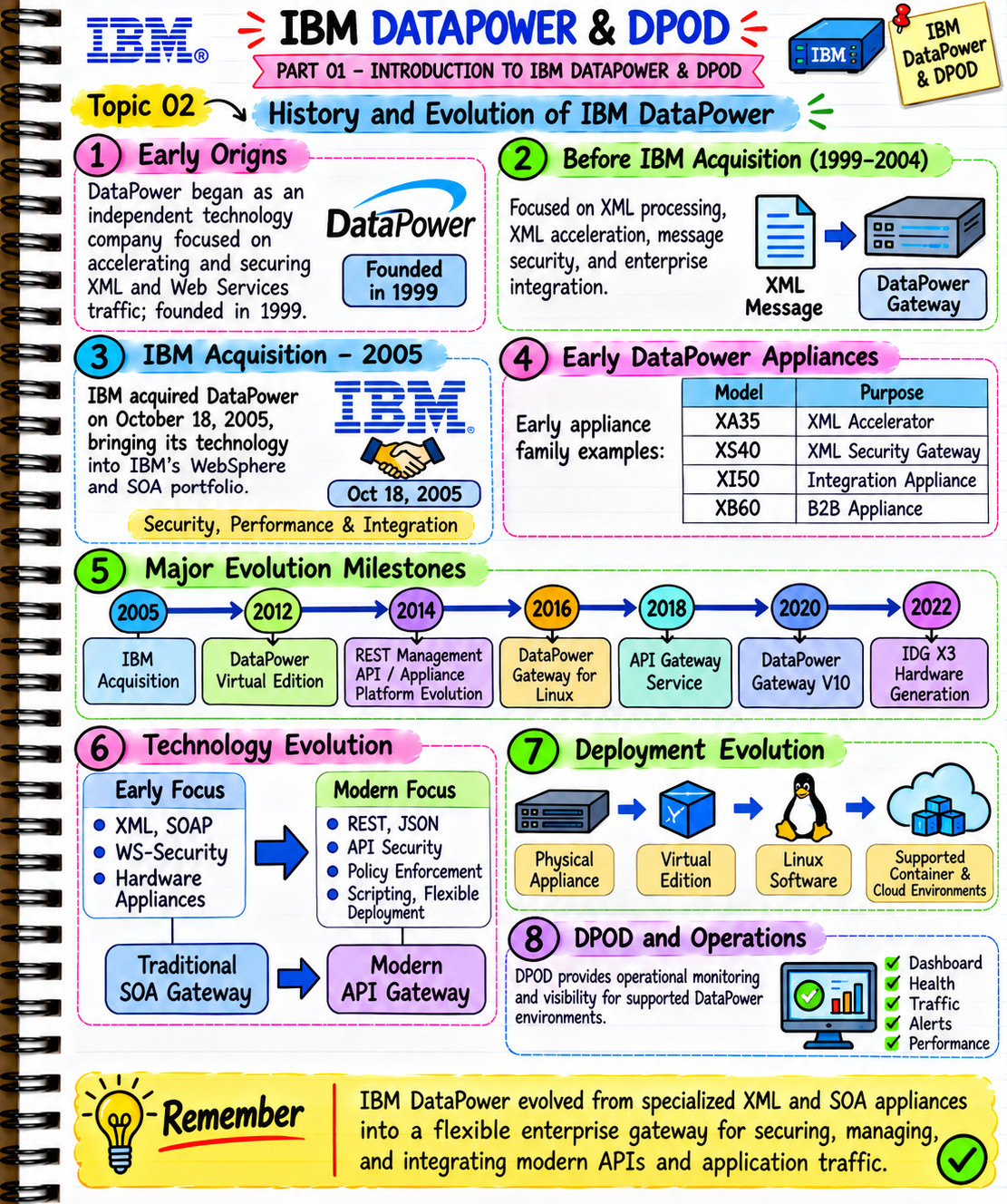
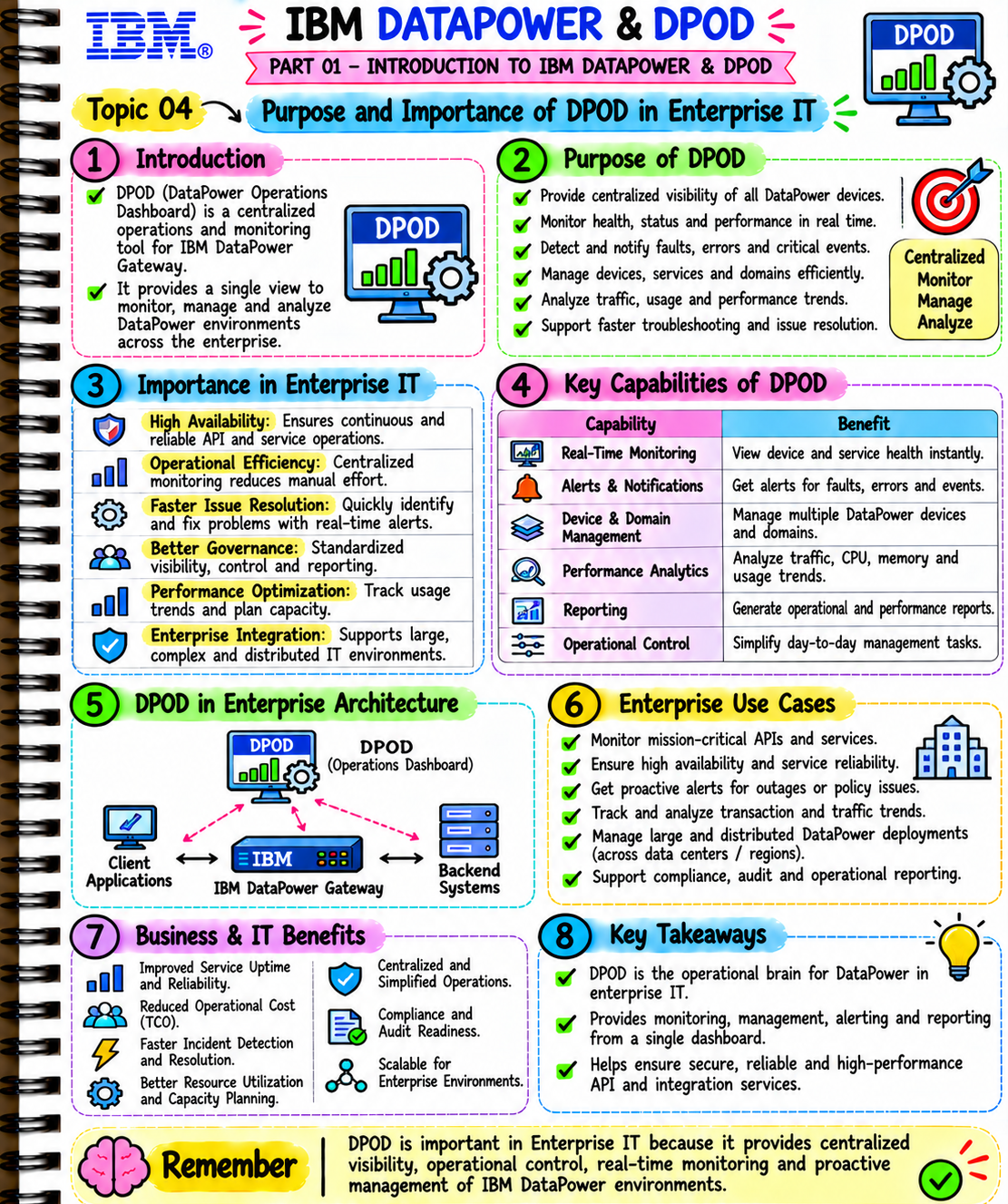
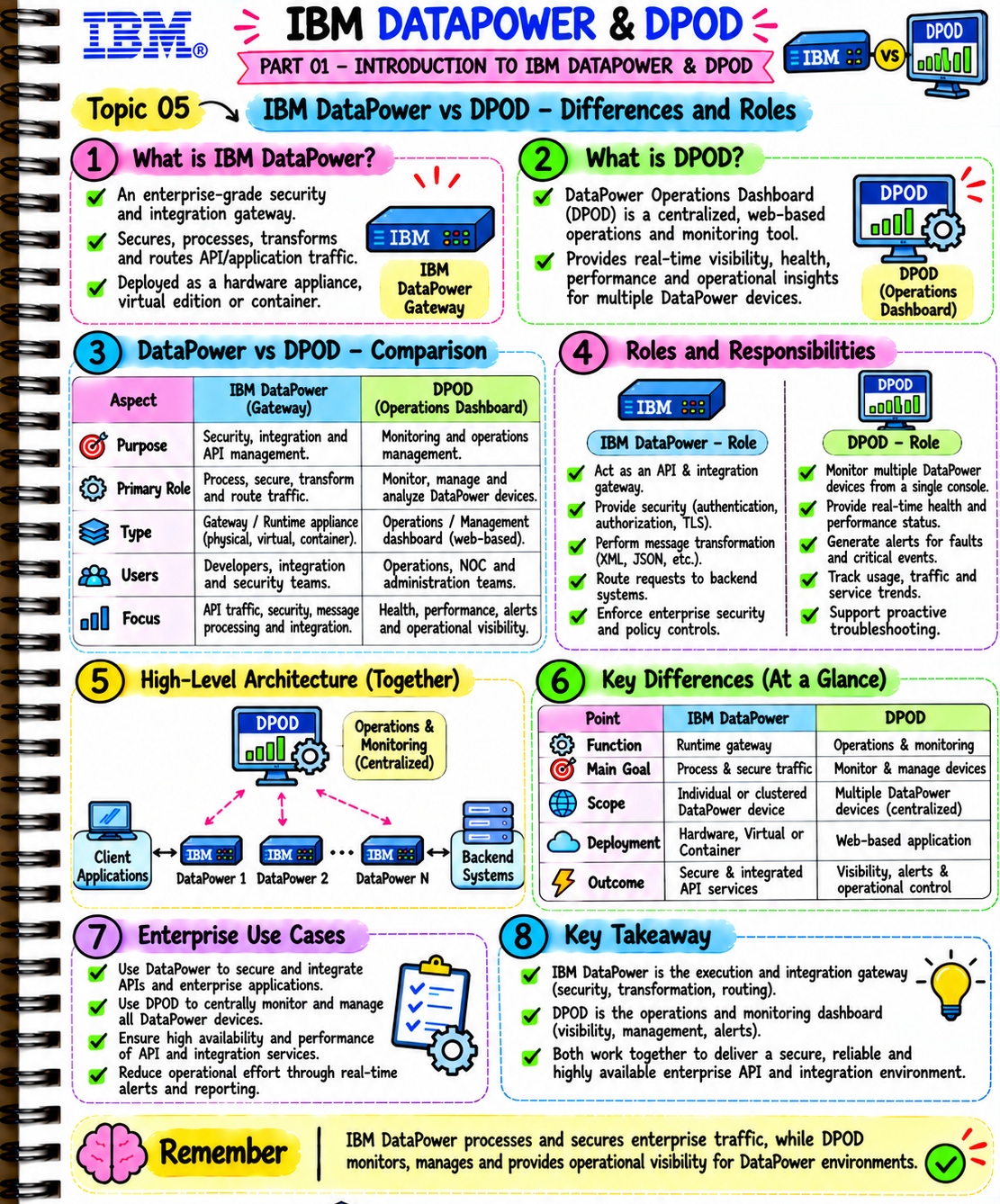
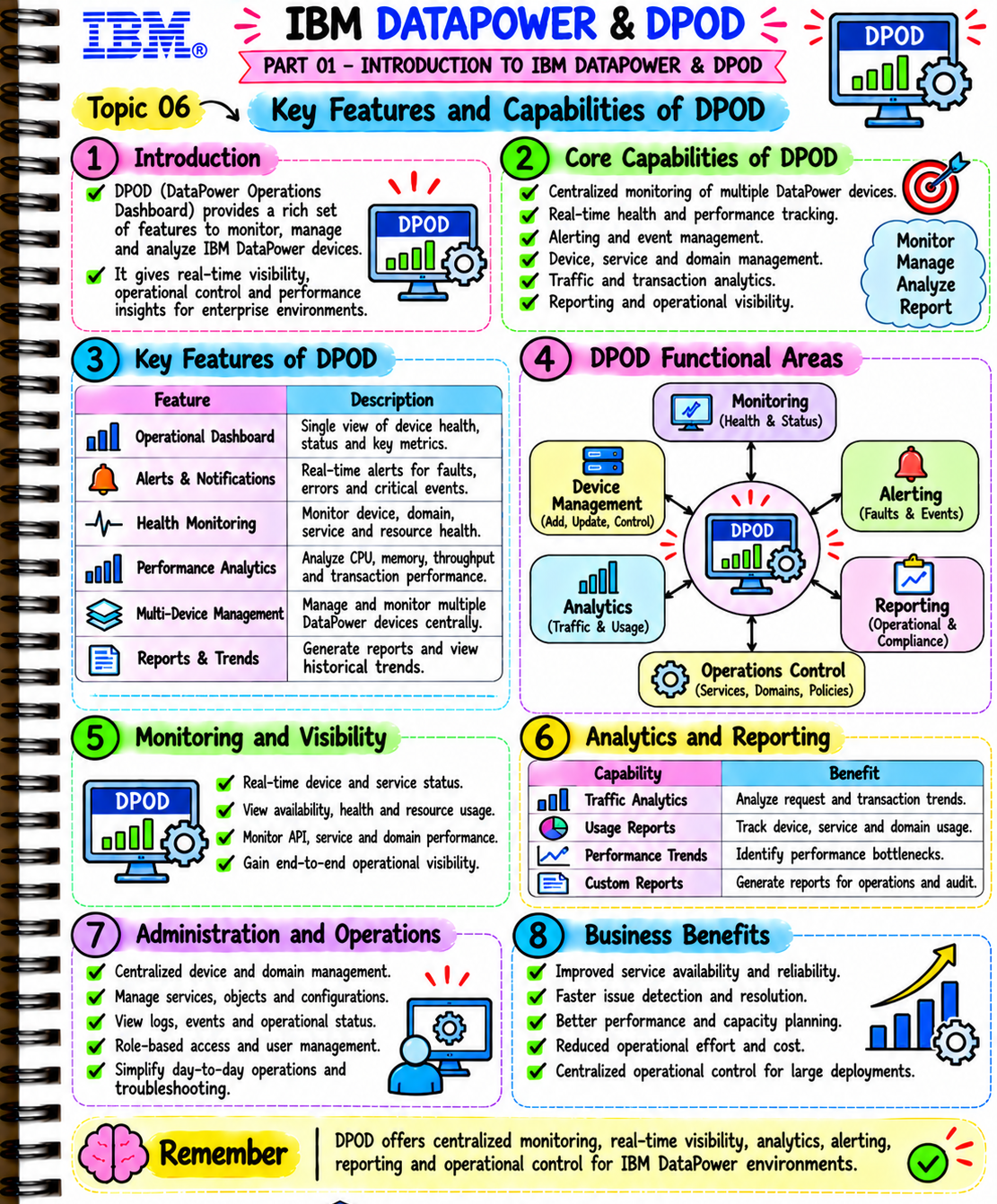
Understand the purpose of DataPower, its evolution, enterprise use cases, DPOD capabilities, operational terminology, and the differences between gateway administration and dashboard-based monitoring.
Key areas:
- IBM DataPower Gateway fundamentals
- Introduction to DataPower Operations Dashboard
- Enterprise gateway use cases
- DataPower and DPOD roles and responsibilities
- DPOD terminology and operational concepts
- DataPower in mainframe environments
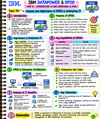
PART 02 — IBM Mainframe Fundamentals
Develop an understanding of IBM mainframe architecture and the technologies used in enterprise application environments.
Key areas:
- IBM Mainframe architecture
- IBM z/OS fundamentals
- Mainframe hardware and software components
- CICS Transaction Server
- IBM IMS
- IBM MQ messaging architecture
- Mainframe TCP/IP networking
- Application communication and transaction processing
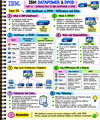
PART 03 — IBM DataPower Architecture
Explore the architecture and major components of IBM DataPower Gateway.
Understand how appliances, firmware, application domains, and different service types contribute to enterprise integration.
Key areas:
- DataPower Gateway architecture
- Physical and virtual appliances
- Hardware and logical components
- Firmware and software architecture
- Application domains
- DataPower services
- Multi-Protocol Gateway (MPGW)
- Web Service Proxy (WSP)
- XML Firewall and API Gateway
- High availability and clustering concepts
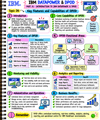
PART 04 — DPOD Architecture, Installation and Configuration
Understand DPOD architecture, deployment requirements, installation concepts, and initial configuration.
Learn how DataPower appliances are connected, registered, and monitored through DPOD.
Key areas:
- DPOD architecture and components
- Deployment architecture
- Server prerequisites and requirements
- Installation and initial configuration
- Database and data storage concepts
- DataPower appliance connectivity
- Device registration and onboarding
- User roles and access management
- Configuration validation and health checks
PART 05 — DPOD Dashboard and Monitoring
Learn how operational dashboards help teams monitor enterprise gateway environments.
Understand appliance health, infrastructure utilization, service performance, transaction activity, and operational metrics.
Key areas:
- DPOD interface and dashboard navigation
- System health monitoring
- DataPower appliance monitoring
- CPU and memory utilization
- Network interface monitoring
- Service-level monitoring
- Transaction volume and traffic analysis
- Response time and latency monitoring
- Dashboard reports and operational metrics
PART 06 — Transaction Analysis and Log Management
Develop an understanding of how transactions move through DataPower environments and how operational teams investigate failures.
Key areas:
- DataPower transaction processing
- Transaction monitoring and analysis
- Request and response flow
- Transaction identification and correlation
- Transaction search and filtering
- Log categories and severity levels
- Error and diagnostic logs
- Audit logs and system events
- Production log investigation
- Transaction failure analysis
PART 07 — IBM Mainframe Integration and Connectivity
Explore how IBM DataPower interacts with mainframe systems and enterprise backend applications.
Understand connectivity concepts, message formats, integration technologies, and end-to-end transaction flows.
Key areas:
- DataPower and IBM z/OS connectivity
- CICS integration
- IMS integration
- IBM MQ integration
- Backend connection configuration
- SSL/TLS communication
- SOAP and REST services
- XML and JSON message transformation
- Mainframe request and response analysis
- End-to-end connectivity troubleshooting
PART 08 — Production Support and Troubleshooting
Understand common enterprise middleware incidents and the troubleshooting process used by production support teams.
Key areas:
- DPOD production support responsibilities
- DataPower appliance availability issues
- Backend connectivity failures
- HTTP 4xx and 5xx errors
- Timeout and connection reset problems
- SSL certificate and handshake failures
- Authentication and authorization issues
- High CPU and memory utilization
- Slow transaction and performance issues
- Incident, problem, and change management
PART 09 — Advanced Operations and Security
Explore advanced monitoring, operational performance, resource planning, infrastructure security, and recovery concepts.
Key areas:
- Advanced DPOD monitoring
- Performance analysis and optimization
- Capacity and resource planning
- High availability and disaster recovery
- Advanced transaction troubleshooting
- DataPower security architecture
- Certificate and key management
- Role-based access control
- Security policies and monitoring alerts
- Maintenance, backup, and recovery
PART 10 — Practical Learning, Production Scenarios and Interview Preparation
Connect theoretical understanding with practical operational scenarios.
Explore dashboard monitoring, transaction statistics, failed transaction investigation, mainframe connectivity troubleshooting, and security-related incidents.
Practical learning areas:
- DPOD dashboard navigation
- DataPower appliance onboarding and monitoring
- Transaction statistics analysis
- Failed transaction investigation
- CICS connectivity troubleshooting
- IBM MQ connectivity troubleshooting
- SSL/TLS failure analysis
- Real-world production incident case studies
- DataPower and DPOD interview preparation
- Mainframe middleware operations workflow
WHO SHOULD READ THIS BOOK?
This guide is particularly useful for:
- IBM DataPower Administrators
- DPOD Monitoring Professionals
- Middleware Support Engineers
- Mainframe Operations Engineers
- Production Support Engineers
- Application Support Analysts
- IBM z/OS Learners
- CICS, IMS, and IBM MQ Support Professionals
- IT Graduates and Freshers interested in middleware
- Professionals preparing for enterprise IT operations roles
It is suitable for readers who want to understand the relationship between middleware platforms, mainframe applications, gateway operations, and production monitoring.
WHY CHOOSE DIGITAL STUDY NOTES?
A structured reference for enterprise middleware learning.
- Clear progression from fundamentals to advanced operations
- Dedicated coverage of DataPower Gateway and DPOD
- Mainframe architecture and integration concepts
- Monitoring and transaction analysis
- Production troubleshooting scenarios
- Infrastructure security and performance concepts
- Practical learning and operational workflows
- Interview preparation subjects
- Enterprise-focused technical knowledge
CAREER AND PROFESSIONAL APPLICATIONS
The concepts covered in this guide can help readers build knowledge relevant to roles such as:
IBM DataPower Support Engineer
Understand gateway architecture, appliance operations, service types, and connectivity concepts.
Middleware Support Engineer
Develop knowledge of enterprise integration, backend communication, transaction flows, and middleware troubleshooting.
Mainframe Production Support Engineer
Understand z/OS, CICS, IMS, IBM MQ, and their interactions with enterprise middleware.
Application Support Engineer
Develop skills in log investigation, transaction analysis, HTTP error troubleshooting, and application connectivity.
DPOD Monitoring Professional
Understand dashboard monitoring, appliance health, performance metrics, transaction statistics, and operational alerts.
RECOMMENDED LEARNING APPROACH
Follow the guide in a structured sequence:
UNDERSTAND — Learn IBM DataPower, DPOD, and mainframe fundamentals.
EXPLORE — Study architecture, services, deployment, and connectivity.
MONITOR — Understand dashboards, system health, and transactions.
ANALYZE — Investigate request/response flows, logs, and failures.
TROUBLESHOOT — Explore production incidents and backend connectivity problems.
ADVANCE — Strengthen your knowledge of performance, security, availability, and recovery.
PREPARE — Review practical scenarios and interview-related concepts.
PRODUCT DETAILS
Book Title: IBM DataPower Operations Dashboard (DPOD) — Master Guide
Publisher/Brand: Digital Study Notes
Subject: Enterprise Middleware and IBM Mainframe Operations
Learning Level: Basic to Advanced
Primary Technologies: IBM DataPower Gateway, DPOD, IBM z/OS, CICS, IMS, IBM MQ, SOAP, REST, XML, JSON, and SSL/TLS.
Main Focus Areas: Operations, Monitoring, Troubleshooting, Mainframe Integration, Production Support, and Security.
Format: Digital study material.
Planned Book Structure: Introduction, organized learning sections, technical explanations, diagrams, practical examples, learning exercises, interview preparation, glossary, and references, according to the final edition.
TAKE THE NEXT STEP IN YOUR ENTERPRISE IT JOURNEY
Understanding enterprise middleware requires more than knowing individual technologies. It requires understanding how gateways, backend applications, mainframe systems, transactions, monitoring platforms, and production support teams work together.
This guide helps you build that understanding through a structured approach to IBM DataPower, DPOD, and mainframe middleware operations.
LEARN → UNDERSTAND → MONITOR → ANALYZE → TROUBLESHOOT → ADVANCE
Get the IBM DataPower Operations Dashboard (DPOD) — Master Guide from Digital Study Notes and strengthen your enterprise middleware knowledge.
DIGITAL STUDY NOTES
Learn Today. Grow Tomorrow.
Thank you for supporting Digital Study Notes!
TECHNICAL SCOPE & IMPORTANT INFORMATION
- IBM DataPower Gateway administration and DPOD administration are treated as separate subjects.
- z/OS, CICS, IMS, and IBM MQ are discussed as mainframe technologies and integration subjects, not as DPOD components.
- DPOD functionality, installation procedures, interfaces, and monitoring capabilities may vary depending on the product version. Consult the relevant IBM documentation for version-specific procedures.
- This is an independent educational publication. It is not an official IBM publication and is not affiliated with or endorsed by IBM.
- This is a digital product; no physical book will be shipped.
- Please review the product details and included materials before purchasing.
- This guide supports professional learning and interview preparation but does not guarantee certification, employment, or job placement.