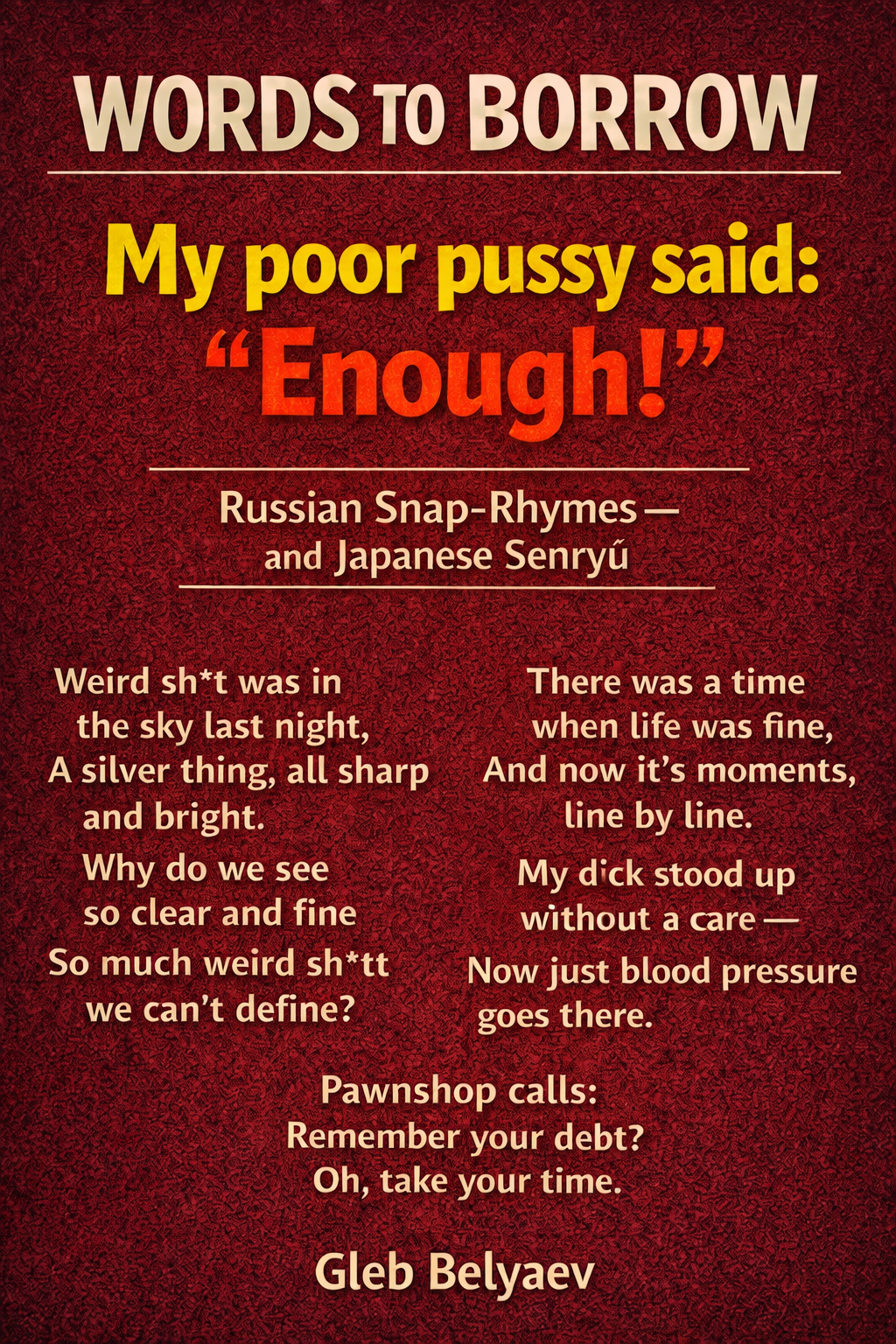
My poor pussy said: “Enough!”
Preface
This book, published as part of the Words To Borrow series, is fully aligned with the series’ mission: to help introduce into global circulation cultural gems capable of enriching virtually any culture, yet not nearly as widely known as they deserve to be.
In this book I present Russian chastushki and Japanese senryū.
Russian chastushki are a folk verse form that proved so well suited to its purpose that it spread to virtually every conceivable subject. However, by now, the only chastushki that remain truly alive and leave an indelible impression are those that discovered the perfect match between this verse form and the genres of sharp philosophical humour and satire, almost always laced with a powerful dose of absurdism and obscenity. These are precisely the chastushki I offer to the world for immediate adoption and the widest possible dissemination. For their global “branding” I have used the term snap-rhymes, though a simple transliteration may work just as well.
The search for analogues of the chastushka in other world cultures has met with rather modest success. On the one hand, there exists a comparable and very rich tradition of the limerick. On the other, that tradition is already widely known in the English-speaking world without any help from me.
Fortunately, I discovered Japanese senryū — and this layer of culture struck me as an excellent counterpart to Russian chastushki. I have selected a number of senryū for this book.
Senryū is a Japanese verse form structurally identical to haiku (three lines, 5-7-5 syllables), but fundamentally different in content: where haikuturns to nature and the moment, senryū turns to human beings and their weaknesses. The form is named after the poet Karai Senryū (18th century), who selected from the mass of verses submitted by the townspeople of Edo for poetry competitions precisely those that mocked human vices, foolishness, and everyday absurdity. In modern Japan, senryū remains a living and mass-participation genre: newspapers hold annual competitions that attract millions of submitted poems, and the best of them become household phrases. Outside Japan, senryū is incomparably less well known than haiku — and entirely undeservedly so.
Snap, Crack, and Gone: The Chastooshka, the Snap-Rhyme, and What Senryū Knows Too
Four lines that hit before you see them coming
Every culture has discovered, at some point, that four lines can do what a novel cannot. Get in fast, land hard, and leave before the reader has time to object.
The Russian chastooshka — or snap-rhyme, as we call it in translation — is a folk verse form, four lines, strict rhyme, no mercy. It emerged from village life somewhere in the nineteenth century and never stopped. Soviet collective farms, urban kitchens, the internet — the chastooshka survived them all, because what it does cannot be done any other way.
There was a time when life was fine,
And now it’s moments, line by line.
Even cat these days expects
Alimony from tomcats.
The chastooshka almost always works this way: the first two lines set a scene or a rhythm, and the last two detonate it. The reader doesn’t see the turn coming until it has already happened.
There was a time when life was fine,
And now it’s moments, line by line.
My dick stood up without a care —
Now just blood pressure goes there.
The chastooshka is often obscene. This is not incidental. In a culture where official speech was relentlessly sanitized, it occupied the space that no other form would enter. The obscenity was not decoration. It was precision.
Forty years and not one man —
I’ve bored them all to hell.
I’ll go and sit upon a fire
And burn my cunt as well.
The chastooshka almost never explains itself. It trusts the listener completely.
Weird shit was in the sky last night,
A silver thing, all sharp and bright.
Why do we see so clear and fine
So much weird shit we can’t define?
On the other side of the world, the Japanese senryū arrived at something similar by a different road.
Senryū looks like haiku — three lines, the same syllable structure. But where haiku reaches for the transcendent moment in nature, senryū finds poetry where poetry isn’t supposed to be.
That’s it — divorce!
She hears him out,
sits there and smokes.
The bachelor —
eats off yesterday’s paper.
Tastes fine to him.
The chastooshka and the senryū did not know about each other. They emerged from different continents, different centuries, different social worlds. But they share something that may be more fundamental than influence: the understanding that the shortest distance to truth is not explanation but image, and that four lines — or three — are enough, if you choose them correctly.
Both forms are alive. Both are still being written. Both are waiting, as they always have been, for a global audience.