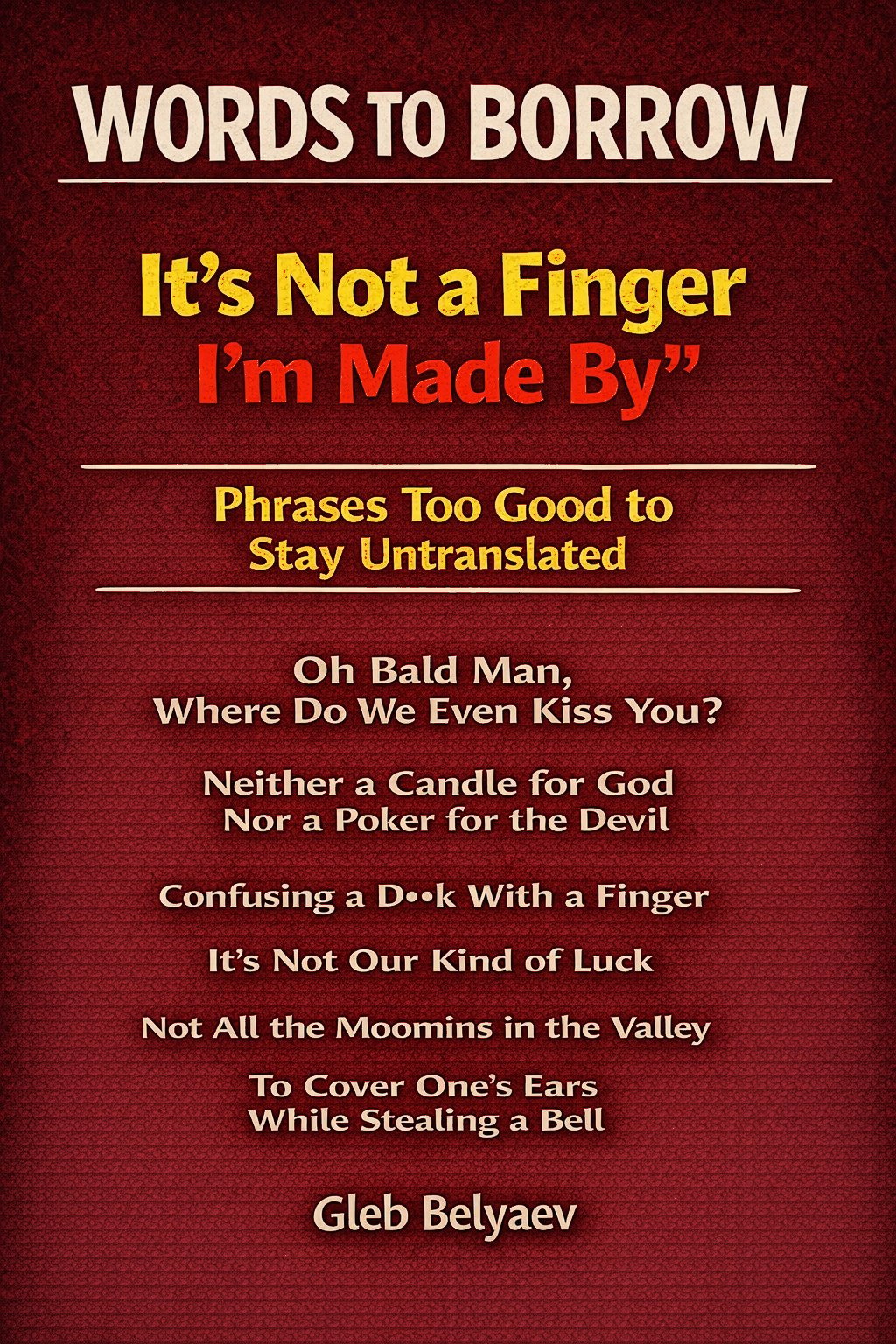
“It’s Not a Finger I’m Made By”. Phrases Too Good to Stay Untranslated
Introduction
Every language holds expressions where experience, sharp observation, and precision of wording are compressed into just a few words. Many such expressions have already achieved worldwide recognition — but far more remain locked inside their languages of origin, despite deserving a global fate.
This book gathers such expressions from different languages and cultures — Russian, Chinese, Persian, Turkish, Georgian, and others. Each entry includes a translation, an explanation of how it works and what cultural context it carries, and an assessment of its potential to enter worldwide use.
"As Needed As a Gate on a…"
In English, if you want to say something is spectacularly useless, you have plenty of options. As useful as a screen door on a submarine. As useful as a chocolate teapot. As useful as tits on a bull. The formula is simple: pair two things that have no business being together. German does it too: das fünfte Rad am Wagen — the fifth wheel on the wagon. French: la cinquième roue du carrosse — the fifth wheel on the carriage. Yiddish gave English one of its best: ich darf es vi a loch in kop — I need it like a hole in the head. And the feminist slogan "A woman needs a man like a fish needs a bicycle" — coined by Irina Dunn in 1970 and popularized by Gloria Steinem — is built on the same logic.
Russian has its own rich collection:
Нужен как собаке пятая нога. Needed like a dog needs a fifth leg.
Нужен как козе баян. Needed like a goat needs an accordion.
Нужен как рыбе зонтик. Needed like a fish needs an umbrella.
Нужен как попу гармонь. Needed like a priest needs a concertina.
And the most famous, unprintable one — which pairs a body part with a small garden gate, and which we will leave to the reader's imagination and Google Translate.
What makes the Russian versions distinctive is not the logic — the logic is the same everywhere. It's the sound. Many of these pairings exist not just because the images are absurd, but because the words sound good together. Козе — баян. Попу — гармонь. Рыбе — зонтик. The pairs are chosen as much for their melody as for their meaning. The vowels rhyme, the rhythms match, the phrase rolls off the tongue like a small song. In English, German, or French, the humour lives entirely in the image — the absurdity of the mismatch. In Russian, it lives in the image and in the music.
And yet — the Russian phrases survive translation surprisingly well. Because sometimes the pairing is simply brilliant on its own terms. A dog and a fifth leg. A goat and an accordion. A fish and an umbrella. Each one creates a tiny cartoon in the listener's mind, in any language. You don't need the original melody to see the goat staring blankly at the accordion.
And the unprintable one? It works in translation too — perhaps even better, because the reader who looks it up will discover that the pairing is not just vulgar but precise: the gate implies an opening that needs to be fenced off, which is exactly what the body part in question does not need. The image is architecturally perfect.
Oh Bald Man, Where Do We Even Kiss You?
A Levantine Arabic proverb. A person stands before a bald man and does not know where to plant a kiss. Not because the bald man is unattractive—but because there are too many equally valid spots on his head. Hair is markup: here is the forehead, here is the crown, here is the back. Remove the hair and the entire surface becomes one continuous space without landmarks. The kisser is lost not because there is nothing to kiss, but because everything can be kissed—and no single point is better than any other.
The proverb is applied to a person who is impossible to please. Not someone capricious—but someone who has no hierarchy of desires, no point of entry, no “start here.” Whatever you offer is no worse and no better than any other option, which means that choice itself becomes impossible. The bald man does not push you away—he simply gives you nothing to latch onto.
This is a subtle and unexpected mechanism. Usually a difficult person is one who wants too much, or wants contradictory things, or keeps changing the requirements. The Arabic proverb describes a different type: a person whose preference structure is absent. He is not being fussy or picky—he is simply built in such a way that you cannot find which side to approach him from. The problem is not him—the problem is the absence of navigation.
The English “there’s no pleasing you” is the standard dictionary equivalent, but it describes the result, not the mechanism. You cannot please him—full stop. Why—unknown. Perhaps the person is difficult. Perhaps his expectations are too high. The Arabic proverb explains why: because he has no borders between zones, no hairline to tell you “the forehead is here.”
A Jew Is 28% Fear, 2% Sugar, and 70% Chutzpah
A Yiddish formula — not a proverb in the usual sense. More of a self-diagnosis. A people who spent centuries living on someone else's territory, under someone else's laws, among someone else's majorities, described themselves in three ingredients.
Fear — 28%. Not cowardice, but vigilance. A constant scanning of the environment: who is in power, what is the mood, where might the blow come from. Twenty-eight percent is not panic. It is the background mode of survival.
Sugar — 2%. I cannot claim to know exactly what this means. Even though I was raised by three Jewish grandmothers simultaneously. If it refers to how one treats people, then it was precisely my grandmothers that the neighbours always came to when they needed help and a kind word. Most likely, these two percent are a sober assessment of how much "sugar" the Jews received during their wanderings across the world.
Chutzpah — 70%. The overwhelming part. Chutzpah is a word that entered English long ago, but entered it imprecisely. In American English, chutzpah usually means audacity, nerve, gall — and is perceived rather positively: the courage to assert yourself, to demand what is yours. In Yiddish, khutspe is more complex. It is audacity that can be both admirable and outrageous. The classic example from the Talmud: a man who murders his parents and then asks the court for leniency as an orphan — that is khutspe.
The formula works because the proportions are precise. Not "a lot of fear, a little sweetness, a lot of nerve" — but specific numbers. Twenty-eight. Two. Seventy. The pseudo-scientific precision gives the self-irony the weight of a laboratory report. It is a joke pretending to be a chemical analysis.
English has no comparable formula for collective self-description. There are individual self-ironic clichés — stiff upper lip for the British, can-do attitude for Americans — but these are labels, not recipes. They describe a single quality, not a ratio of several. No one has ever said: "An Englishman is 40% stubbornness, 3% emotion, and 57% tea."
What makes the Yiddish formula unique is its mathematical form. Proverbs usually work in images: animals, objects, actions. This one works in numbers. And the numbers are not round — which makes them funnier and more convincing. Twenty-eight percent fear is neither "a lot" nor "a little." It has been measured. By someone. At some point. With a precision that is itself an act of chutzpah.