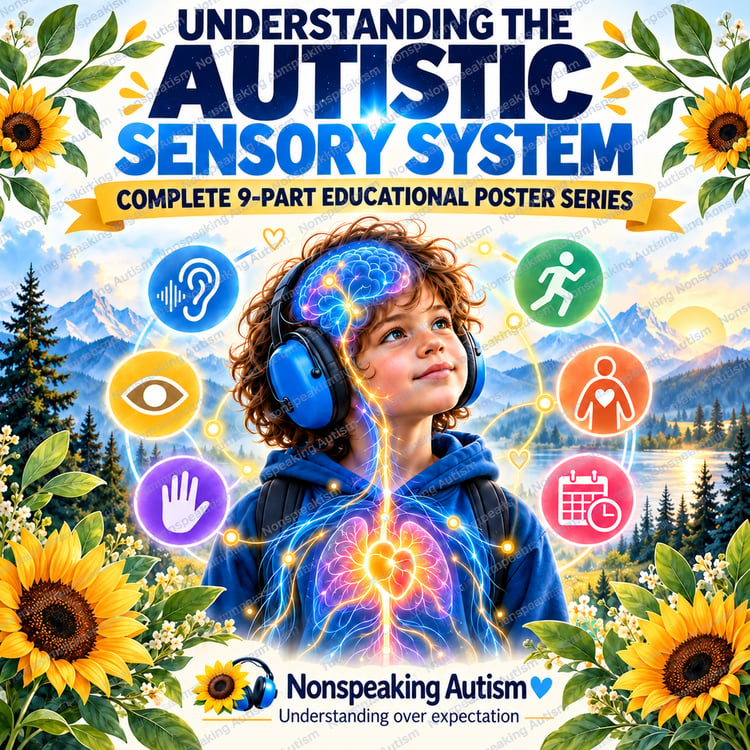

The Science Behind Social Sensitivities
The Science Behind Social Sensitivities
Why social situations may feel overwhelming for some autistic and AuDHD people — and how environments and communication can be made more accessible.
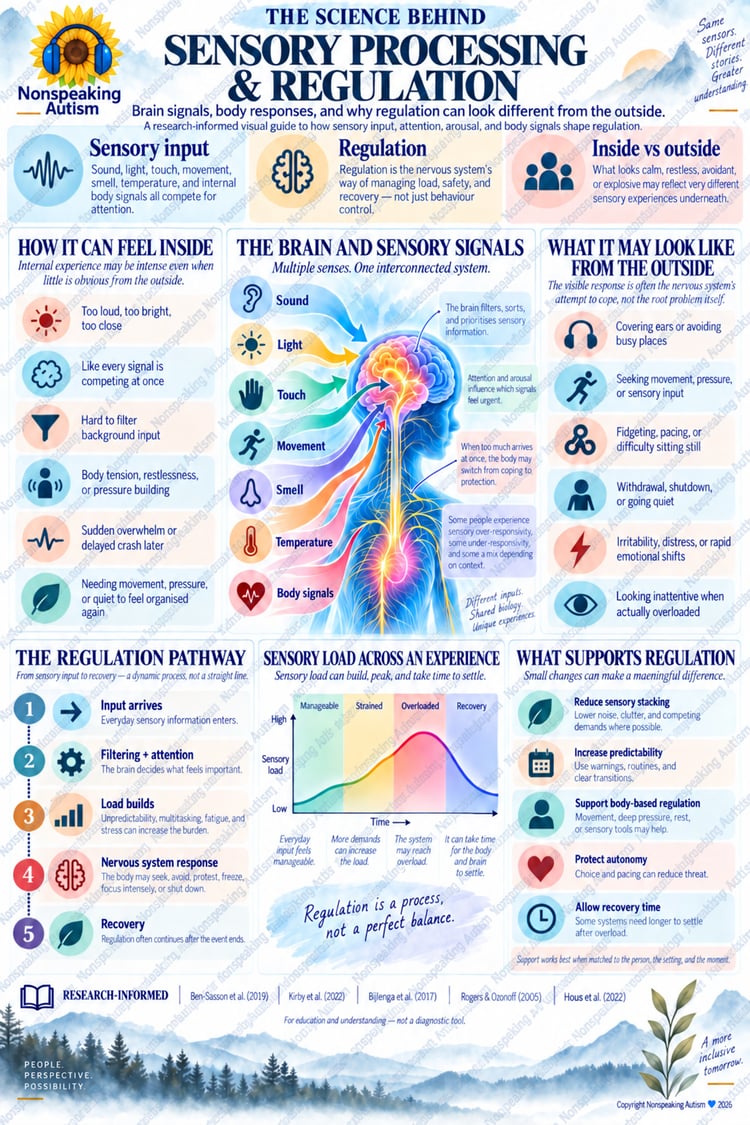
Social situations are not “just social.” They can involve noise, movement, unpredictable conversation, facial expressions, body language, unfamiliar people, rapid processing, uncertainty and sensory input — all happening at once.
For some autistic and AuDHD people, that combination can create a significant processing and regulation load. What looks from the outside like withdrawal, anxiety, avoidance, silence or difficulty joining in may reflect a person trying to manage sensory, cognitive, communication and emotional demands simultaneously.
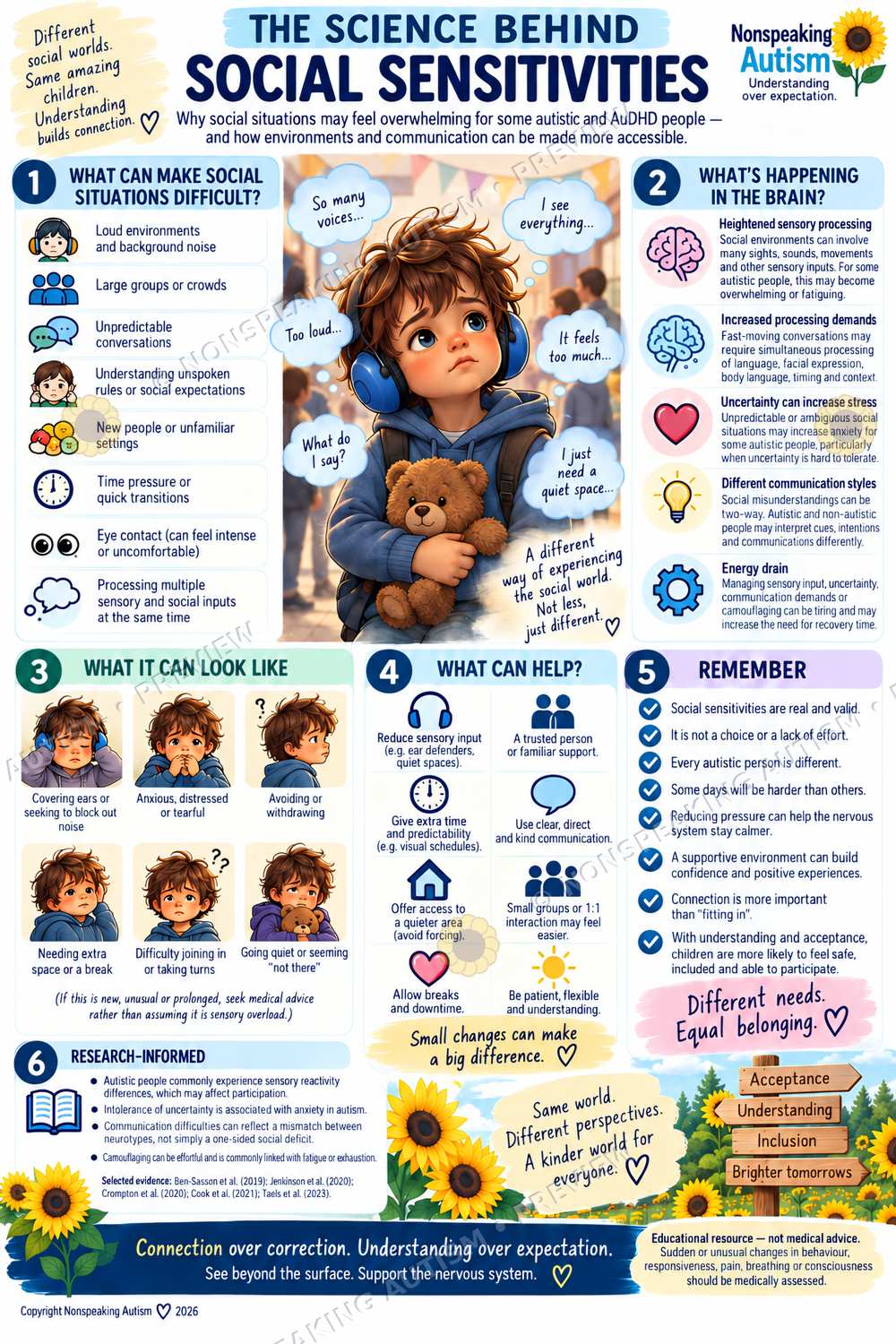
The Science Behind Social Sensitivities is a compassionate, research-informed educational poster designed to help families, educators and professionals look beyond outward behaviour and consider what the nervous system may be managing underneath.
The central message is simple:
A different way of experiencing the social world. Not less — just different.
🧠 What This Poster Explores
This visual resource brings together several factors that can influence social participation, including:
- sensory overload in noisy, busy or crowded environments
- unpredictable conversations and unfamiliar situations
- difficulty processing several social and sensory inputs at once
- eye contact that may feel intense or uncomfortable
- increased processing demands during fast-moving interactions
- uncertainty and its relationship with anxiety
- differences in autistic and non-autistic communication styles
- the energy cost of social monitoring and camouflaging
- what social overwhelm may look like from the outside
- practical ways adults can reduce pressure and improve accessibility
Rather than asking only, “Why aren’t they joining in?”, the poster encourages a more useful question:
“What might be making this environment difficult to access?”
🌻 What Can Make Social Situations Difficult?
A social environment can place many demands on a person at the same time.
Busy classrooms, parties, playgrounds, family gatherings, clubs, shops and community spaces may include multiple voices, background noise, movement, smells, visual activity and unpredictable interactions.
At the same time, a person may be expected to work out when to speak, interpret another person's intentions, follow rapidly changing conversations, respond quickly and manage their own sensory and emotional state.
Research consistently identifies sensory-reactivity differences as common in autism, although individual sensory profiles vary considerably.
This means social participation cannot always be understood separately from sensory access and regulation.
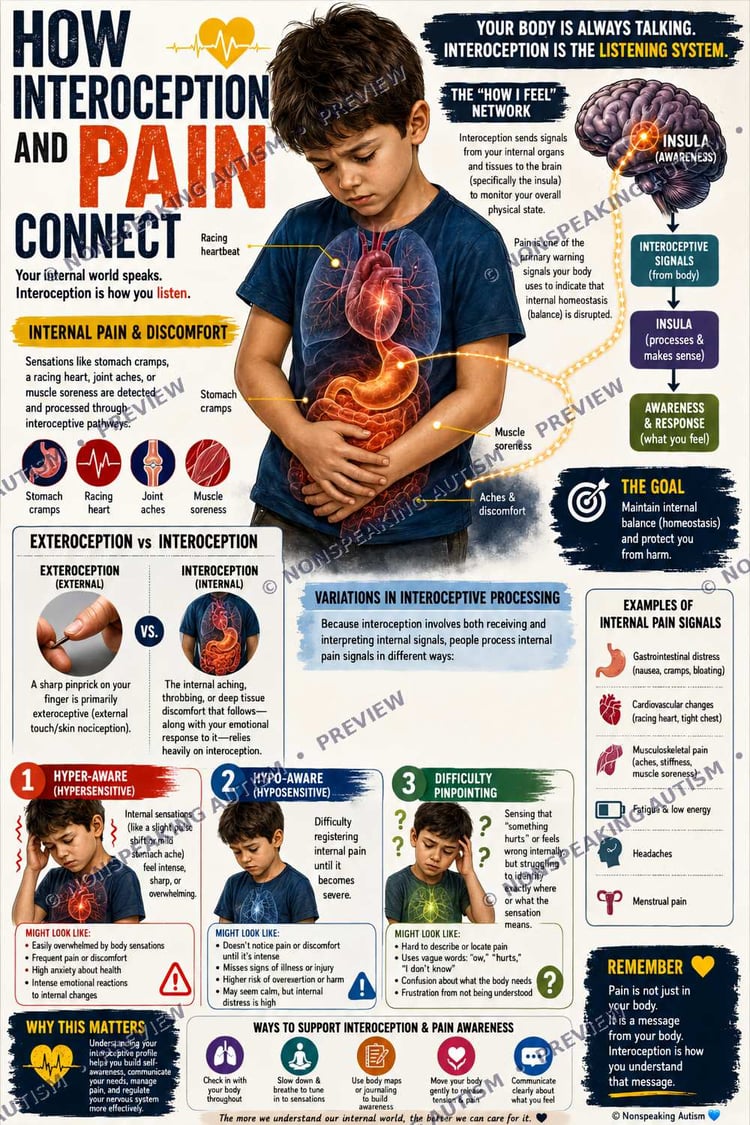
🧠 What May Be Happening Underneath?
The poster introduces five important areas to consider.
Heightened sensory processing: Social spaces can contain many competing sensory inputs. For some people, these may become distracting, exhausting or overwhelming.
Increased processing demands: Conversations may require simultaneous processing of spoken language, facial expression, gesture, timing, context and environmental information.
Uncertainty: Not knowing what will happen, what someone means or what response is expected can increase stress. Research has found a substantial association between intolerance of uncertainty and anxiety in autistic populations, although experiences vary between individuals.
Different communication styles: Communication difficulty is not necessarily one-sided. Research examining autistic and non-autistic interactions supports the idea that differences in communication style and neurotype can contribute to mutual misunderstanding.
Energy drain: Continually managing sensory input, social expectations, uncertainty, communication demands or camouflaging can require considerable effort.
💙 What Social Overwhelm Can Look Like
A child or young person experiencing too much social or sensory demand might:
- cover their ears or try to block out noise
- appear anxious, distressed or tearful
- avoid or withdraw from interaction
- need additional personal space
- struggle to join in or take turns
- become quieter or temporarily communicate less
- seek a familiar person or comforting object
- need substantial downtime after social situations
These responses should not automatically be interpreted as rudeness, unwillingness, poor behaviour or lack of interest in other people.
Equally, not every instance of withdrawal or distress is caused by autism or sensory overload. New, severe, prolonged or unusual changes should be considered carefully, including possible physical or mental-health causes where appropriate.
🤝 What Can Help?
Support does not have to mean forcing someone to tolerate increasingly overwhelming situations.
Small environmental and communication changes can sometimes make participation far more accessible.
Helpful approaches may include reducing unnecessary sensory input, providing access to quieter spaces, allowing ear defenders or other preferred sensory supports, offering additional processing time, making routines more predictable, using visual information where helpful, allowing breaks and downtime, and communicating clearly without unnecessary pressure.
A trusted person or familiar support can also make unfamiliar situations easier to navigate.
For some people, smaller groups or one-to-one interaction may be more accessible than large-group social environments.
The aim is not to make someone appear more socially typical.
The aim is to create conditions in which they can communicate, participate and connect in ways that work for them.
♾️ Different Communication Does Not Mean Less Communication
One of the most important ideas behind this resource is that autistic communication should not automatically be measured against non-autistic social norms.
Research by Crompton and colleagues found that information transfer between autistic people could be highly effective, while mixed autistic–non-autistic interactions showed more communication friction. Related research also found that interpersonal rapport was influenced by whether interaction partners shared the same neurotype.
This supports a broader understanding of social communication:
Sometimes the difficulty is not simply located within one person. It can arise from a mismatch between different ways of communicating and interpreting the world.
That shifts the focus from “fixing” autistic social behaviour toward building mutual understanding and accessible communication.
🌿 Social Camouflaging & Recovery Time
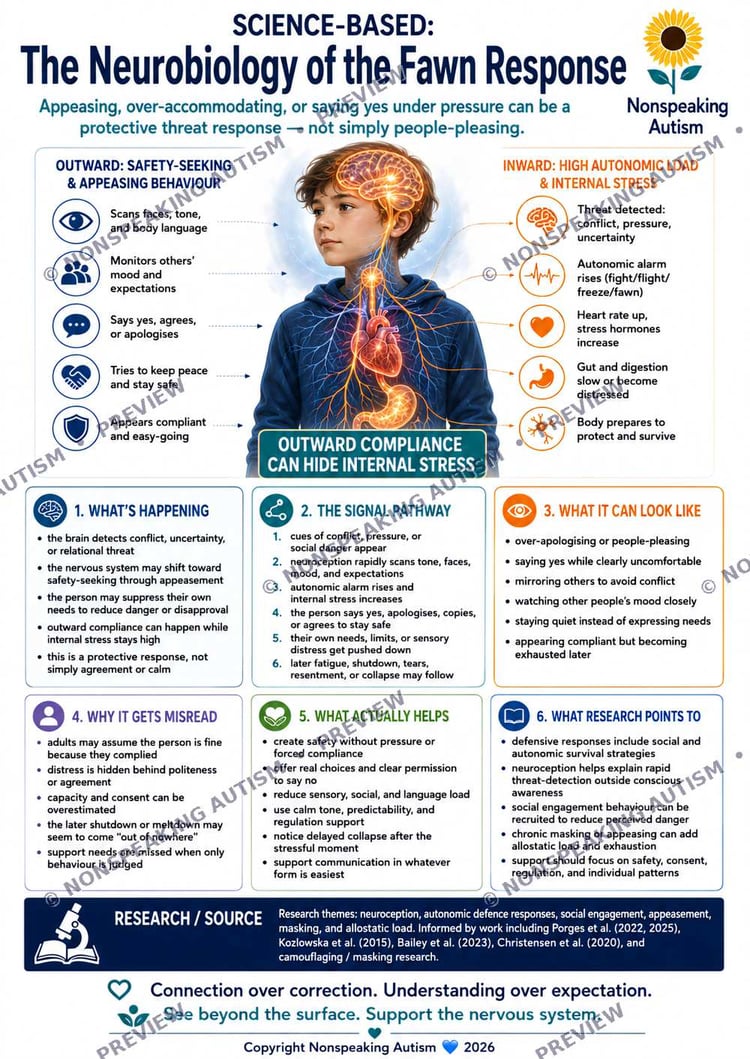
Some autistic people learn to consciously or unconsciously monitor their behaviour in social environments — for example, rehearsing conversations, suppressing natural movements, copying expected social behaviour or carefully managing facial expressions and responses.
This is often described as camouflaging or masking.
A systematic review found that camouflaging is a complex phenomenon and that greater self-reported camouflaging has been associated with poorer mental-health outcomes, while also noting important limitations in the evidence base.
Someone therefore may appear to have managed a social situation successfully while still requiring significant recovery time afterwards.
Looking calm does not necessarily tell us how much effort the situation required.
🔬 Research-Informed
This resource is informed by research across sensory processing, uncertainty, autistic communication and camouflaging.
Selected evidence includes:
Ben-Sasson, A., Gal, E., Fluss, R., Katz-Zetler, N., & Cermak, S. A. (2019). Update of a Meta-analysis of Sensory Symptoms in ASD: A New Decade of Research. Journal of Autism and Developmental Disorders, 49, 4974–4996.
Jenkinson, R., Milne, E., & Thompson, A. (2020). The relationship between intolerance of uncertainty and anxiety in autism: A systematic literature review and meta-analysis. Autism, 24(8), 1933–1944.
Crompton, C. J., Ropar, D., Evans-Williams, C. V. M., Flynn, E. G., & Fletcher-Watson, S. (2020). Autistic peer-to-peer information transfer is highly effective. Autism, 24(7).
Crompton, C. J., Sharp, M., Axbey, H., Fletcher-Watson, S., Flynn, E. G., & Ropar, D. (2020). Neurotype-Matching, but Not Being Autistic, Influences Self and Observer Ratings of Interpersonal Rapport. Frontiers in Psychology, 11, 586171.
Cook, J., Hull, L., Crane, L., & Mandy, W. (2021). Camouflaging in autism: A systematic review. Clinical Psychology Review, 89, 102080.
Research describes group-level patterns and associations; it does not mean every autistic or AuDHD person will experience social situations in the same way.
👨👩👧 Who Is This Resource For?
This poster may be particularly useful for:
- parents and carers
- autistic and AuDHD children, young people and their families
- teachers and teaching assistants
- SEN/SEND and special-education teams
- school inclusion and pastoral staff
- occupational therapists
- speech and language therapists
- psychologists and allied-health professionals
- support workers and family-support services
- autism and neurodiversity training
- classrooms, clinics, therapy spaces and family resource areas
It can be used as a conversation starter, staff-training visual, family education resource or supportive reference when discussing social accessibility.
📦 What You Receive
Your purchase includes:
1 × The Science Behind Social Sensitivities educational poster
1 × high-resolution PDF
The purchased version is supplied clear and without the promotional preview watermark. Watermarks visible on Payhip listing images are used for preview and copyright-protection purposes.
This is a digital educational resource from Nonspeaking Autism.
Digital download only — no physical product will be shipped.
⚠️ Important Educational & Medical Disclaimer
This resource is provided for educational and informational purposes only.
It is not medical advice, a diagnostic tool, an individual sensory assessment, psychological assessment, treatment plan or substitute for personalised advice from appropriately qualified health, education or therapy professionals.
Autistic and AuDHD people are highly diverse. A person may experience some, many or none of the examples shown on the poster, and similar behaviours can occur for many different reasons.
The terms used in this resource are intended to make complex ideas accessible and should not be interpreted as claiming that one single neurological mechanism explains every person's social experience.
Never assume that a sudden or significant change in behaviour, responsiveness, communication or participation is “just autism” or sensory overload. New, unusual, severe or prolonged changes — particularly those involving pain, breathing, consciousness, responsiveness or significant distress — should receive appropriate professional or medical assessment.
💛 The Message Behind the Resource
Social participation should not require a person to constantly override their nervous system simply to appear as though they are coping.
Sometimes greater inclusion begins with something much simpler:
less noise,
less pressure,
more processing time,
clearer communication,
greater predictability,
and permission to participate differently.
Different people will need different things — and those needs can change from one day or environment to another.
Different needs. Equal belonging.
Same world. Different perspectives. A kinder world for everyone.
Connection over correction. Understanding over expectation.
See beyond the surface. Support the nervous system.
© Copyright & Permitted Use
Copyright © 2026 Nonspeaking Autism. All rights reserved.
Purchase permits use of this resource for personal, home, classroom, school, clinic or individual professional educational use.
The digital file may not be resold, redistributed, shared as a downloadable file, uploaded to other websites or platforms, commercially reproduced, altered for resale, or incorporated into another product for sale without permission.