
Course 3: Editing and Quality Checks (Book Editing and Proofreading, UK and US) (PDF Guide)
A 32-page printable PDF guide for UK and US self-publishers about to pay for editing: the six kinds of book editing, which one you need, 2026 UK (CIEP) and US (EFA) rate guides, and how to check proofs before you publish.
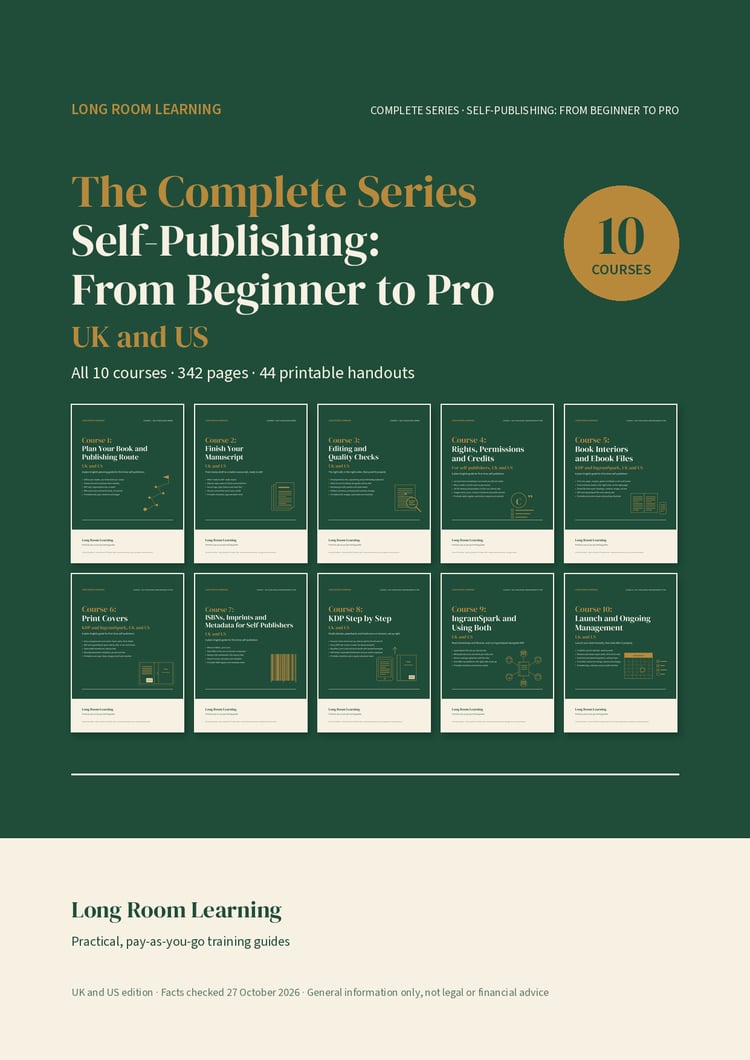
It is part of Self-Publishing: From Beginner to Pro, a ten-course series of printable PDF guides from Long Room Learning. Written in plain UK English with UK and US rules side by side. Facts, prices and platform rules were checked on the official websites on 27 October 2026.
What you'll learn
- The six kinds of editing side by side (manuscript assessment, developmental, structural, line editing, copyediting, proofreading) and the order to do them in
- Which kind of edit fixes which problem
- Briefing an editor and budgeting, with the CIEP's suggested minimum rates from 1 March 2026 and the EFA's 2026 rate chart, plus worked examples
- Reviewing an edit: tracked changes, queries and the style sheet
- When to use sensitivity readers, authenticity readers and fact-checkers
- Proofreading versus copyediting, and how to mark corrections
- The final author check, ebook previews, KDP proof copies and IngramSpark eProofs
- Why late changes cost more: the ripple from pagination to spine width and price
UK and US at a glance, mistakes to avoid, a glossary and six printable handouts
Who it's for
First-time self-publishers in the UK or the US who are about to pay for editing, or do some of it themselves, and want the right kind of help in the right order.
Who it's not for
It does not cover typesetting a book or building an ebook (Course 5), cover design (Course 6) or clearing permissions (Course 4). It is not a directory of editors and does not recommend any editor or firm.
Common questions
What is the difference between developmental editing, line editing, copyediting and proofreading?
They are separate jobs that fix different problems: developmental and structural editing deal with the story or argument and structure, line editing with sentences, copyediting with correctness and consistency against a style sheet, and proofreading is the final check of words and layout after typesetting. Paying for one does not get you the others. Course 3 sets them out side by side.
How much does a copyeditor cost in the UK?
As a benchmark, the Chartered Institute of Editing and Proofreading's suggested minimum hourly rates from 1 March 2026 are £31.92 for proofreading, £37.11 for copyediting and £42.66 for substantial or development editing. These are minimums, not prices: many editors charge more. Course 3 also gives the EFA's 2026 US rate chart and worked budget examples.
What order should my book be edited in?
Big to small: story or argument first, then structure, then sentences, then consistency and correctness, and proofreading last, after layout. A proofread cannot rescue a book whose structure does not work.
Do I still need a proofreader after a copyedit?
Proofreading is a different job: it comes after layout and checks the designed pages, where new errors appear (missing lines, bad breaks, wrong headers). Course 3 explains what a proofreader does and does not do.
How do I check a KDP proof copy or an IngramSpark eProof?
Confirm each correction was made correctly, then inspect the files in the platform's previewer and order a printed proof. Record every correction round and approval with dates. Course 3 includes a proofreading checklist and a corrections and approvals record.
What you get
An instant-download A4 PDF (32 pages) to read on screen or print, plus six printable handouts: editing plan and editor brief, style sheet, edit budget estimator, author review query log, proofreading checklist, and corrections and approvals record.
Digital download (PDF). General information only; not legal or financial advice. Rate guides are benchmarks, not prices; editors set their own fees. Rates and rules were checked on the official websites on 27 October 2026 and can change at any time. Long Room Learning is independent and not affiliated with or endorsed by the Chartered Institute of Editing and Proofreading, the Editorial Freelancers Association, the Society of Indexers, BSI, Amazon, Kindle Direct Publishing, IngramSpark or any other organisation named. No product or service is endorsed.