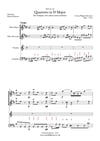
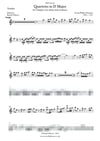
Georg Philipp Telemann - Quartetto in D Major - TWV 43: D7
Quartetto in D Major for trumpet, two oboes and continuo (TWV 43: D7)
I. Largo
II. Vivace
III. Siciliano
IV. Vivace
'Since the best man could not be obtained, mediocre ones would have to be accepted'
Above: the announcement that J S Bach would be appointed as Cantor of the Thomaskirche in 1723 made by City Councillor Platz of Leipzig.
When Platz mentioned the 'best man' he was referring to Georg Philipp Telemann—the most highly regarded composer in Germany at the time. Telemann declined the position in Leipzig after using the offer to secure a pay raise for his position in Hamburg. It is in Hamburg, between 1720 and 1730, that this piece was composed. Very few further details are known about the origin of this work or when it was originally performed. The original manuscript score survives in the Sächsische Landesbibliothek Staats- und Universitätsbibliothek in Dresden.
The Largo is a rhetorical exchange between the oboes and the trumpet. The oboes play exceptionally lyrically only to be interrupted by the trumpet, which seems to be asserting its role as a signalling instrument from the battlefield. The movement ends as it began with a hint of reflective introspection. The Vivace is a lively march-style fugue. The trumpet occasionally co-operates with the oboes in the passage-work and on other occasions it reverts to its more traditional role of sounding the arpeggio of D major in the low (principalé) register. The Siciliano is calmer in spirit, which runs without interruption from the trumpet. The movement contains a beautiful section of sequential dissonances. The final Vivace is a rhetorical dance with a celebratory feel.
Programme Notes © Russell Gilmour 2011
Parts:
Critical Commentary, Score, Oboe Primo, Oboe Secondo, Tromba [Trumpet in D], Cembalo [Basso Continuo]
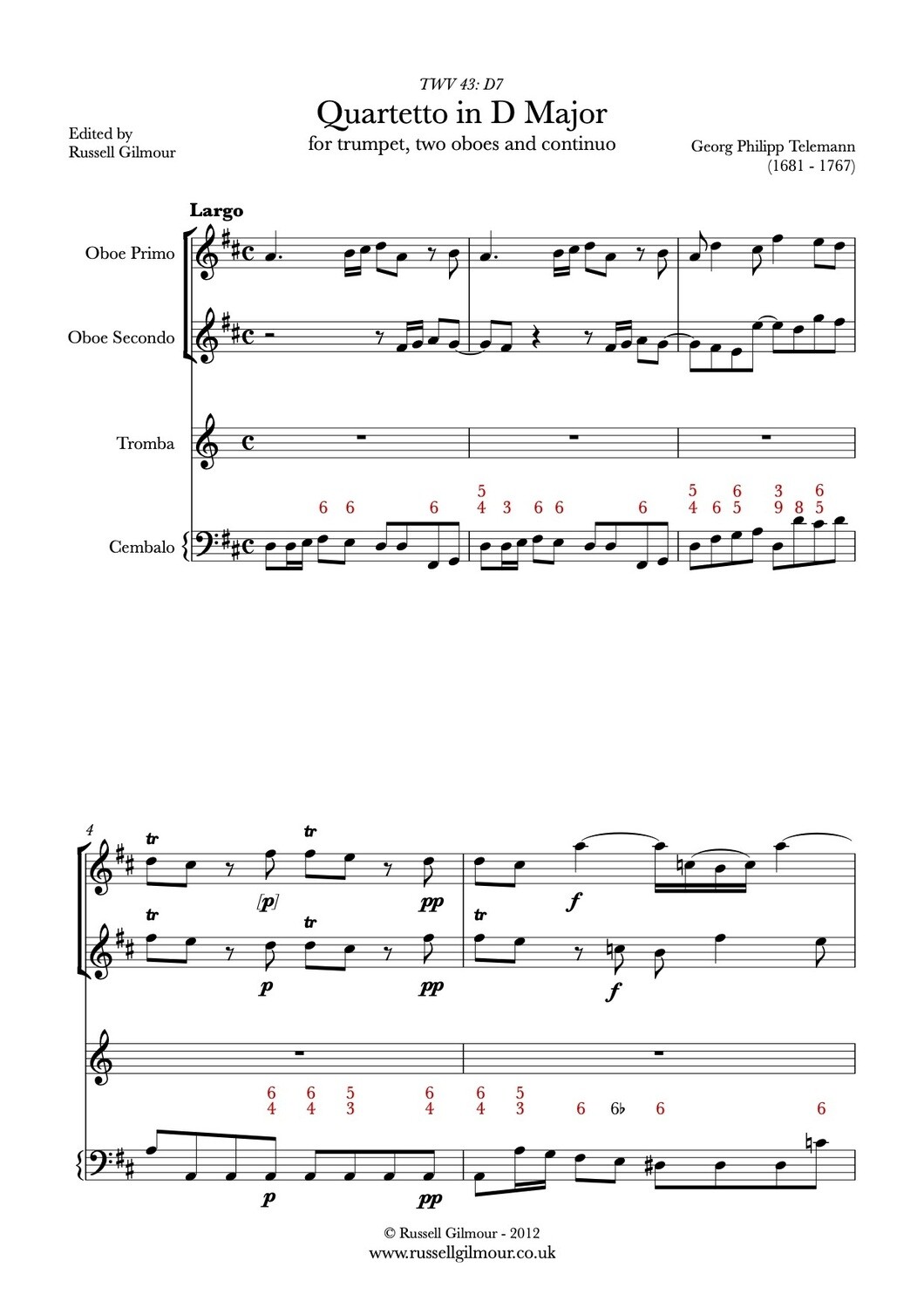
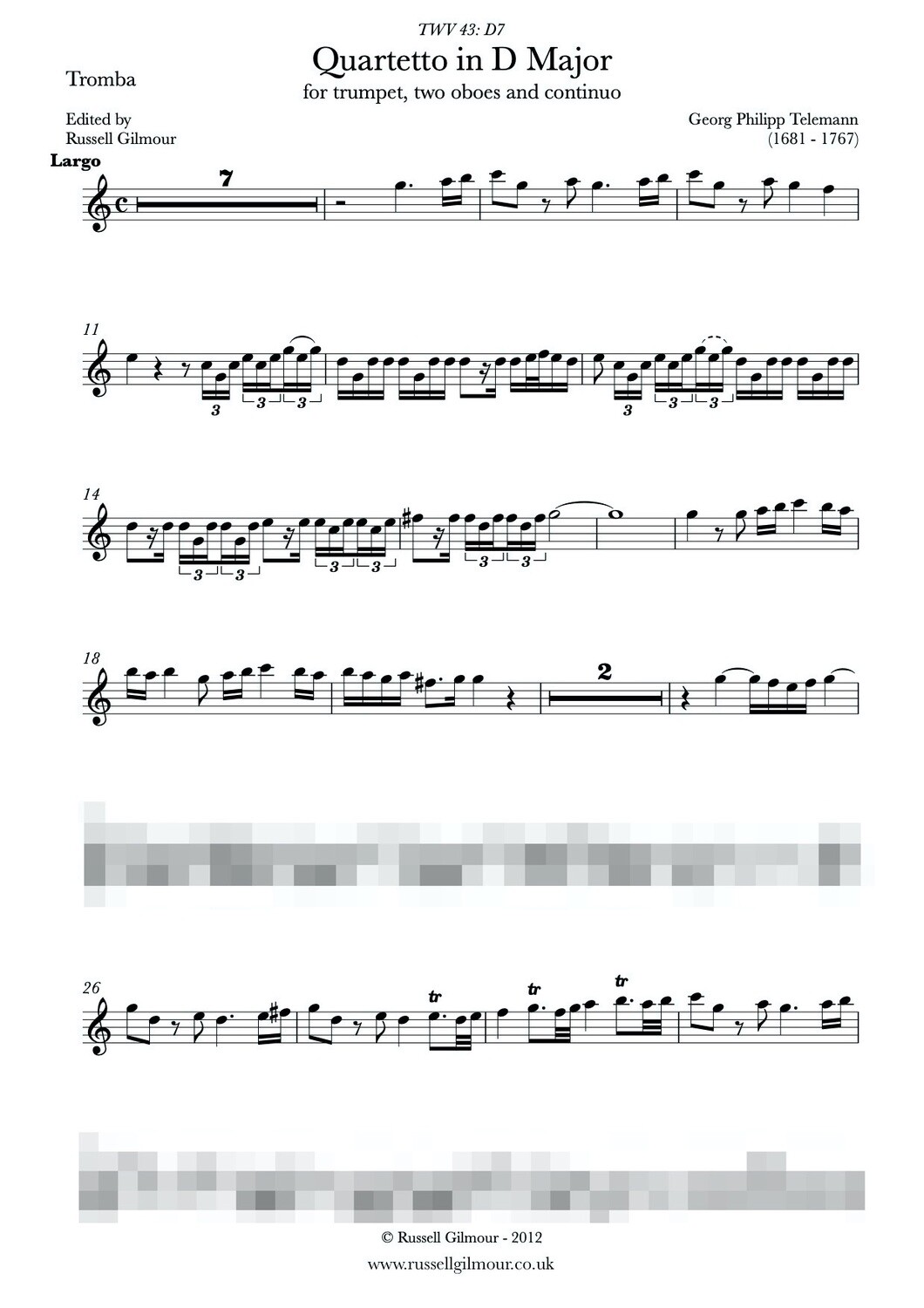
Telemann’s original parts are highly legible and exceptionally neat. However, they are quite difficult to read from in a performance situation as the facsimile (unless printed in high resolution and in colour) is not easily viewable because the background is not white. There is also no original score (nor bar numbers or rehearsal markings) which can make rehearsing from the manuscript a painstaking affair. The present edition was undertaken as a personal project, primarily to familiarise myself with this work and to attempt to make a clear edition with standardised bar numbers from which to rehearse with relative ease. The present edition also deals with the issue of difficult page turns. Dynamics have only been added when they were originally present. The figurations above the Cembalo part are as per the original. For further details on consistency and accidentals, please see the Critical Commentary (included in the digital download).
Title: Quartetto in D Major (TWV 43: D7)
Author: Georg Philipp Telemann, edited by Russell Gilmour
Publisher: Russell Gilmour
Format: PDF
Size: A4
Orientation: Portrait
PDF pages: 51
PDF protection: email address embedded in PDF