
FIND YOUR BLOODLINE™ Guide
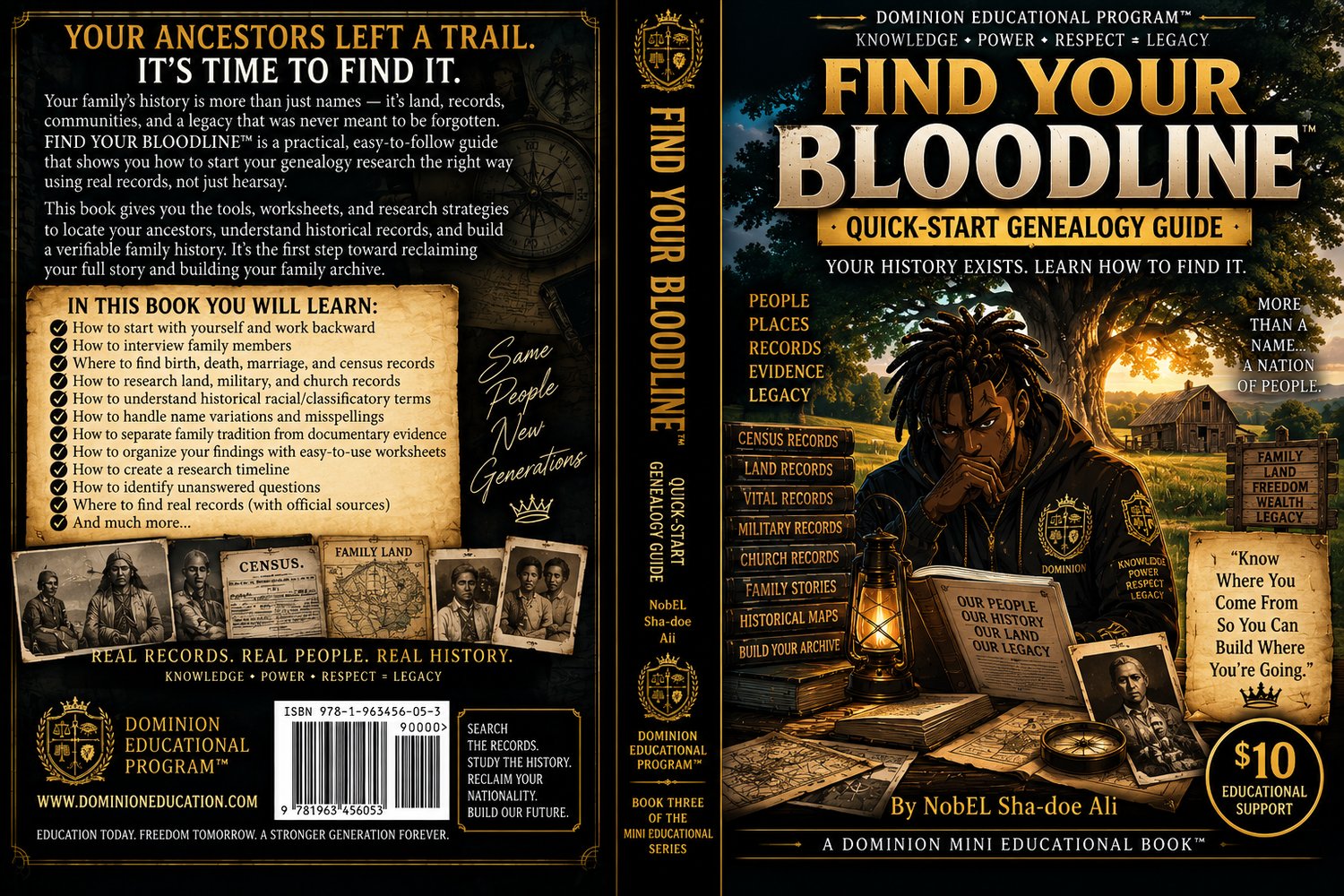
🌳 FIND YOUR BLOODLINE™
Quick-Start Genealogy Guide
Suggested Educational Support: $10
YOUR ANCESTORS LEFT A TRAIL. IT’S TIME TO FIND IT.
You know the family stories. You’ve heard the names. You may even know where your grandparents or great-grandparents came from.
But where are the records?
FIND YOUR BLOODLINE™ is a beginner-friendly 44-page genealogy guide designed to teach you how to start researching your family history using records, evidence, interviews, locations, and documented family connections.
Instead of immediately jumping hundreds of years into the past, this guide teaches you to begin with what can be established today and work backward one generation at a time.
Inside, you’ll learn how to research:
• Yourself, parents & grandparents
• Birth & death records
• Marriage records
• U.S. Census records
• Land & property records
• Military records
• Church & cemetery records
• Community records
• Family photographs & documents
• Name changes, variations & misspellings
• Historical racial/classificatory terminology
• Family traditions & oral history
• Conflicting genealogical evidence
• Friends, Associates & Neighbors — the FAN research method
🗣️ INTERVIEW THE ELDERS
Your elders may carry information that was never written in a government record.
That’s why this guide includes 40 Elder Interview Questions™ designed to help preserve information about:
Family names.
Maiden names.
Nicknames.
Family land.
Migration.
Military service.
Churches.
Burial grounds.
Old photographs.
Community relationships.
Family traditions.
Historical identity terminology.
And the stories previous generations passed down.
But a family story is the beginning of an investigation—not automatically the end of one.
🔎 THE EVIDENCE LADDER™
FAMILY STORY → CLUE → RECORD → CORROBORATION → CONCLUSION
Learn how to take something your grandmother, grandfather, aunt, uncle, or elder told you and turn it into a research question that can be investigated through historical records.
📜 LEARN HOW TO READ HISTORICAL CLASSIFICATIONS CORRECTLY
Historical records may describe the same family differently across different years and institutions.
Instead of automatically converting an old classification into a modern identity conclusion, FIND YOUR BLOODLINE™ teaches you to:
RECORD THE EXACT WORD → IDENTIFY WHO CREATED THE RECORD → IDENTIFY THE DATE & PLACE → RESEARCH THE HISTORICAL RULES → COMPARE OTHER RECORDS → THEN DRAW A SUPPORTED CONCLUSION.
If the records disagree, keep the disagreement.
That conflict may become one of your most important research clues.
📂 YOUR GENEALOGY RESEARCH TOOLKIT INCLUDES:
✓ Ancestor Worksheet™
✓ Elder Interview Sheet™
✓ Source Log™
✓ Document Log™
✓ Research Timeline™
✓ Unanswered-Question Sheet™
✓ Chapter Research Labs
✓ Corroboration Checks
✓ Repository Research Map™
✓ Evidence Ladder™
✓ Record-Conflict Research Methods
REAL RECORDS. REAL PEOPLE. REAL HISTORY.
This is your quick-start guide.
Once you begin finding the records, the next step is learning how to organize and preserve everything you discover through BUILD YOUR FAMILY ARCHIVE™ and the larger Dominion genealogy curriculum.
📖 44 Pages
🌳 Beginner Friendly
📜 Record & Evidence Focused
🗣️ 40 Elder Interview Questions
📂 Worksheets & Research Labs Included
💵 Suggested Educational Support: $10
DOMINION EDUCATIONAL PROGRAM™
Knowledge • Power • Respect = Legacy
SEARCH THE RECORDS.
STUDY THE HISTORY.
BUILD THE ARCHIVE.
LEAVE THE NEXT GENERATION MORE THAN A STORY.
Educational and genealogical research material. Historical records should be evaluated in their original context and corroborated with additional evidence before drawing conclusions about ancestry or identity.