
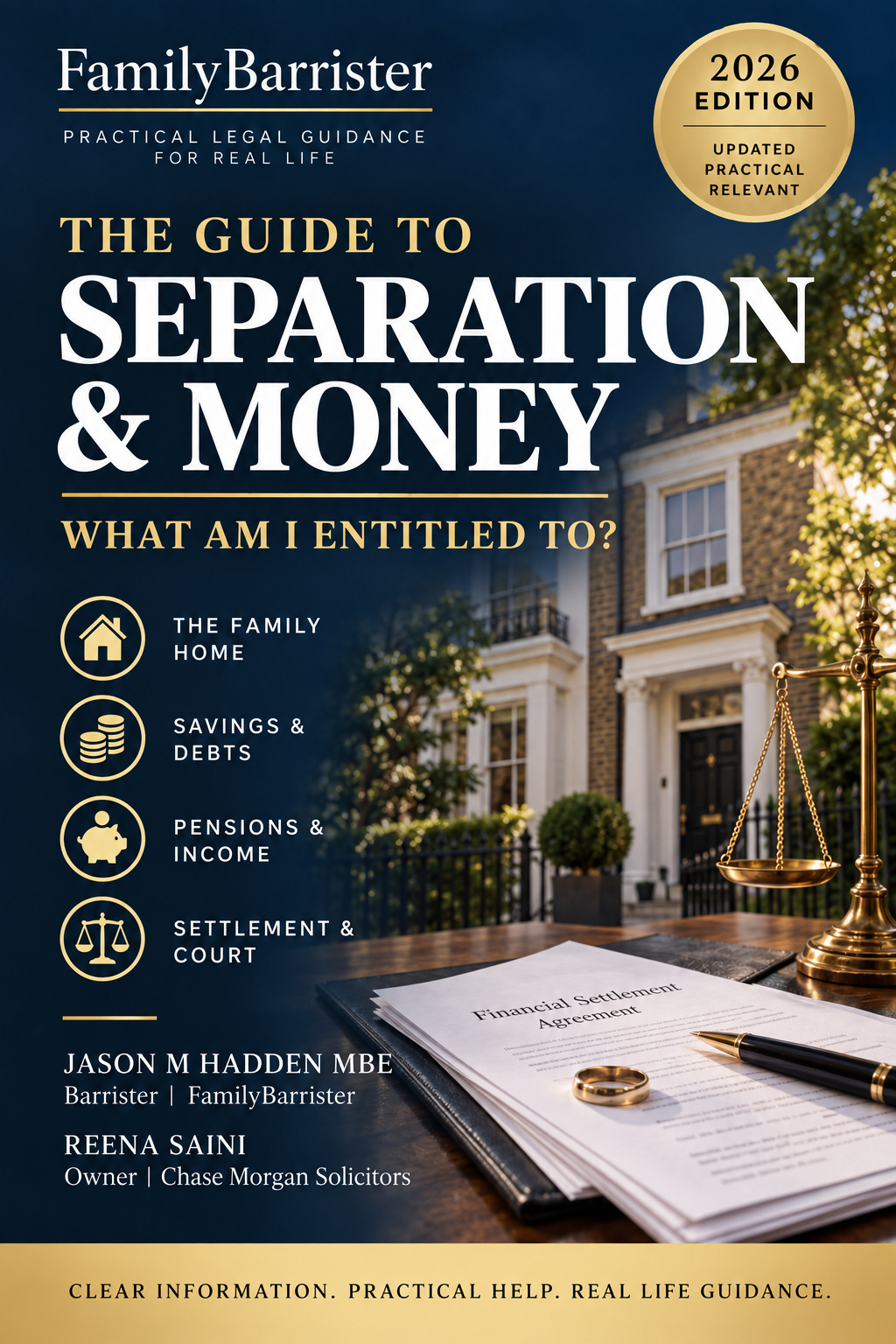
The Guide to Separation & Money
THE GUIDE TO SEPARATION & MONEY
What am I entitled to?
It is one of the questions I am asked most often:
“If we separate, what am I actually entitled to?”
Usually, that question is followed by several others.
What happens to the house? Will everything be divided equally? Can my husband or wife claim my pension? What if I owned the property before we married? What happens to an inheritance, a business or money held in someone else’s name? And do we really have to go to court?
The honest answer is that separation and money can feel overwhelming. You may be frightened about where you will live, worried about the children, unsure how you will pay the bills and completely baffled by phrases such as “financial remedy”, “Form E” and “clean break”.
That is why we have written this guide.
Financial work is not something I specialise in any longer, so I did not want to pretend that my experience alone was enough. I went to Reena Saini, owner of Chase Morgan Solicitors and a solicitor with almost 20 years’ experience. Reena was exactly the specialist I wanted beside me to help write this properly.
Together, we have tried to produce the guide we would want someone to have when a relationship ends: clear, honest, practical and human.
This is not a legal textbook. It does not assume that you understand the court system or speak fluent lawyer. It explains what the law actually means for you and the decisions you may have to make.
The 134-page guide covers:
- What you may be entitled to after separation or divorce
- Whether everything is automatically divided 50/50
- What can happen to the family home
- Savings, debts, investments and inheritances
- Pensions and why ignoring them can be an expensive mistake
- Spousal maintenance and future income
- Businesses, company interests and director income
- Financial disclosure and Form E
- The advantages and disadvantages of exchanging Form E voluntarily
- Mediation, negotiation and ways of avoiding court
- Consent orders and clean breaks
- What a financial court hearing is really like
- The First Appointment, FDR and final hearing
- What happens if you are not married
- Cohabitation, TOLATA claims and beneficial interests
- Matrimonial home rights
- Pre-nuptial and post-nuptial agreements
- Overseas property and hidden assets
- What to do if money suddenly disappears
- Practical checklists, route maps and real-life case studies
I have also included a section for anyone thinking:
“We may separate in six months or a year. Is there anything I should be doing now?”
The guide will not tell you that every case has the same answer, because it does not. Family finances are rarely that simple. But it will help you understand the questions you should be asking, the information you should be gathering and the mistakes you should try to avoid.
You do not need to read it from beginning to end. Use the clickable contents and go straight to the issue that is keeping you awake tonight. Come back to the rest when you are ready.
Separation is difficult enough. Understanding what happens next should not be.
Clear information. Practical help. Real-life guidance.
This guide concerns the law of England and Wales and provides general educational information. It is not a substitute for legal advice about your individual circumstances.