

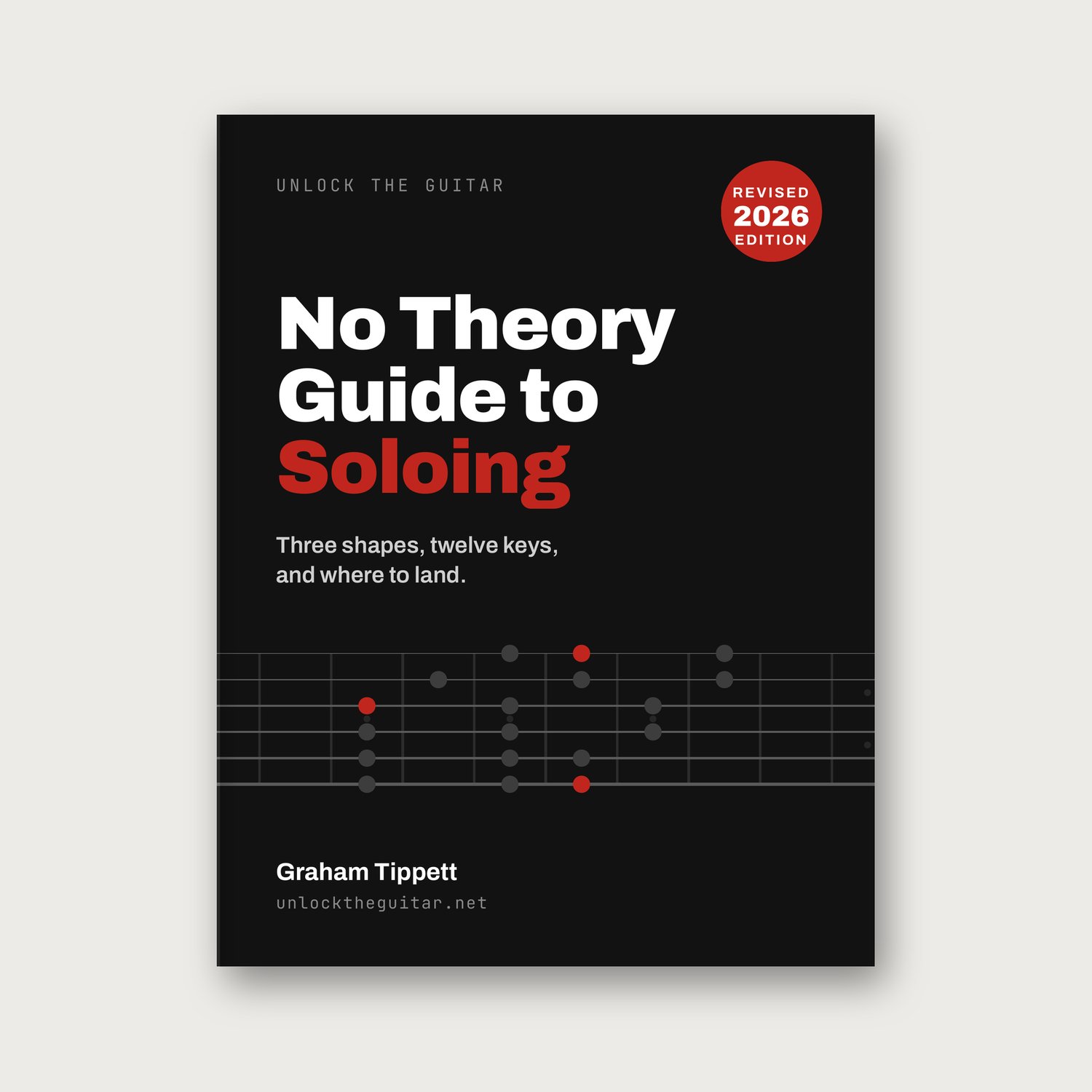
No Theory Guitar Soloing
On Sale
$9.99
$9.99
Solo over the songs you like without learning theory first.
Most scale books assume you want to understand everything before you’re allowed to play anything. This one doesn’t. It’s for players who already know a pentatonic box or two, want to get beyond it, and don’t have hours a day to spend on theory.
The method is small on purpose. You learn three shapes, and they’re the same in all twelve keys; only where you put them changes. You find the key from the song’s chords using one table. Then you land on the chord the song keeps coming back to. That last step is what turns running a scale into playing a solo, and it’s the part most methods never spell out.
What’s in it
Revised 2026 edition. It’s been rewritten and redesigned from the ground up, with new diagrams, a new flavors chapter, a new blues chapter, and corrections throughout. 33 pages, PDF, 8.5 x 11.
Most scale books assume you want to understand everything before you’re allowed to play anything. This one doesn’t. It’s for players who already know a pentatonic box or two, want to get beyond it, and don’t have hours a day to spend on theory.
The method is small on purpose. You learn three shapes, and they’re the same in all twelve keys; only where you put them changes. You find the key from the song’s chords using one table. Then you land on the chord the song keeps coming back to. That last step is what turns running a scale into playing a solo, and it’s the part most methods never spell out.
What’s in it
- The three shapes, taught once, with a simple rule for moving them to any key
- A lookup table that tells you which shapes to use from a song’s chords
- Where to land, over a single chord and through the changes
- Three flavors over one chord: sad, bright or dark over a minor chord, and plain, bluesy or dreamy over a major one. You change the sound by moving the shapes to a different fret, with no theory needed
- One-note fixes for the two stray chords you’ll run into most in rock and pop
- An honest chapter on the 12-bar blues: where this method works, where it doesn’t, and what to do instead
- A half-hour practice plan
- A reference page for every key, with its chords, the three shapes, and four short loops to practice over
- The theory words in the book are labels, so you can talk to other musicians. You don’t need to know why any of it works.
Revised 2026 edition. It’s been rewritten and redesigned from the ground up, with new diagrams, a new flavors chapter, a new blues chapter, and corrections throughout. 33 pages, PDF, 8.5 x 11.