
THE OPERATING SHIELD™
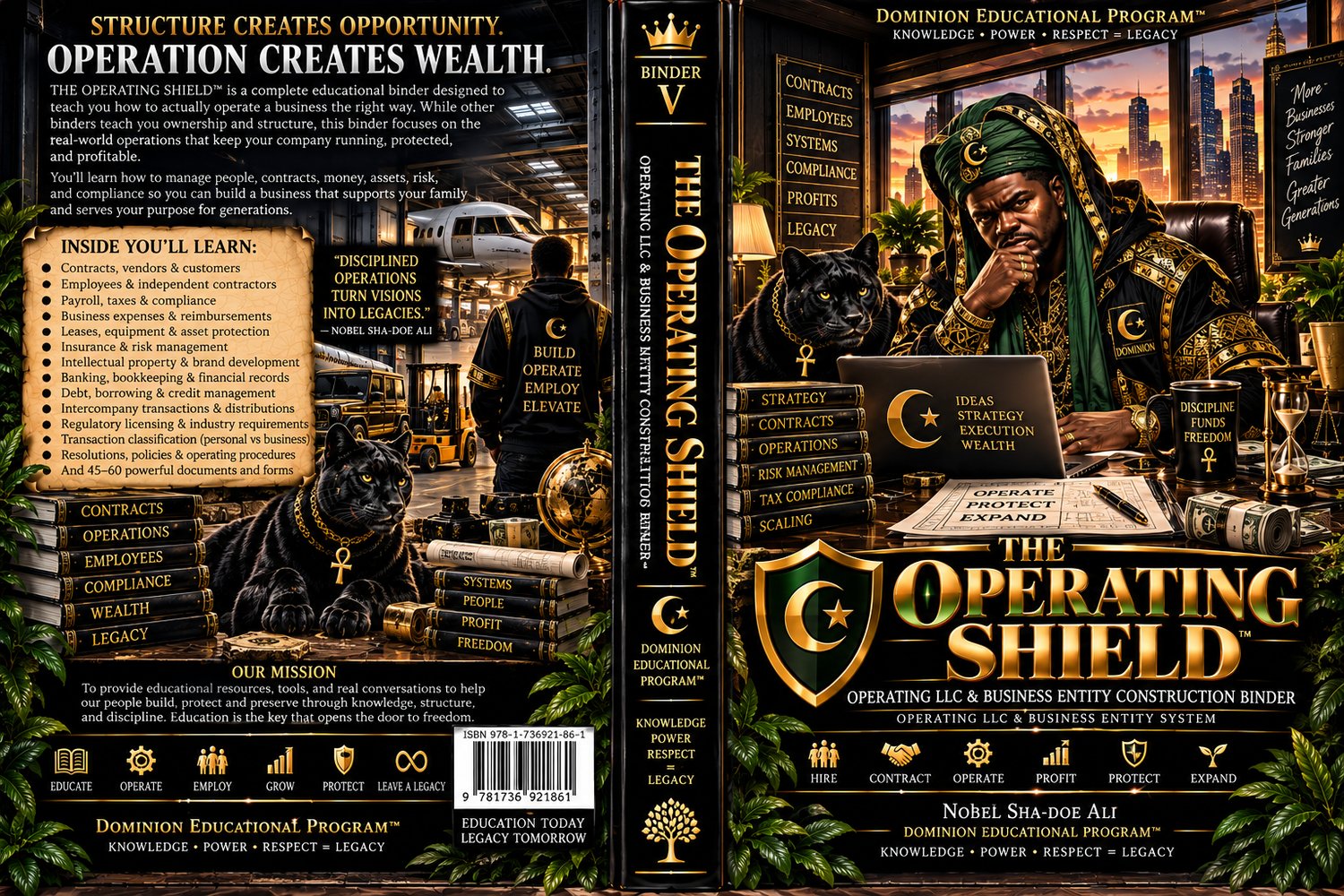
THE OPERATING SHIELD™
Operating LLC & Business Entity Construction Binder
Binder V — Dominion Estate Architecture Series™
By NobEL Sha-doe Ali
“The liability shield isn’t just something you file. It’s something you maintain.”
The Operating Shield™ teaches what happens after the LLC is formed.
Binder IV — The Holding Company Architect™ teaches the ownership layer. Binder V moves into the company itself and teaches the operational layer—where customers are served, contracts are signed, workers are paid, vendors are hired, expenses occur, money moves, risks develop, and business records are created.
A business does not become properly operated simply because Articles of Organization were filed with the state.
The company must actually behave like a company.
From Paper Entity to Operating Business
Students learn how an operating company handles the everyday activities that create both profit and liability:
Contracts • Customers • Vendors • Employees • Independent Contractors • Payroll • Business Expenses • Reimbursements • Banking • Bookkeeping • Equipment • Vehicles • Commercial Leases • Insurance • Intellectual Property • Data • Licenses • Regulatory Compliance • Debt • Business Credit • Intercompany Transactions • Owner Payments • Resolutions • Recordkeeping • Business Continuity
The objective is to build an operating system where someone can look at a transaction months or years later and determine:
What happened?
Why did it happen?
Who authorized it?
Which company was involved?
What contract controlled it?
Where did the money go?
How was it recorded?
What tax treatment was considered?
And what evidence proves it?
The Dominion Transaction Classifier™
One of the most important lessons in the entire binder is learning that money moving into or out of a business does not all mean the same thing.
Students learn to distinguish between:
Personal Transaction
Business Transaction
Capital Contribution
Loan
Reimbursement
Compensation
Distribution
Dividend — where applicable
Intercompany Transaction
Why does that matter?
Because calling something the wrong thing can affect bookkeeping, payroll, taxation, financial statements, ownership records, and legal documentation.
A $5,000 transfer could represent capital, debt, compensation, a distribution, payment for services, reimbursement, or something else entirely.
The label should follow the actual transaction—not whatever label produces the desired result.
Employees vs. Independent Contractors
The binder also addresses one of the most important operational risks facing growing businesses: worker classification.
Students learn why simply calling someone an “independent contractor,” signing a contractor agreement, or issuing a 1099 does not automatically determine the worker's legal classification.
The system introduces federal employment-tax classification, wage-and-hour considerations, payroll operations, onboarding, timekeeping, contractor documentation, and the need to check additional state requirements.
Maintaining the Liability Shield
A major portion of The Operating Shield™ focuses on entity separateness.
Students examine problems involving:
Commingling • Personal Use of Company Money • Undocumented Owner Withdrawals • Improper Signatures • Weak Bookkeeping • Sham Transactions • Misleading Creditors • Undocumented Intercompany Transfers • Improper Related-Party Transactions • Missing Contracts • Poor Records
The book does not promise that completing a checklist magically prevents veil piercing.
Veil-piercing and alter-ego standards are heavily state-specific and fact-dependent.
Instead, students learn to build the operational evidence of a genuinely separate business:
Separate banking.
Separate books.
Real contracts.
Correct signatures.
Documented transactions.
Accurate accounting.
Proper authorization.
Truthful dealings.
Consistent records.
Contracts, Customers & Vendors
Students learn how contracts become part of the company's operational infrastructure—from customer agreements and statements of work to vendor onboarding, purchase orders, invoice approvals, change orders, deposits, and payment records.
The lesson is simple:
THE RIGHT COMPANY SHOULD SIGN THE RIGHT CONTRACT THROUGH THE RIGHT AUTHORIZED PERSON.
Banking, Bookkeeping & Business Expenses
The system teaches students how to establish a paper trail from:
TRANSACTION → DOCUMENT → PAYMENT → BANK → BOOKS → TAX RECORD → PERMANENT BUSINESS FILE
Students also learn why company accounts should not become personal pocketbooks and how reimbursements, owner payments, business expenses, loans, and capital transactions require different documentation.
Intercompany Operations
For students building the larger Dominion architecture, the binder goes deeper into transactions between related companies.
Students examine:
Intercompany Services • Intercompany Loans • Shared Costs • Shared Workers • Property Use • Related-Party Transactions
The goal is to make related entities operate as real separate entities, rather than drawing boxes on an organizational chart while treating all money and property as one undifferentiated pool.
58-DOCUMENT OPERATIONAL VAULT
The binder includes 58 operational documents, educational models, policies, registers, agreements, and checklists, covering areas such as:
Customer Agreements • Vendor Agreements • Statements of Work • Change Orders • Purchase Orders • Worker Classification • Employee Onboarding • Contractor Onboarding • Payroll • Expense Policies • Reimbursements • Banking • Cash Controls • Accounting • Equipment • Vehicles • Commercial Leases • Insurance • Incident Reports • Intellectual Property • Data • Licenses • Compliance • Borrowing • Promissory Notes • Capital Contributions • Owner Loans • Compensation • Distributions • Intercompany Agreements • Entity Separateness • Annual Operations Audits • Emergency Business Continuity
Students aren't simply handed forms.
They are taught what the document does, why it exists, when it should be used, what authority supports the transaction, what evidence belongs with it, and what happens after it is signed.
The Operating Principle
CLASSIFY → AUTHORIZE → CONTRACT → PERFORM → PAY → RECORD → RECONCILE → REPORT → PROTECT → REVIEW
The purpose of The Operating Shield™ is not merely to help someone own a company.
It is to teach them how to operate one with discipline.
Real businesses create freedom. Disciplined operations preserve it.
DOMINION EDUCATIONAL PROGRAM™
Knowledge • Power • Respect = Legacy