







The Little Match Girl
On Sale
€39.00
€39.00
The Little Match Girl: Mini-Framework
Hans Christian Andersen, 1845
Designed for
- Teachers and school facilitators working with ages 13-18. It suits language, literature, history, ethics and PSHE/social-emotional lessons, and it works in mixed and multicultural groups. You don’t need a background in Gothic fiction.
- Team leaders, managers, trainers and HR or DEI facilitators who want a short, story-based way to open a conversation about visibility, indifference and who gets noticed at work. It needs no prep beyond reading a short story.
Ages: 13+ for school groups. Adults are the default for team settings. The ending is a child’s death by exposure, so read it first and decide how to approach it. The guide includes a content note.
The angle: Nobody in this story disbelieves the girl. Nobody asks her anything. The framework is about being walked past, and about what decides who gets stopped for. It’s the second half of a pair with The Erl-King, which is about not being believed.
What’s inside
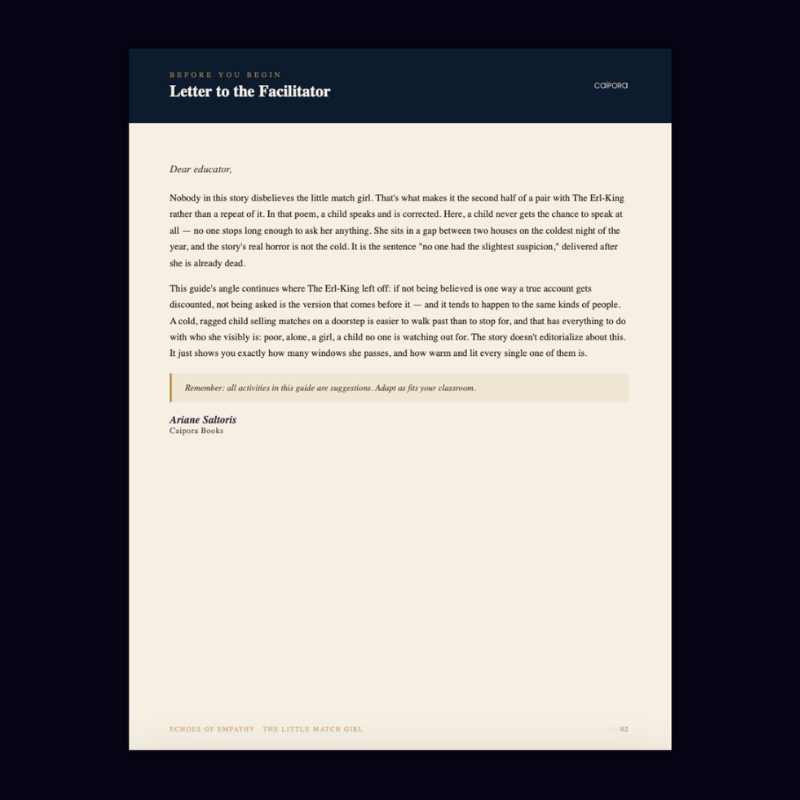
- A short letter that sets up the angle
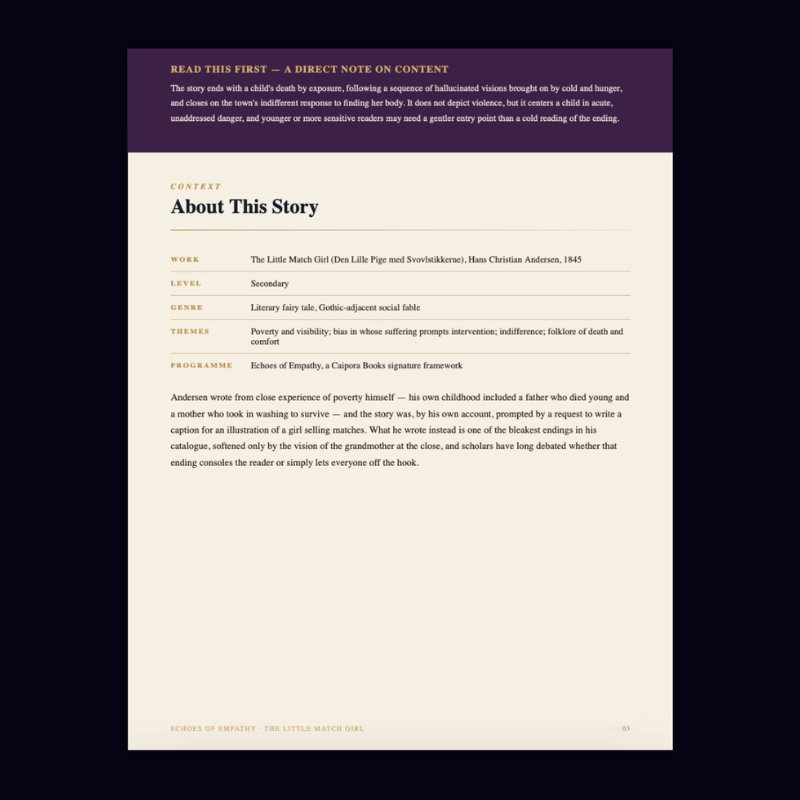
- A content note on the ending
- Background on the story and on Andersen’s own childhood
- The Echoes X-Factor, “Who Gets Noticed”: questions to ask before, during and after reading, built around something every reader has felt, so it works whether or not anyone has read the story
- A closing piece, “The Person I Walked Past”: a short personal writing task in any form. Sharing is invited, never required.
- A History extension: what protection a child like her had in 19th-century Europe, and what gap remains today
- References
What to expect
- One core activity and one extension. There is no rubric, because the point is recognition, not grading.
- Every activity is a suggestion. Use all of it, or only the questions.
- It’s a mini-framework, not a full unit or a lesson-by-lesson script.