Your Cart
Loading

Echoes of Empathy by Caipora Books

Helping Teach Empathy Through Horror Fiction, Dark Folk- and Fairy Tales.

Browse through Ariane's Tiny Frameworks & Activities


For Educators, Book Clubs & Small Organisations

What is Echoes of Empathy

Echoes of Empathy is a framework program that uses horror fiction and dark folktales to promote discussions about societal issues from a common starting point.


Rather than leading discussions from a diversity starting point, the framework uses shared humanity to build sympathy for the characters before touching on differences such as gender roles, race, and social cultural background.

How it works, a discussion in three parts:

Before reading

short questions that put each participant in a first-person position from the story (“have you...”).

During reading

guided pauses at the moments where the story turns.

After reading

structured discussion and an activity that moves from the story to the group’s own world.

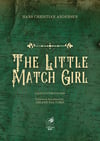
The Little Match Girl
On Sale
€39.00
€39.00
Added to cart

The Little Match Girl: Mini-Framework

Hans Christian Andersen, 1845


Designed for

  • Teachers and school facilitators working with ages 13-18. It suits language, literature, history, ethics and PSHE/social-emotional lessons, and it works in mixed and multicultural groups. You don’t need a background in Gothic fiction.
  • Team leaders, managers, trainers and HR or DEI facilitators who want a short, story-based way to open a conversation about visibility, indifference and who gets noticed at work. It needs no prep beyond reading a short story.


Ages: 13+ for school groups. Adults are the default for team settings. The ending is a child’s death by exposure, so read it first and decide how to approach it. The guide includes a content note.


The angle: Nobody in this story disbelieves the girl. Nobody asks her anything. The framework is about being walked past, and about what decides who gets stopped for. It’s the second half of a pair with The Erl-King, which is about not being believed.


What’s inside

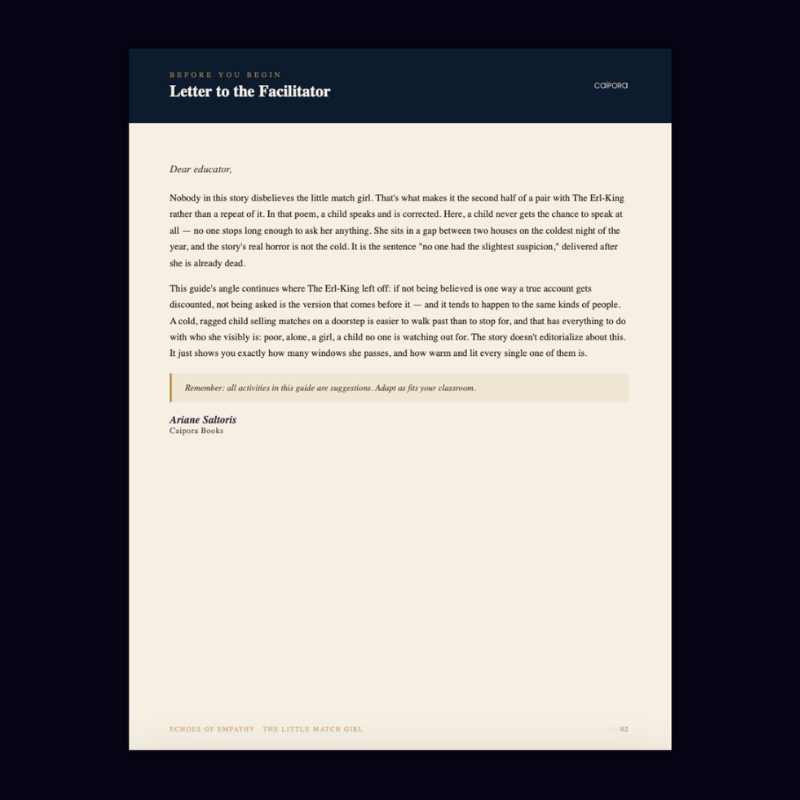
  • A short letter that sets up the angle
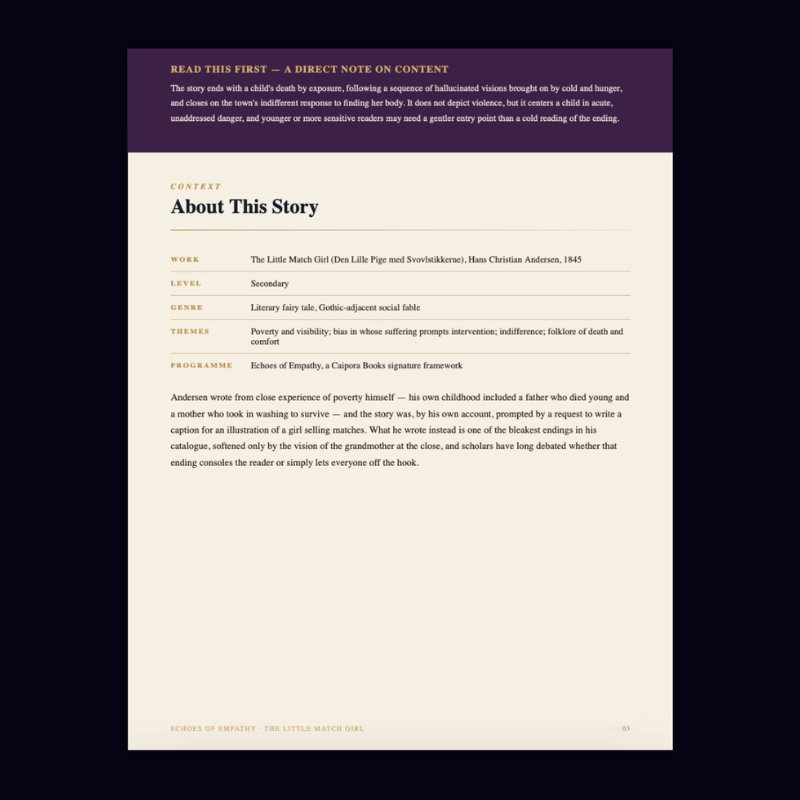
  • A content note on the ending
  • Background on the story and on Andersen’s own childhood
  • The Echoes X-Factor, “Who Gets Noticed”: questions to ask before, during and after reading, built around something every reader has felt, so it works whether or not anyone has read the story
  • A closing piece, “The Person I Walked Past”: a short personal writing task in any form. Sharing is invited, never required.
  • A History extension: what protection a child like her had in 19th-century Europe, and what gap remains today
  • References


What to expect

  • One core activity and one extension. There is no rubric, because the point is recognition, not grading.
  • Every activity is a suggestion. Use all of it, or only the questions.
  • It’s a mini-framework, not a full unit or a lesson-by-lesson script.


About Me

Hi, I am Ariane Saltoris, Horror Fiction researcher, published author, folklorist, mom. The creator of Echoes of Empathy, the frameworks that help you teach empathy through uncanny tales, and founder of Caipora Books.

What People Say About "Echoes of Empathy"

Far from being merely a vehicle for entertainment, fantasy, horror, and science fiction have, over the centuries, consistently served as critical instruments for addressing issues within our society. This assertion finds renewed support in the twenty-first century through horror, a genre that has proven capable of capturing the climate of uncertainties, anxieties, tensions, and radicalisms characteristic of our liquid times, as conceptualized by sociologist Zygmunt Bauman. For this reason, it is essential to underscore the importance of the Echoes of Empathy project by the Brazilian researcher, writer, and editor Ariane Saltoris. What is presented here is a well-grounded proposal with significant transformative potential in the field of education through horror—an expression of the fantastic that is able to engage and sustain the attention of diverse audiences across age groups and sociocultural backgrounds. I commend Saltoris for her initiative in embracing fear as an agent for the betterment of society.

— Alexander Meireles da Silva, Full Professor at the Federal University of Catalão (UFCAT), Brazil

This facilitator's guide is a genuinely creative piece of work. Using "The Little Match Girl" as the emotional anchor for a structured conversation about empathy is a smart choice — the story is short, vivid, and universally known, which makes it easy for a group to engage with quickly, but it also carries enormous weight: poverty, invisibility, indifference, and how a society makes peace with death are all present in just a few pages. The way the framework is built — with clear guidance for before, during, and after the reading, plus discussion questions and activities — shows real pedagogical thinking. It doesn't just hand educators a story and hope for the best; it gives them a path to walk their group through discomfort toward reflection, which is exactly what good facilitation should do.

— Ligia Fascioni, Dr. Eng. Design Management

Echoes of Empathy Blog

Why Gothic Horror Belongs in the Classroom
There is a persistent assumption in educational settings that the literature best suited to building empathy is warm, accessible, and preferably life-affirming. Gothic fiction, with its ghosts and its monsters and its refusal of resolution, seems to...
Read More
Who Gets to Be the Monster? Race, Fear, and the Colonial Imagination
There is a question that Gothic fiction has been answering for two centuries without quite admitting it is doing so. The question is this: who gets to be the monster? It sounds like an aesthetic question — a matter of casting, of narrative choice, o...
Read More
Why We Need Fear to Feel Human: The Psychology of Horror and Empathy
In every culture, people have whispered stories meant to unsettle. Around fires, in candle-lit rooms, or now on screens glowing through the dark, we return to fear not because we enjoy suffering—but because it reminds us that we can feel. Horror, fa...
Read More