Durability - for coaches and ambitious athletes (EN)
**The fourth determinant of endurance running: how well your profile holds up when the effort goes long.**
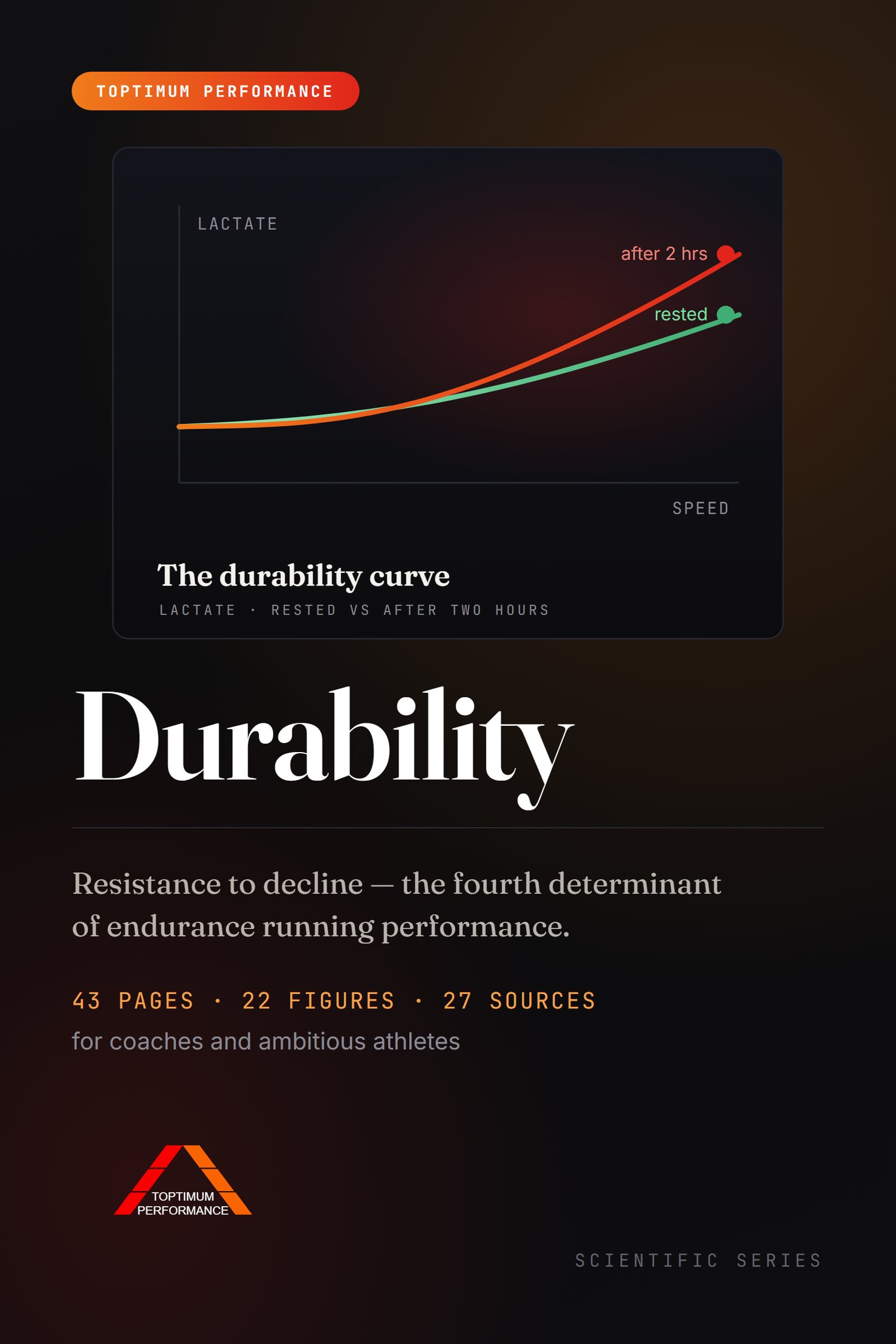
The fourth determinant of endurance running performance. You measure VO₂max, threshold and running economy in a rested state — but a race is not run rested. Durability is how well that profile holds up when the effort goes long.
Two runners with an identical curve in a rested state can be far apart after an hour and a half. In one, the threshold barely drops; in the other, it collapses. That difference, the resistance to decline, is durability, and it is precisely what decides a marathon. Yet it is rarely measured, because it only becomes visible once you have first tired the athlete out.
This guide puts durability on the map as a property in its own right, trainable alongside VO2max, threshold and economy. What shifts and when, which physiology underlies it, how much is innate and how much you build on top, and how you measure it with a pre-fatigued test rather than the classic measurement in a rested state.
**What's inside**
- A conceptual framework: durability, resilience and fatigability disentangled
- What shifts under prolonged effort and why every anchor drifts down with it
- The physiology: the role of a high, robust LT2, muscle typology and the trainable component
- Durability and race pace per distance
- Riegel's power-law model as a way of thinking about it
- Measuring: the pre-fatigued durability test, and how to judge progress
- A glossary in which every technical term is briefly explained
**A few things you'll find here and rarely elsewhere**
- Why a measurement in a rested state is only half the story and what a threshold measurement after ninety minutes of running reveals that the classic test misses.
- Durability, resilience and fatigability — three terms that are often run together, sharply distinguished here.
- How much is innate, how much trainable — the muscle-typological component alongside what you build on top of it.
- The link with race pace: why durability weighs more heavily the longer the distance becomes.
**For whom**
Coaches and ambitious athletes who compete over the longer distances, and who want to understand why a strong rested curve does not automatically mean a strong race.
**Extent**
43 pages
22 figures
27 scientific sources (with DOI where available)
Glossary