

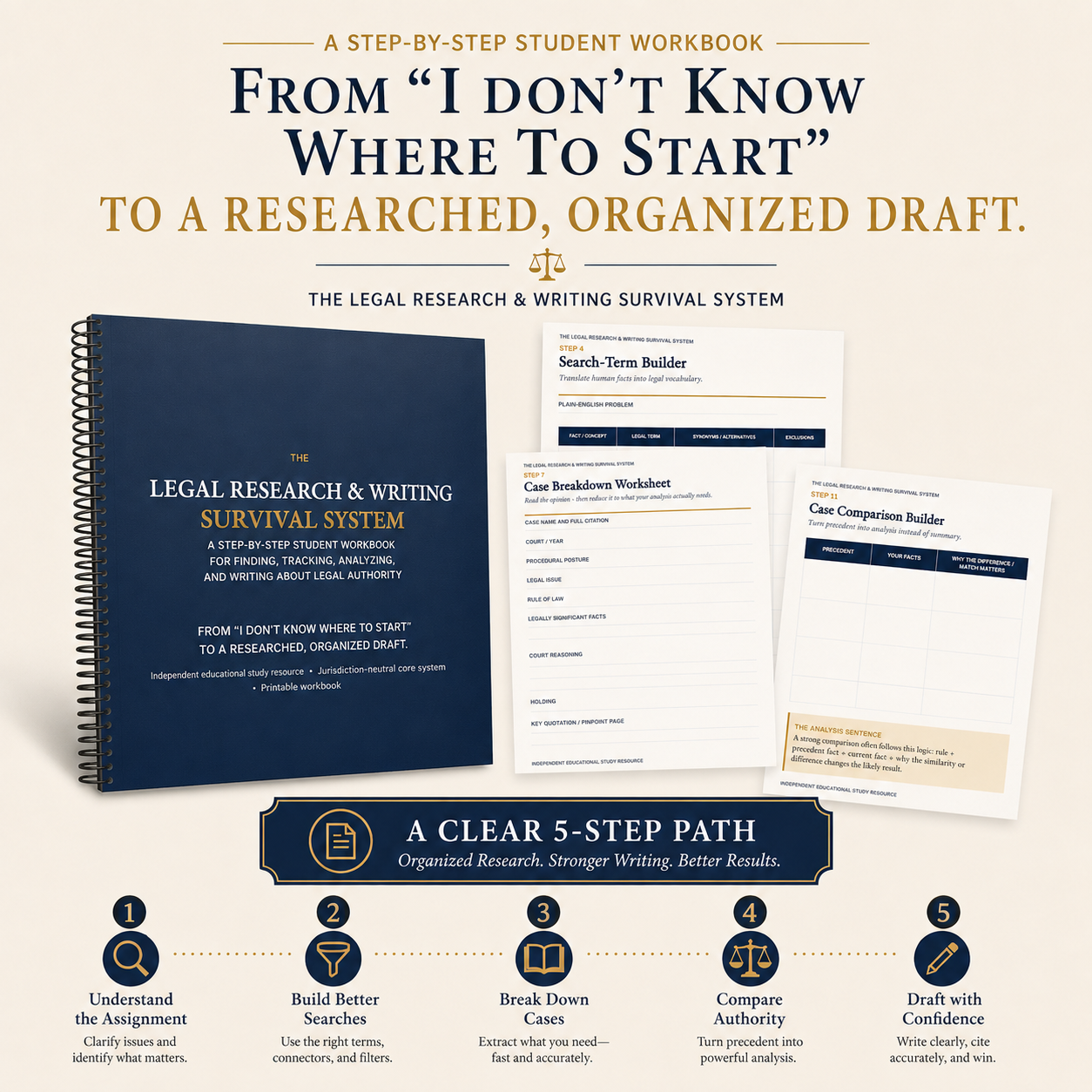




The Legal Research & Writing Survival System
A Step-by-Step Student Workbook for Finding, Tracking, Analyzing & Writing About Legal Authority
Stop wondering where to start.
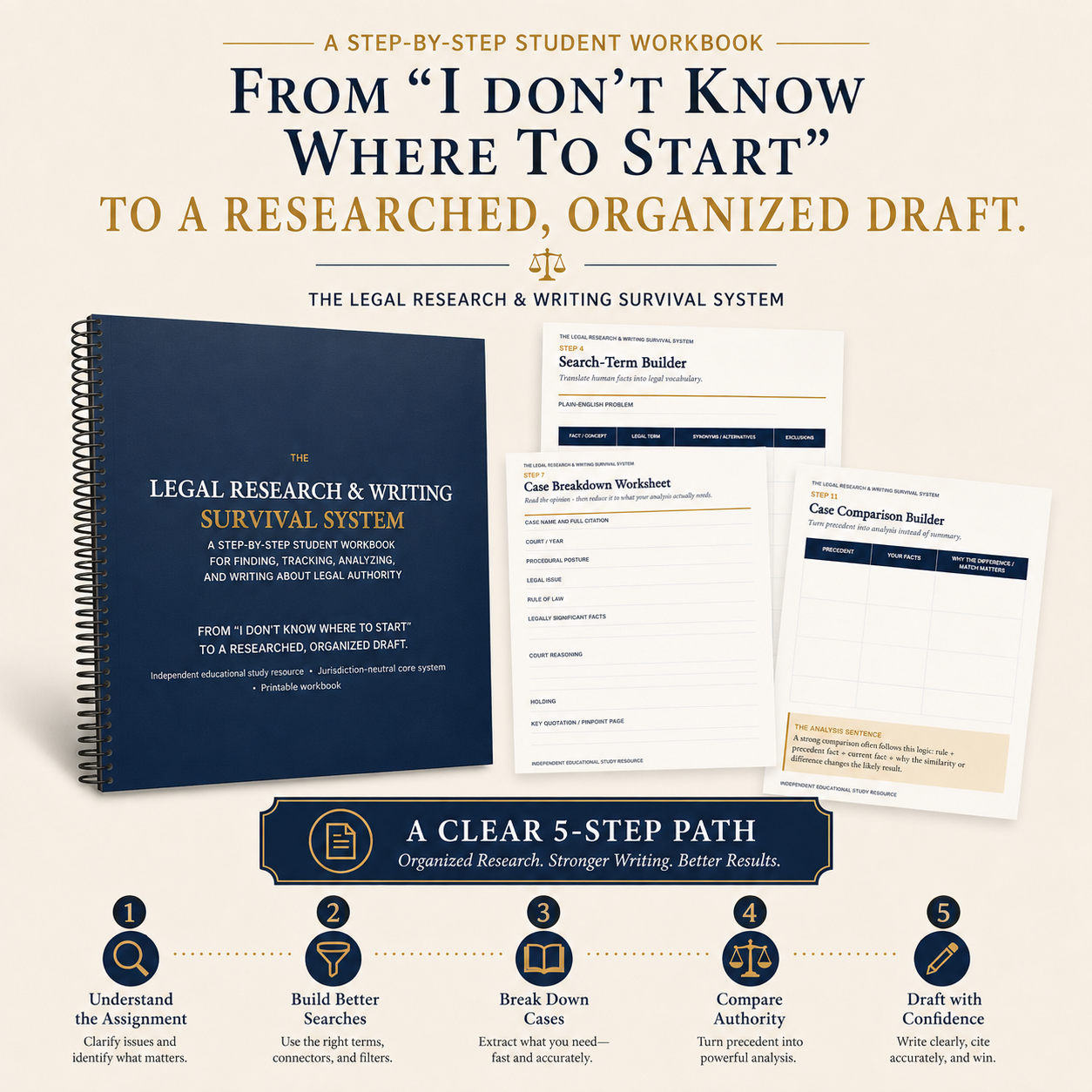
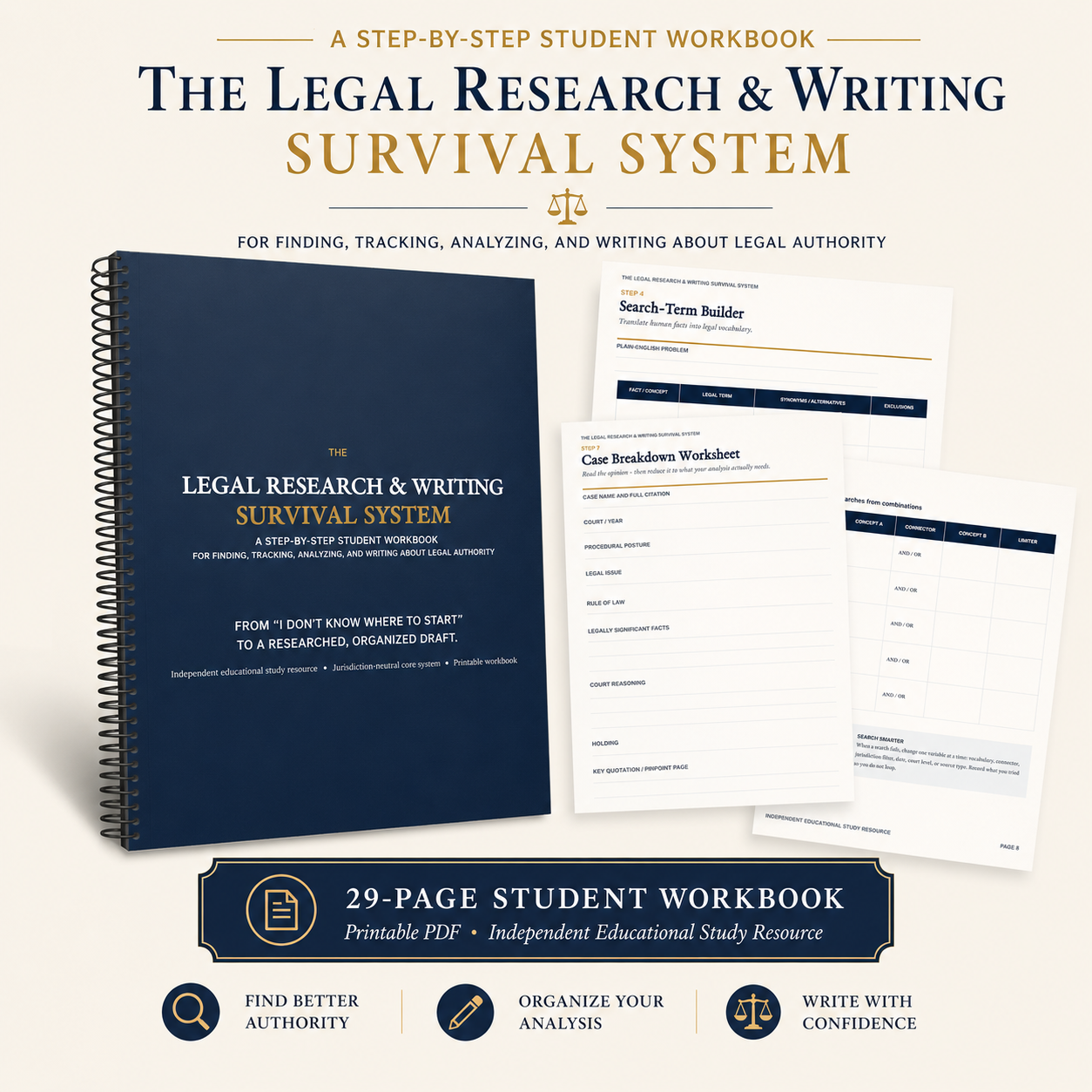
The Legal Research & Writing Survival System is a 29-page printable PDF workbook designed to help paralegal, pre-law, law students, and independent learners organize the legal research and writing process from assignment to final draft.
Use the system to identify issues, build stronger searches, track authority, break down cases and statutes, compare precedent, synthesize rules, organize legal analysis, plan memoranda, and complete a final quality-control review.
Printable PDF • 29 Pages • Instant Digital Download
From “I Don’t Know Where to Start” to a Researched, Organized Draft
Legal research can become overwhelming very quickly.
You receive a fact pattern.
You know you are supposed to find cases and statutes.
You open Westlaw, Lexis, Google Scholar, a legal database, or your textbook.
Then the questions begin:
What am I actually researching?
Which jurisdiction matters?
What search terms should I use?
Which cases are important?
How do I know whether an authority controls?
What am I supposed to pull out of a case?
How do I compare precedent to my facts?
How do I turn all of this research into legal analysis?
That is the problem The Legal Research & Writing Survival System was created to solve.
This is not a giant textbook about legal research.
It is a working system designed to help you organize the process one step at a time.
The Legal Research & Writing Survival System guides you through a repeatable research and writing process so you can move from a confusing assignment to organized research and a stronger draft.
You'll work through:
- Understanding the assignment
- Identifying jurisdiction
- Recording professor or supervisor requirements
- Breaking a legal problem into researchable issues
- Building stronger search terms
- Tracking what you searched
- Organizing cases, statutes, and other authority
- Distinguishing mandatory and persuasive authority
- Breaking cases into usable pieces
- Updating authority
- Synthesizing rules from multiple sources
- Comparing precedent to your facts
- Developing legal analysis
- Planning an internal legal memorandum
- Reviewing your work before submission
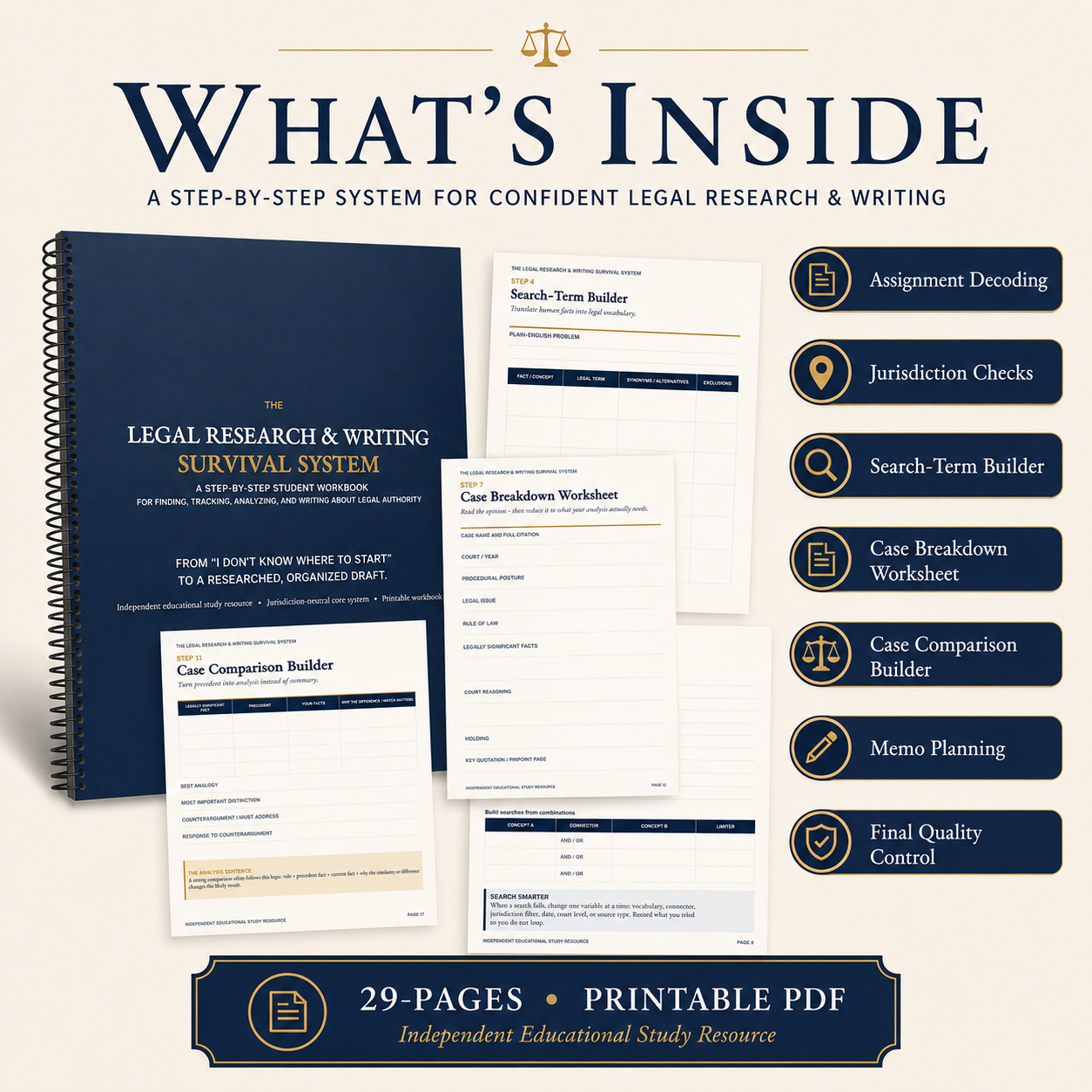
WHAT'S INSIDE
Assignment Decoder
Start by figuring out exactly what the assignment requires before you begin researching.
Record information such as:
- Assignment type
- Main legal question
- Jurisdiction
- Required authority
- Citation requirements
- Page limits
- Deadlines
- Research restrictions
- Required deliverables
The goal is simple:
Do the right research for the right assignment.
Jurisdiction Check
Before relying on a case, statute, rule, or citation format, identify the jurisdiction that controls the assignment.
Use this section to consider:
- State or federal law
- Relevant court
- Controlling jurisdiction
- Local rules
- Citation requirements
- Unpublished authority
- Professor, school, or supervisor requirements
The workbook does not assume every jurisdiction follows the same rules.
Instead, it teaches an important research habit:
Identify. Verify. Then proceed.
Professor / Supervisor Rules Sheet
Keep assignment-specific requirements in one place.
Track:
- Citation style
- Required sections
- Font
- Spacing
- Margins
- Heading format
- Paragraph indentation
- Page limits
- Research-log requirements
- Special grading instructions
No more discovering an important formatting requirement right before submission.
Research Roadmap
Turn a complicated fact pattern into a manageable research plan.
Identify:
- Main issues
- Sub-issues
- Elements
- Possible statutes
- Potential case law
- Terms of art
- Secondary sources
- Follow-up questions
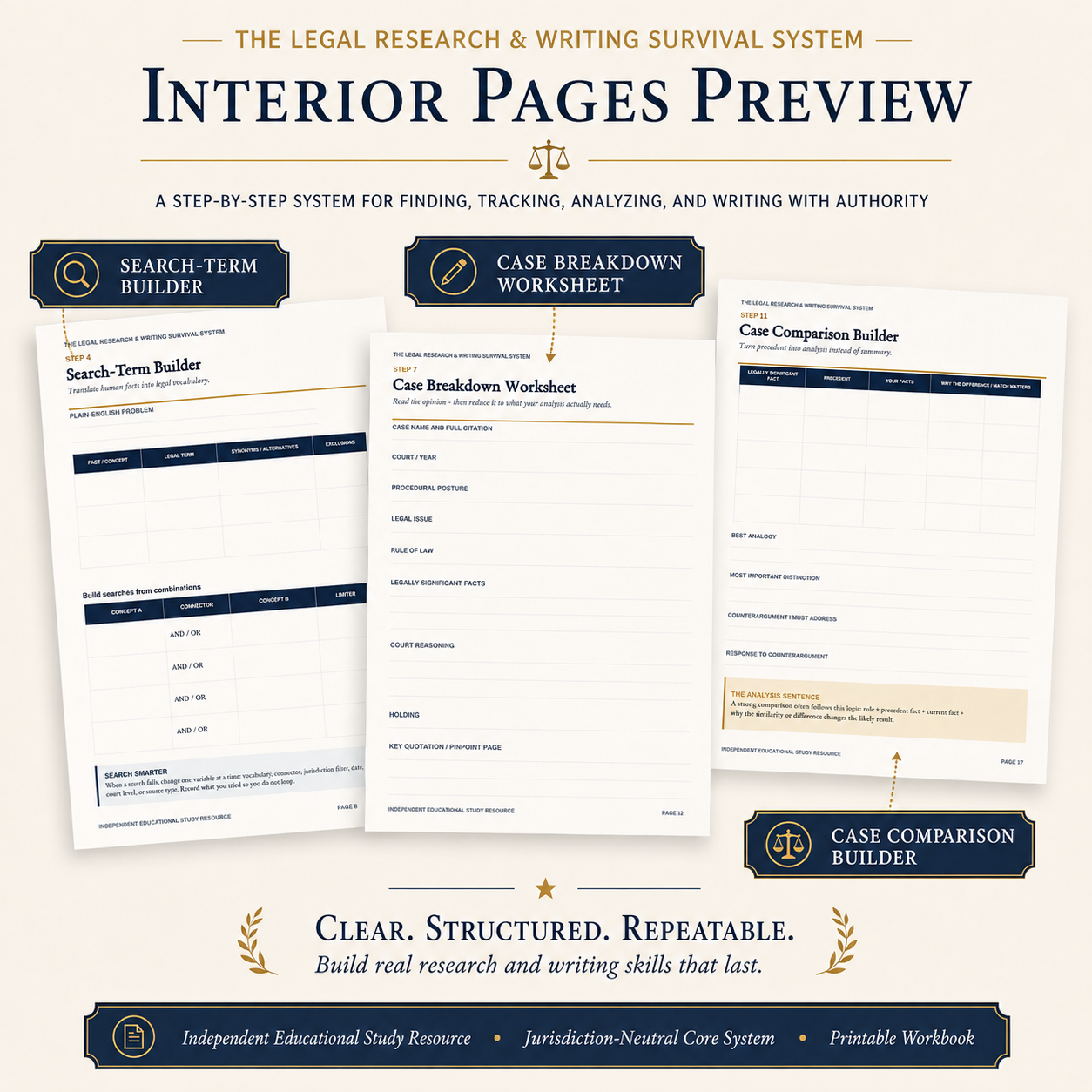
Search-Term Builder
Translate ordinary facts into legal research language.
Organize:
- Facts and concepts
- Legal terminology
- Synonyms
- Alternative wording
- Connectors
- Limiters
- Exclusions
Then build multiple searches instead of repeating the same unsuccessful search over and over.
Legal Research Log
Create a record of what you researched.
Track:
- Research question
- Database or source
- Search date
- Search terms
- Authority found
- Court and year
- Relevant rule
- Important facts
- Citator status
- Pinpoint pages
- Follow-up research
A good research log helps prevent duplicate work and makes it easier to return to useful authority later.
Authority Hierarchy
Organize legal sources by importance and learn to distinguish:
- Primary authority
- Secondary authority
- Mandatory authority
- Persuasive authority
Keep asking the question that matters:
Does this authority control the court deciding the issue?
Case Breakdown Worksheet
Stop treating cases like giant blocks of text.
Break important cases into:
- Case name and citation
- Court
- Year
- Procedural posture
- Legal issue
- Rule of law
- Legally significant facts
- Court reasoning
- Holding
- Key quotation or pinpoint page
The goal is to reduce the opinion to the information your analysis actually needs.
Statute / Rule Breakdown
Organize statutory and rule-based authority by recording:
- Citation
- Jurisdiction
- Relevant language
- Definitions
- Elements
- Exceptions
- Cross-references
- Effective dates
- Related cases
- Questions requiring additional research
Authority Update & Citator Check
Finding an authority is not the end of the research process.
Document:
- Citator used
- Date checked
- Negative treatment
- Positive treatment
- Subsequent history
- Later cases
- Whether the authority remains usable
- Research that still needs to be completed
Rule Synthesis Builder
Legal rules often come from several authorities rather than one perfect case.
Use this section to compare:
- Rules stated by different courts
- Elements
- Exceptions
- Limitations
- Shared principles
- Important factual patterns
Then begin developing a synthesized legal rule.
Case Comparison Builder
Turn precedent into analysis instead of summary.
Compare:
- Legally significant facts from precedent
- Facts from your assignment
- Similarities
- Differences
- Why those similarities or differences matter
- Counterarguments
- Responses to counterarguments
This helps move your writing beyond simply describing cases.
Legal Analysis Builder
Before worrying about perfect wording, work through the reasoning.
Organize:
- Governing rule
- Relevant precedent
- Important facts
- Comparisons
- Distinctions
- Counterarguments
- Likely conclusion
Strong legal writing begins with strong legal reasoning.
Internal Memorandum Builder
Plan the major sections of an internal legal memorandum, including:
- Heading
- Question Presented
- Brief Answer
- Statement of Facts
- Discussion
- Conclusion
The workbook provides structure without pretending that every school, employer,
professor, or jurisdiction requires identical formatting.
Final Quality-Control Checklist
Before submitting your work, review questions such as:
- Did I answer the actual assignment?
- Did I identify controlling authority?
- Did I update important cases?
- Are my quotations accurate?
- Are pinpoint citations correct?
- Did I distinguish contrary authority?
- Is my analysis supported by facts and authority?
- Did I follow the required format?
- Did I verify jurisdiction-specific requirements?
- Did I proofread the final draft?
A CLEAR, REPEATABLE PROCESS
The system is built around a practical workflow:
1. Understand the Assignment
Clarify the issue, jurisdiction, instructions, and goals.
2. Build Better Searches
Develop useful legal terminology, alternatives, connectors, and filters.
3. Break Down Authority
Reduce cases, statutes, and rules to the information your analysis needs
.
4. Compare & Analyze
Connect precedent to the facts instead of simply summarizing authority.
5. Organize the Draft
Turn research and analysis into a structured legal writing plan.
WHO THIS WORKBOOK IS FOR
Paralegal Students
Ideal for students learning how legal research, case analysis, and memorandum writing fit together.
Pre-Law Students
A practical introduction to the organization and reasoning involved in formal legal research and writing.
Law Students
Useful for students developing confidence with research assignments, case synthesis,
comparisons, legal analysis, and memo planning.
Independent Learners
A structured resource for anyone studying the fundamentals of legal research and writing.
Beginning Legal Professionals
A repeatable organizational system for approaching research assignments more methodically.
THIS WORKBOOK MAY BE ESPECIALLY HELPFUL IF YOU'VE EVER THOUGHT:
“I don't know what to research first.”
“I found a bunch of cases, but I don't know which ones matter.”
“How do I know whether this authority controls?”
“I understand the rule but don't know how to analyze it.”
“I keep losing track of what I've already researched.”
“How do I compare my facts to the cases?”
“How do I turn research into a legal memorandum?”
The workbook was created for that exact stage of the learning process.
WHAT YOU RECEIVE
Your purchase includes:
- 1 digital PDF workbook
- 29 professionally formatted pages
- US Letter size
- Printable and reusable for your own personal studies
You may:
- View the PDF digitally
- Save it to your computer or tablet
- Print it
- Reprint reusable worksheets for your own assignments
This is a digital product.
No physical workbook will be mailed.
PRODUCT DETAILS
Format: PDF
Length: 29 pages
Delivery: Instant digital download
Orientation: Portrait / US Letter
Use: Personal educational use
Type: Independent educational study resource
IMPORTANT EDUCATIONAL NOTICE
The Legal Research & Writing Survival System is an independent educational
resource designed to help users organize and practice general legal research and writing skills.
It is not legal advice and does not create an attorney-client relationship.
This workbook is not an official court manual, citation manual, law-school publication, legal database, or substitute for instructions provided by a professor, educational institution, employer, supervising attorney, court, or jurisdiction.
Legal rules, citation practices, court procedures, and educational requirements may differ by jurisdiction and may change over time. Users should verify current requirements using the applicable official authority.
No affiliation with any court, government agency, university, law school, legal publisher, research database, or professional organization is claimed or implied.
PERSONAL-USE LICENSE
Your purchase is licensed for personal educational use only.
You may:
- Download the workbook
- Save your personal copy
- Print copies for your own studies
- Reprint reusable worksheets for your own future assignments
You may not:
- Resell the workbook
- Redistribute the PDF
- Share the purchased file publicly
- Upload it to file-sharing websites
- Provide copies to an entire class or organization
- Modify it for resale
- Include it in another free or paid product
- Claim the content or design as your own
FREQUENTLY ASKED QUESTIONS
Is this only for law students?
No.It is designed for paralegal students, pre-law students, law students,
independent learners, and beginning legal professionals learning legal research and writing.
Does it teach the law of my state?
No. The workbook teaches a research and writing process rather than substantive law
for a particular state.Users should verify jurisdiction-specific rules and requirements
through current official sources.
Is this a Bluebook guide?
No. This is not a substitute for The Bluebook or another citation manual.
Use the citation authority required by your professor, school, employer, court, or jurisdiction.
Does this give legal advice?
No.The workbook is an educational study resource.
Can I print it?
Yes.You may print the PDF for your personal educational use.
Can I reuse the worksheets?
Yes. You may print or duplicate the reusable pages for your own future assignments.
Will this write my memorandum for me?
No. The purpose of the workbook is to help you learn how to organize the research,
reasoning, and writing process yourself.
Stop Guessing Where to Start.
A legal research assignment becomes much easier to manage when you have a process.
Instead of opening a database and hoping the right answer appears,
work through the assignment systematically:
- Understand the issue.
- Identify the jurisdiction.
- Build the searches.
- Track the authority.
- Break down the cases.
- Compare the facts.
- Develop the analysis.
- Organize the draft.
Download The Legal Research & Writing Survival System and build
a research process you can use again and again.