

CAT-PD: Mistrust Subscale — Complete 6-Worksheet Bundle (CAT-PD-MST)
CAT-PD: Mistrust Subscale — Complete 6-Worksheet Bundle (CAT-PD-MST)
Do you constantly wonder what people really want from you? Do you catch yourself scanning for hidden agendas, bracing for the moment someone lets you down? Interpersonal mistrust is one of the most studied — and most overlooked — personality traits in psychological research. This complete 6-worksheet bundle gives you a validated, research-grade tool to measure, understand, and begin working with your own mistrust patterns.
What This Bundle Contains
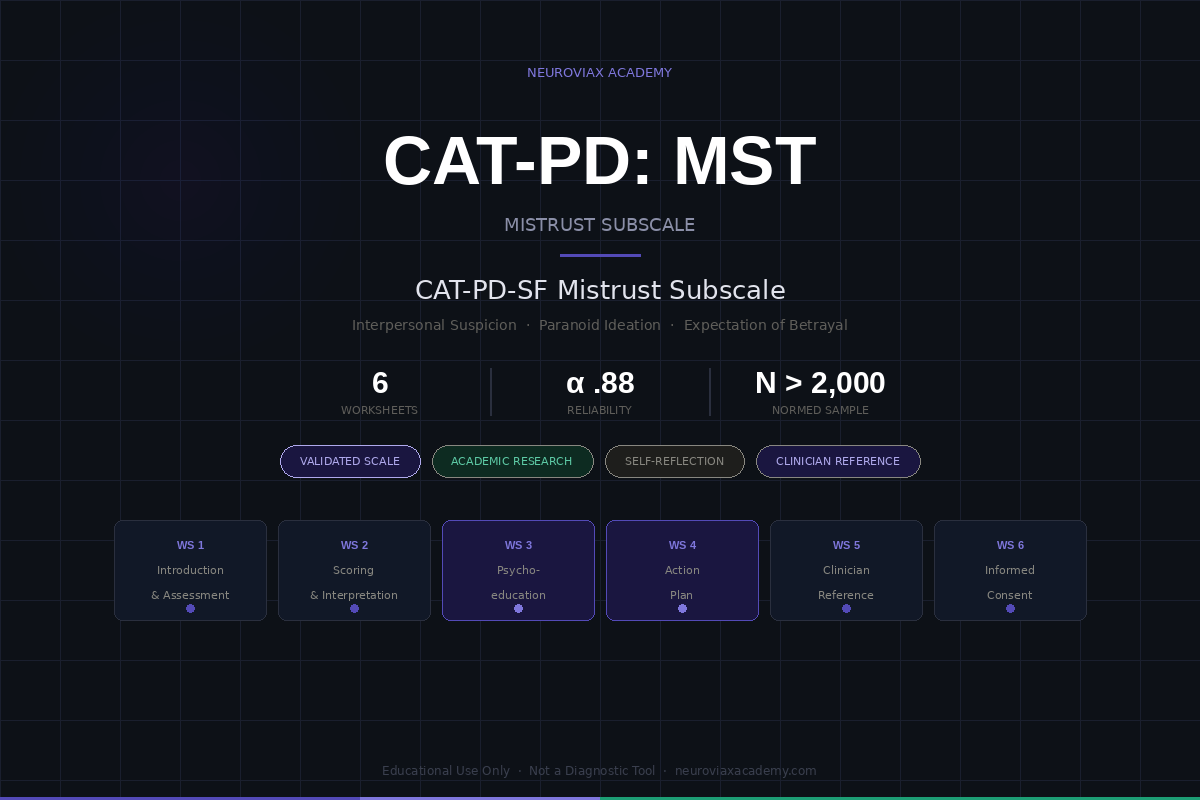
The CAT-PD-MST (CAT-PD-SF Mistrust Subscale) is a subscale drawn from the Computerized Adaptive Assessment of Personality Disorder (CAT-PD) project, developed by Simms and colleagues (2011). It targets one precise dimension of interpersonal functioning: the tendency to anticipate betrayal, suspect hidden motives, and view others as fundamentally untrustworthy. With strong internal consistency (community α = .83; patient α = .88), this is a psychometrically validated instrument adapted for academic self-reflection and educational research.
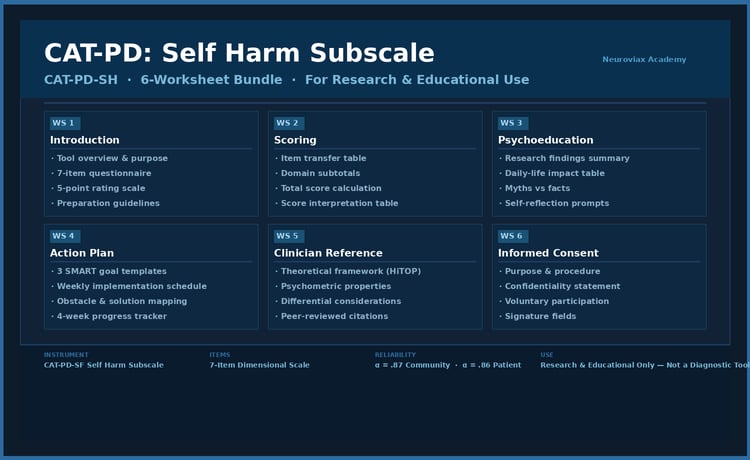
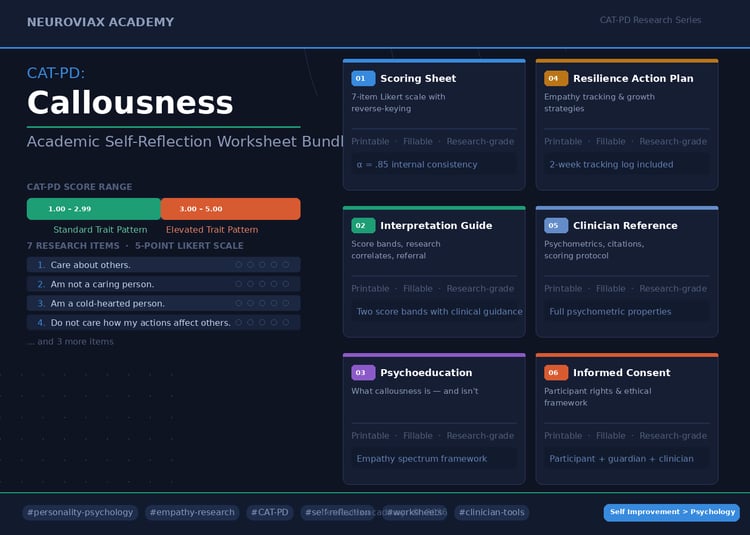
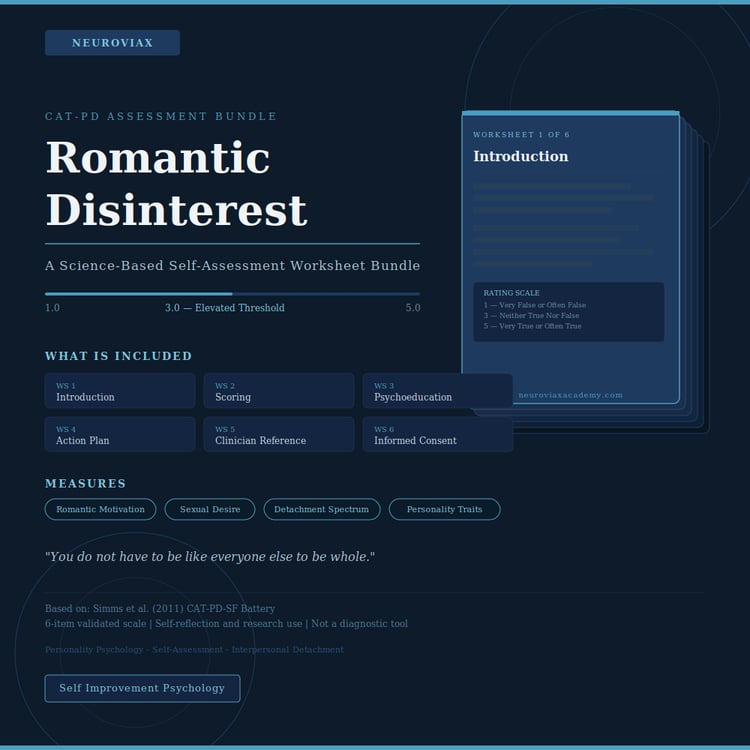
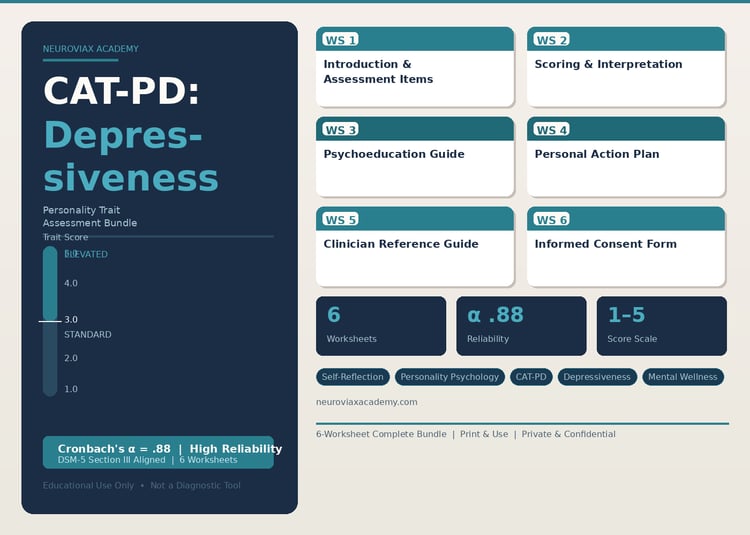
The bundle includes six sequential worksheets designed to take you from assessment to insight to action:
- WS 1 — Introduction: Background on the CAT-PD-MST, instructions for use, and the complete 6-item assessment. You respond to each statement using a structured 5-point rating scale reflecting how you generally think and feel in social situations — not just in response to recent events.
- WS 2 — Scoring: Step-by-step scoring guide with reverse-keyed item handling (Items 5 and 6), domain subtotals across three thematic clusters (Interpersonal Suspicion, Paranoid Ideation, Expectation of Betrayal), and a visual score profile chart. A threshold of 3.0 distinguishes standard from elevated trait patterns.
- WS 3 — Psychoeducation: A research-grounded explanation of what mistrust is, how it develops from early relational experiences, its neurocognitive basis (amygdala activation, threat-detection feedback loops), how it shows up across real-life situations, common myths versus facts, and self-reflection prompts.
- WS 4 — Action Plan: A structured framework for building more balanced trust, including a personal situation reflection, three SMART goal templates, a 7-day weekly implementation planner, an obstacle-solution tracker, support system mapping, and a 4-week progress log.
- WS 5 — Clinician Reference: A technical reference sheet covering theoretical framework (DSM-5 Alternative Model alignment), psychometric properties (reliability, validity, norming data), scoring and interpretation guide for practitioners, and differential diagnostic considerations (Paranoid PD, PTSD, Schizotypal PD, Attachment Trauma).
- WS 6 — Informed Consent: A formal consent document outlining the educational purpose of the tool, confidentiality practices, voluntary participation rights, potential benefits and risks, and a signature field — suitable for use in academic or supervised research settings.
Who This Is For
This bundle is designed for:
- Psychology students and academic researchers studying personality traits, interpersonal functioning, or the cognitive-paranoid dimension of personality
- Individuals interested in evidence-based self-reflection on how trust patterns shape their relationships and emotional well-being
- Counselors, therapists, and clinicians seeking a structured psychoeducational tool to use alongside or in preparation for clinical sessions
- Educators teaching personality assessment, psychopathology, or cognitive-behavioral frameworks in academic settings
- Anyone who has experienced betrayal, manipulation, or early relational disruptions and wants a structured, research-informed way to explore how those experiences may have shaped their view of others
Important Notes
This resource is developed by Neuroviax Academy for educational and academic self-reflection purposes. It is not a clinical diagnostic instrument and does not replace professional mental health evaluation. Elevated scores indicate patterns worth exploring — not a diagnosis. A clinician reference sheet (WS 5) is included specifically for professional use.
If you have ever felt that fully trusting someone felt more dangerous than staying guarded, this toolkit gives you the language, the science, and the structure to start examining that pattern with clarity and care. Download the complete bundle and begin where it feels right.