

CAT-PD: Social Withdrawal — Complete 6-Worksheet Self-Assessment Bundle (CAT-PD-SW)
Do you find yourself pulling away from people even when you're right there in the room with them? You show up, but you don't really connect — and over time, that distance quietly becomes your default. The CAT-PD: Social Withdrawal Assessment Bundle helps you name what's happening, understand why it happens, and take structured steps toward change.
This is a complete 6-worksheet self-assessment series based on the CAT-PD-SF (Computerized Adaptive Test of Personality Disorder — Static Form), developed by Simms and colleagues (2011). The Social Withdrawal subscale (CAT-PD-SW) targets the Detachment trait domain — measuring tendencies toward interpersonal avoidance, limited emotional closeness, and social disengagement. It carries strong psychometric credentials: internal consistency of α = .83–.87, alignment with DSM-5 Alternative Model of Personality Disorders (AMPD), and criterion validity across diverse populations.
What's Inside the Bundle
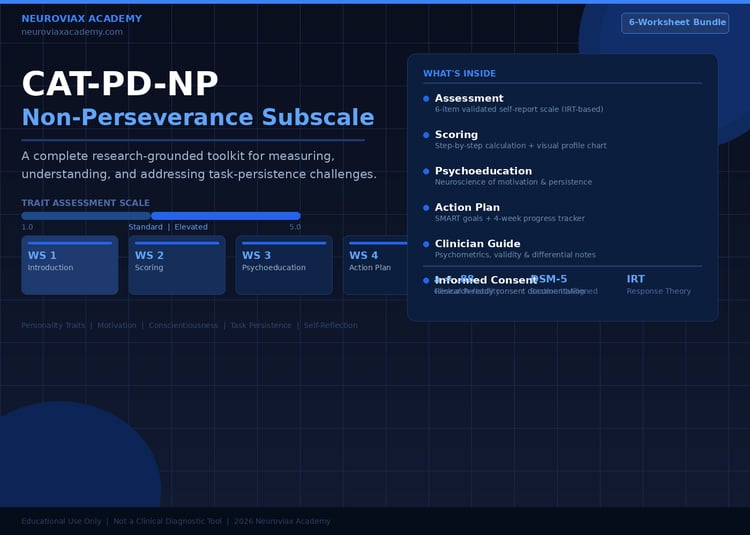
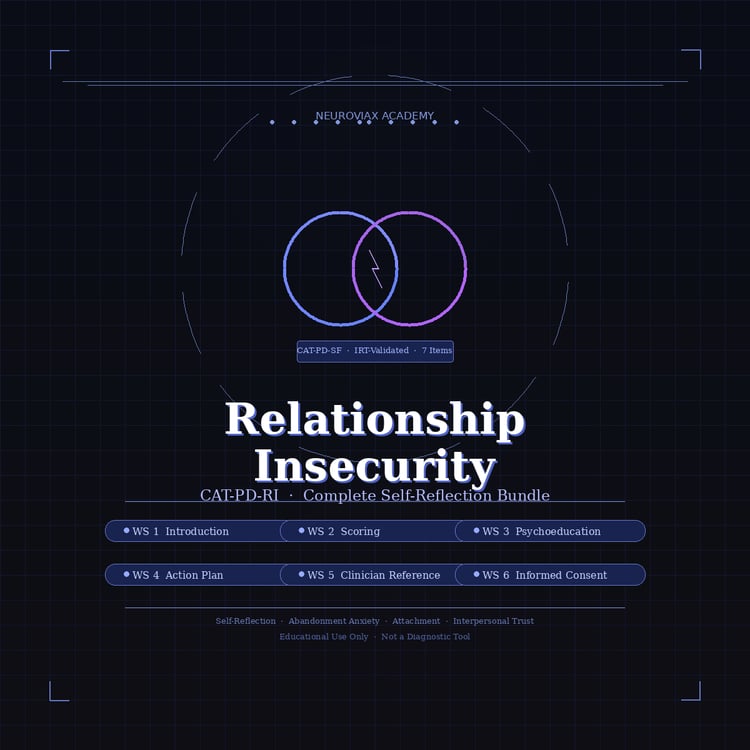
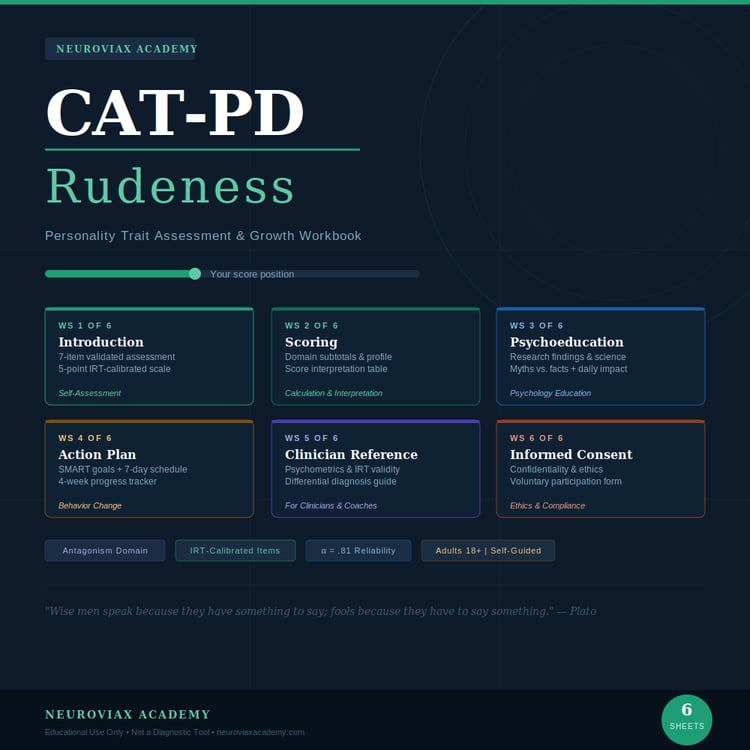
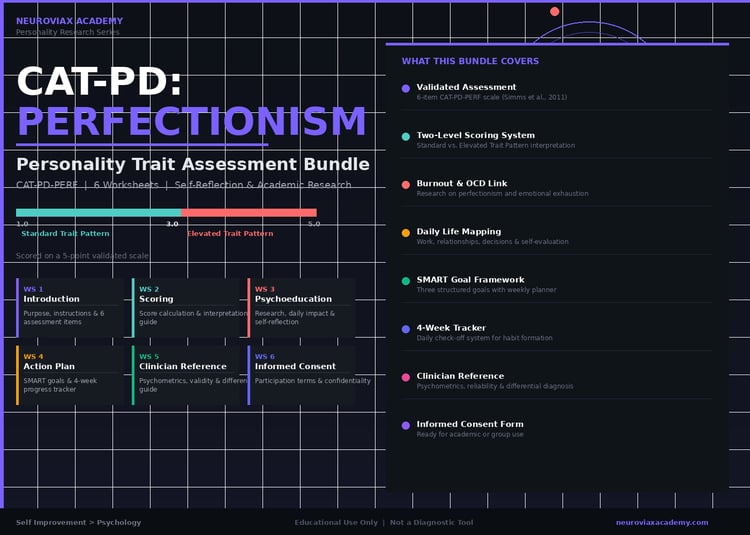
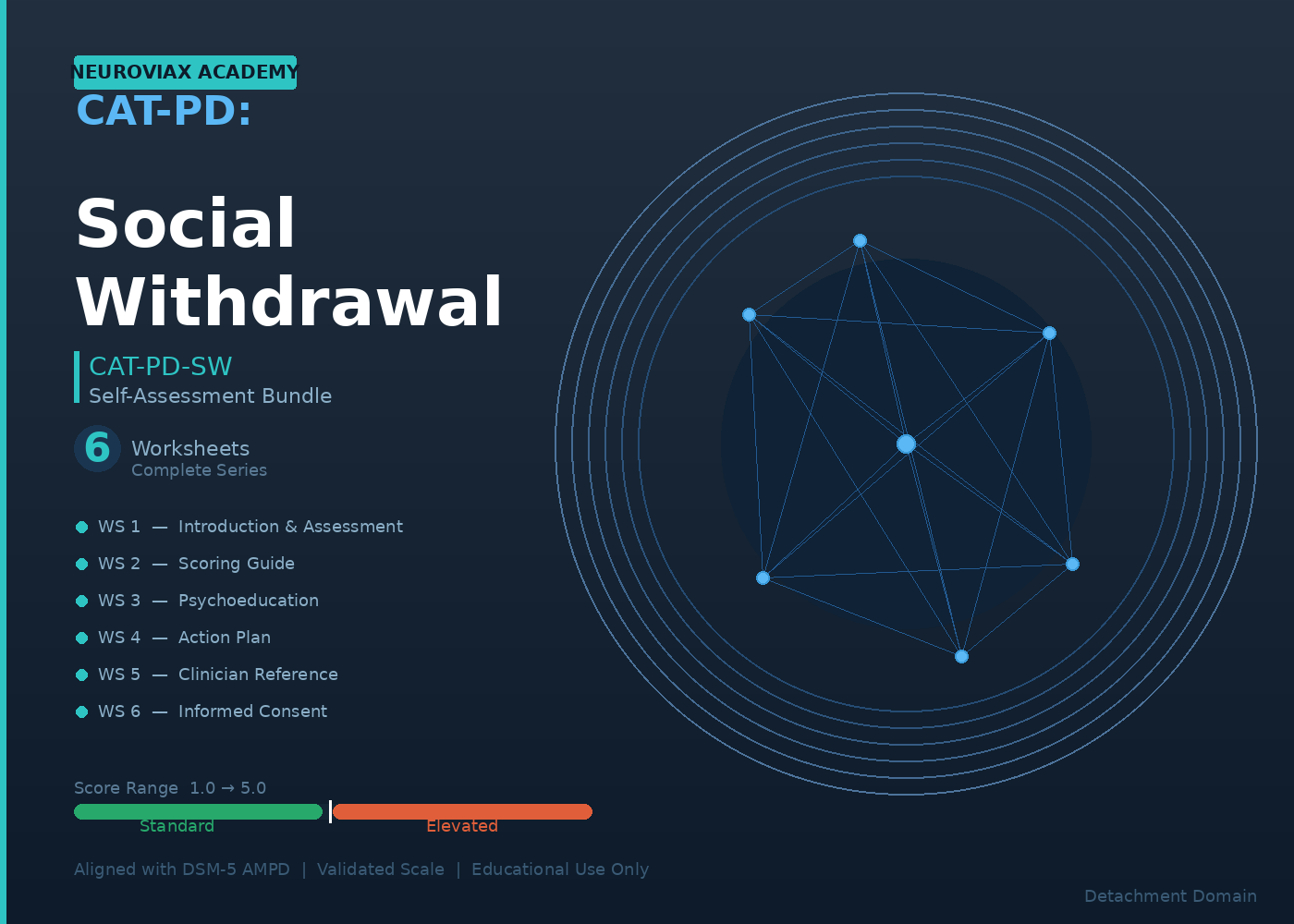
WS 1 — Introduction & Assessment
The core 6-item Likert scale instrument with clear instructions. You rate each statement on a 1–5 scale reflecting how true it feels across time, not just in the moment. Two reverse-keyed items are included to ensure accuracy and reduce response bias.
WS 2 — Scoring Worksheet
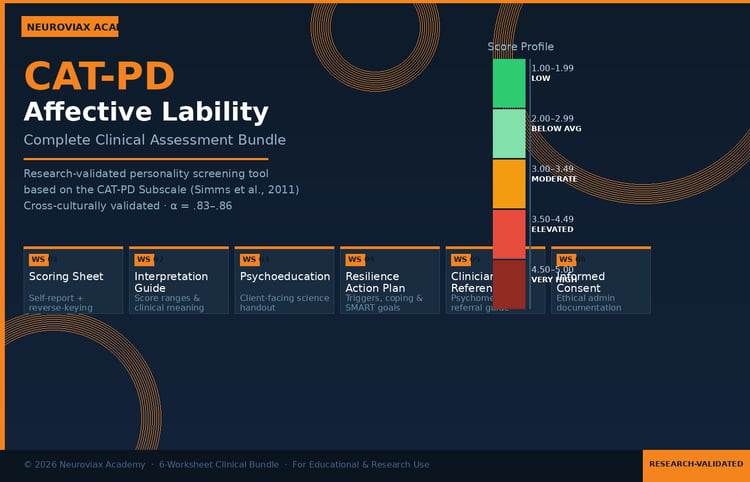
A structured step-by-step scoring guide. Transfer your responses, calculate your adjusted scores, and arrive at a final average between 1.0 and 5.0. A score profile chart helps you visually locate yourself on the trait continuum.
WS 3 — Psychoeducation
An evidence-informed explanation of what social withdrawal actually is — and what it isn't. Covers the neurobehavioral cycle of avoidance, how it affects daily life across work, family, and relationships, common myths vs. facts, and guided self-reflection questions.
WS 4 — Action Plan: Building Intentional Connection
A practical planning worksheet with SMART goal templates, a 7-day implementation schedule, obstacle-solution mapping, support system identification, and a 4-week progress tracker.
WS 5 — Clinician Reference Guide
A professional-facing document covering theoretical framework, psychometric properties, differential considerations (social anxiety, avoidant PD, depression, ASD), and a full evidence base with peer-reviewed citations.
WS 6 — Informed Consent Form
A formal consent document clarifying the educational scope, confidentiality terms, voluntary participation, and risk acknowledgment — suitable for academic or structured group use.
Who This Is For
- Individuals who notice persistent patterns of keeping distance from others and want structured insight
- People exploring whether their preference for solitude has shifted into something more limiting
- Students and researchers using validated personality instruments for academic work
- Mental health professionals looking for a structured psychoeducation and action-planning resource for clients
- Coaches and educators working with self-awareness and interpersonal development
Key Features
- Based on a validated, peer-reviewed scale with strong psychometric properties
- Aligned with DSM-5 AMPD Detachment domain criteria
- Includes both self-use (WS 1–4, 6) and clinician-facing (WS 5) materials
- Print-and-use format — no software required
- Educational use only — not a diagnostic or clinical tool
Social withdrawal isn't a character flaw — it's a measurable trait pattern that becomes self-reinforcing over time. Awareness is the first step. This bundle gives you the structure to take that step intentionally.
Download all 6 worksheets and start your self-assessment today.