
HPLC Course: From First Injection to a Validated Method (64 Animated Video Lessons + Companion Book)
HPLC COURSE
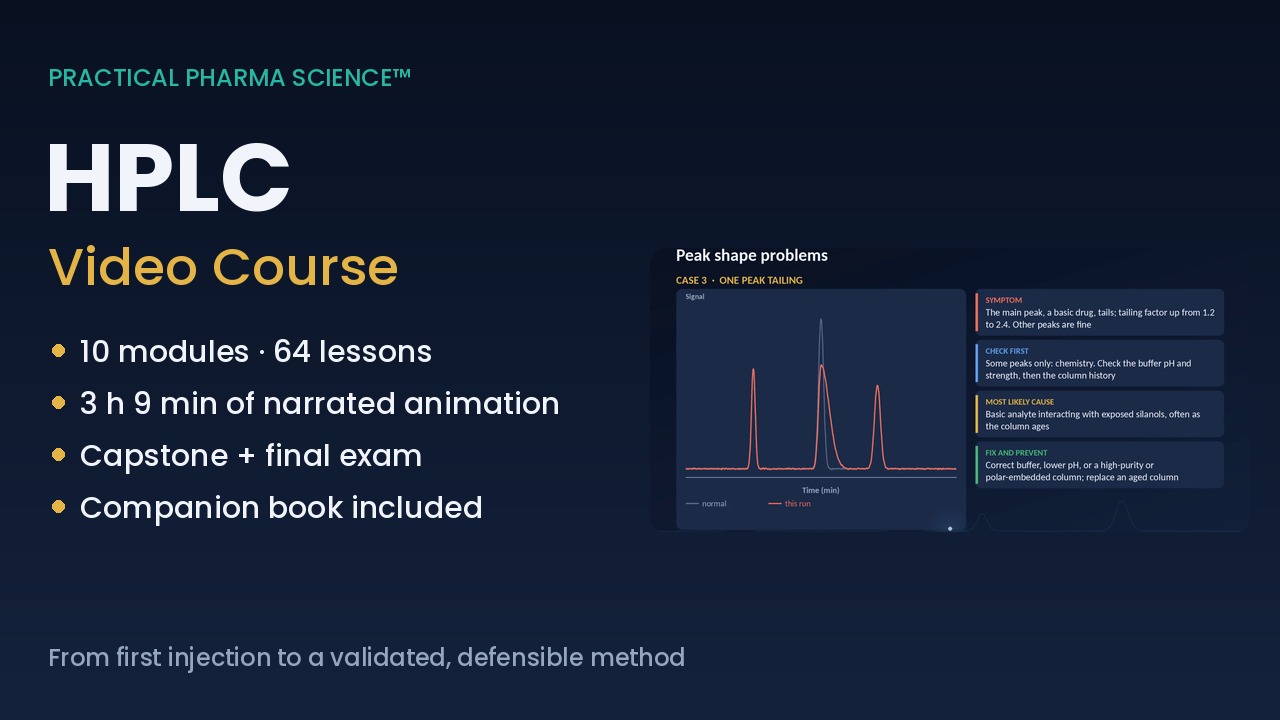
10 modules, 64 lessons, 3 h 9 min of video
Bonus: Video - HPLC Method Development.mp4
Bonus: Video - HPLC Method Validation.mp4
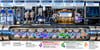
Bonus: Four Posters
Your peak is tailing, the batch is on hold, and QA wants an answer by morning!
This course is for the moment when you need to know why, not just what to click.
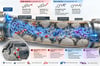
It is 64 short, narrated lessons, every one built from animation instead of a talking head. You watch the band spread inside the column, the van Deemter curve bend, the ionised fraction swing as the pH moves past the pKa, and the chromatogram change as you turn each knob. Each lesson is two to six minutes long, so you can watch one between injections.
It goes from how HPLC actually separates compounds, through columns, mobile phase, detection and system suitability, into a real troubleshooting system, QbD method development to ICH Q14, robustness by design of experiments, validation to ICH Q2(R2), and data integrity the way an inspector reads it. It ends with a capstone you work through yourself and a final exam with a full answer key.
Who it is for: analysts and scientists in QC, R&D and CDMO labs, new hires who need to get productive fast, and experienced analysts who want the reasoning behind the habits.
What you get
- 64 narrated, animated lessons, 3 h 9 min in total, 1080p, yours to keep once you buy it
- 10 modules, each closing with a recap and bench card
- 12 real troubleshooting cases: pressure, peak shape, baseline, retention and precision
- Capstone project, final exam and model answer key
- Companion book (PDF): every lesson in print, with figures, for your bench or your training file
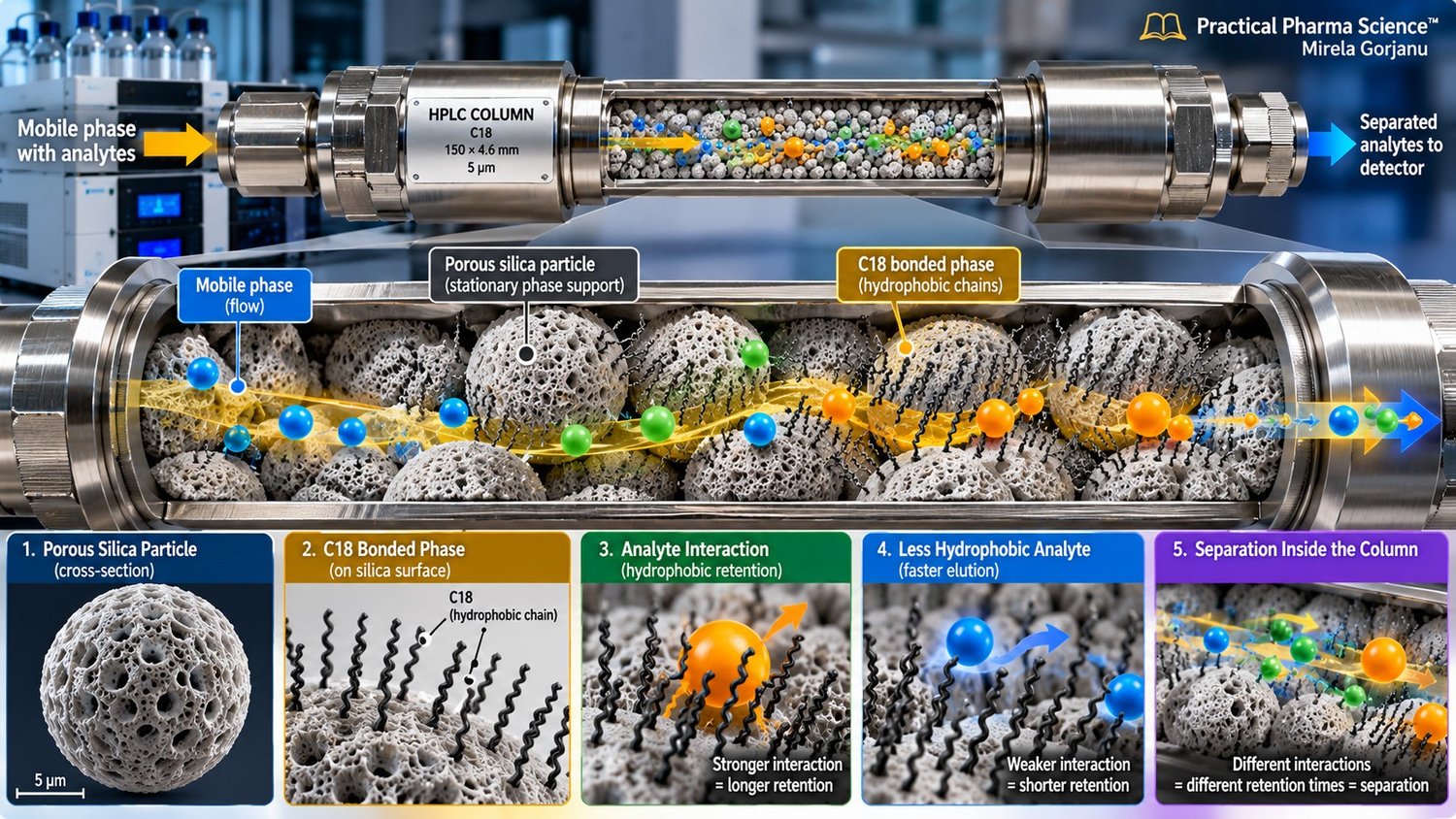
Free preview: watch Lesson 1.3, Inside the column: why compounds separate, before you buy.
Note: the hands-on lessons demonstrate Practical Pharma Science tools and templates. Those tools are not included in the course; several are free at practicalpharmascience.com/tools and the rest are sold separately.
Course contents: 10 modules, 64 lessons, 3 h 9 min of video
Module 1 · How HPLC works (7 lessons, 29 min)
- 1.1 What HPLC actually does
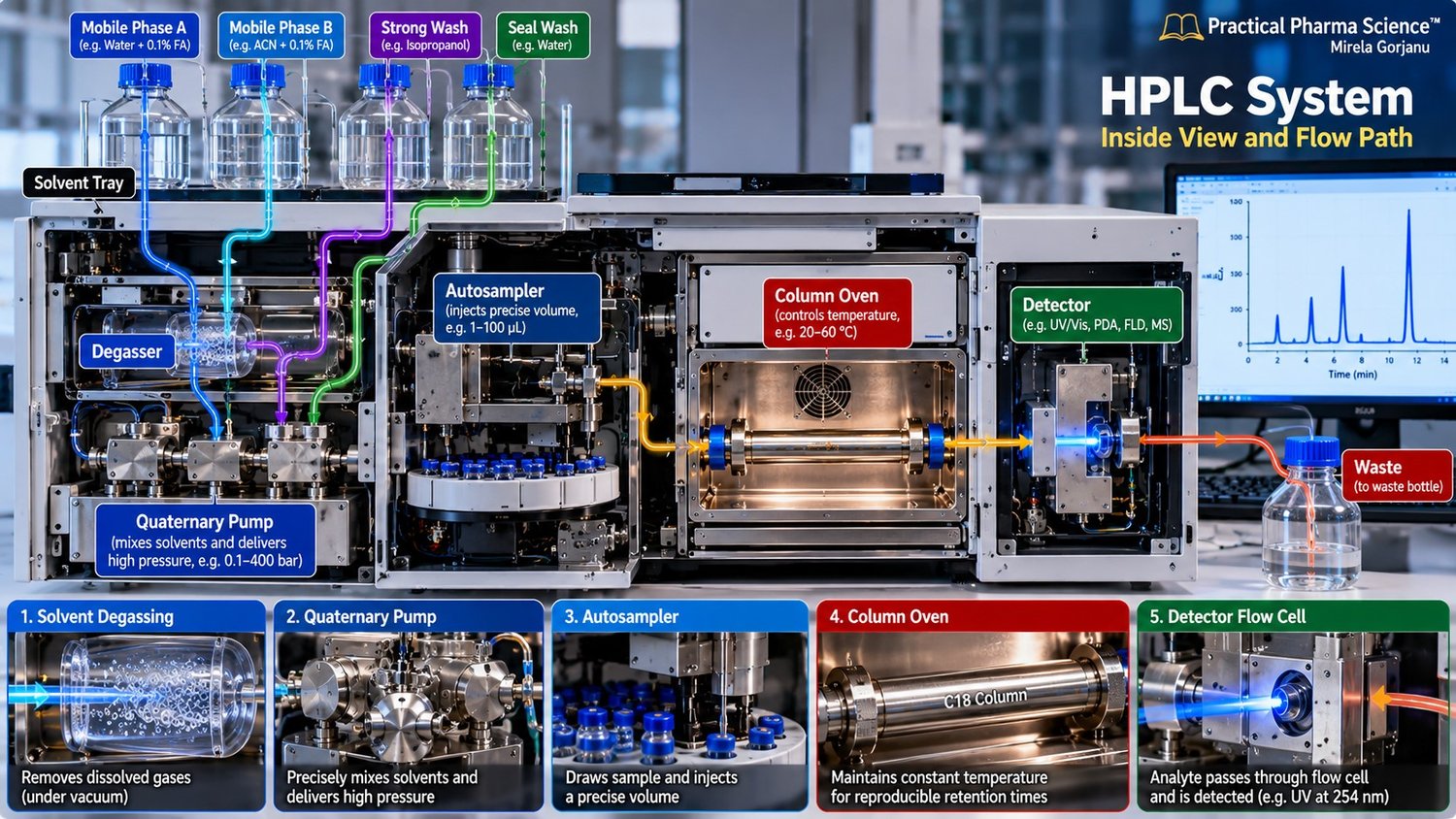
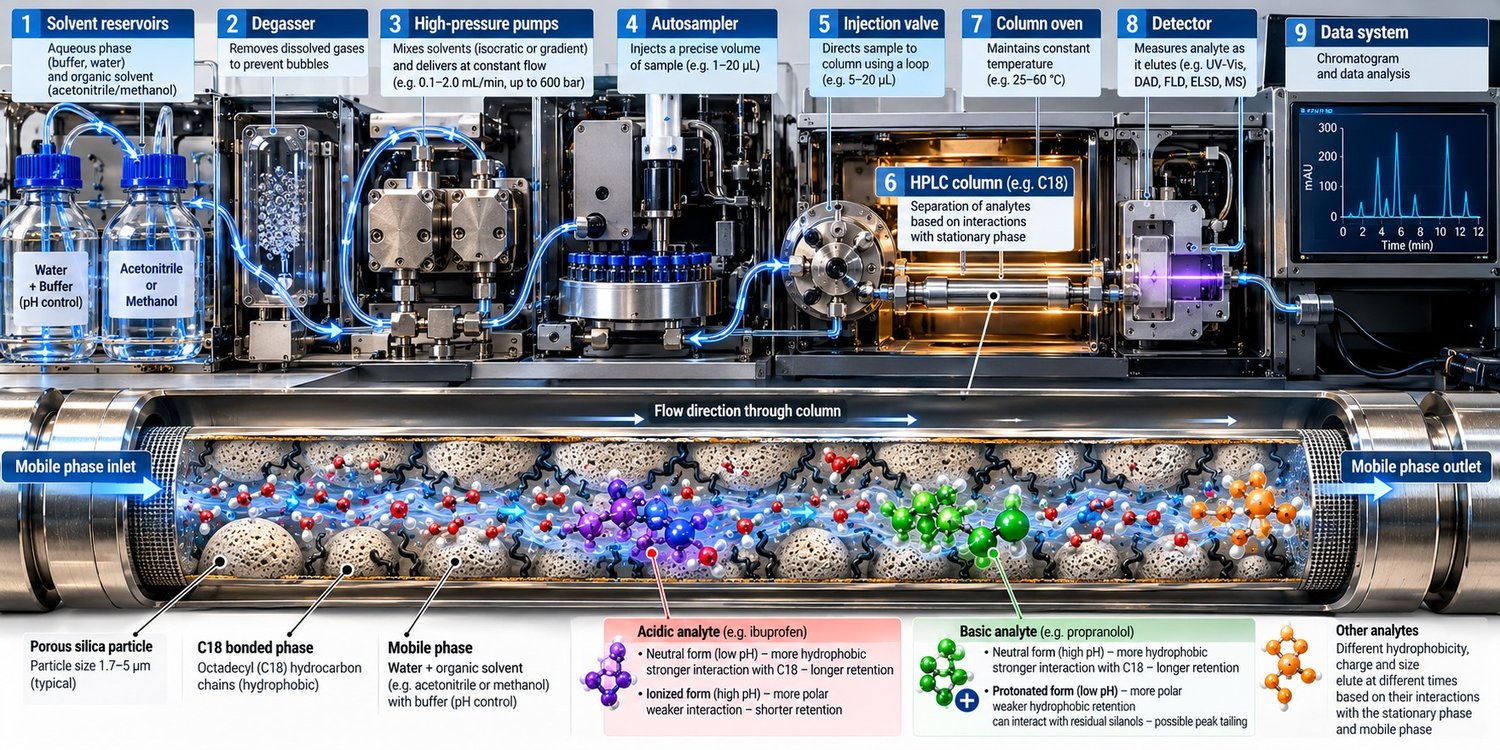
- 1.2 The flow path, component by component
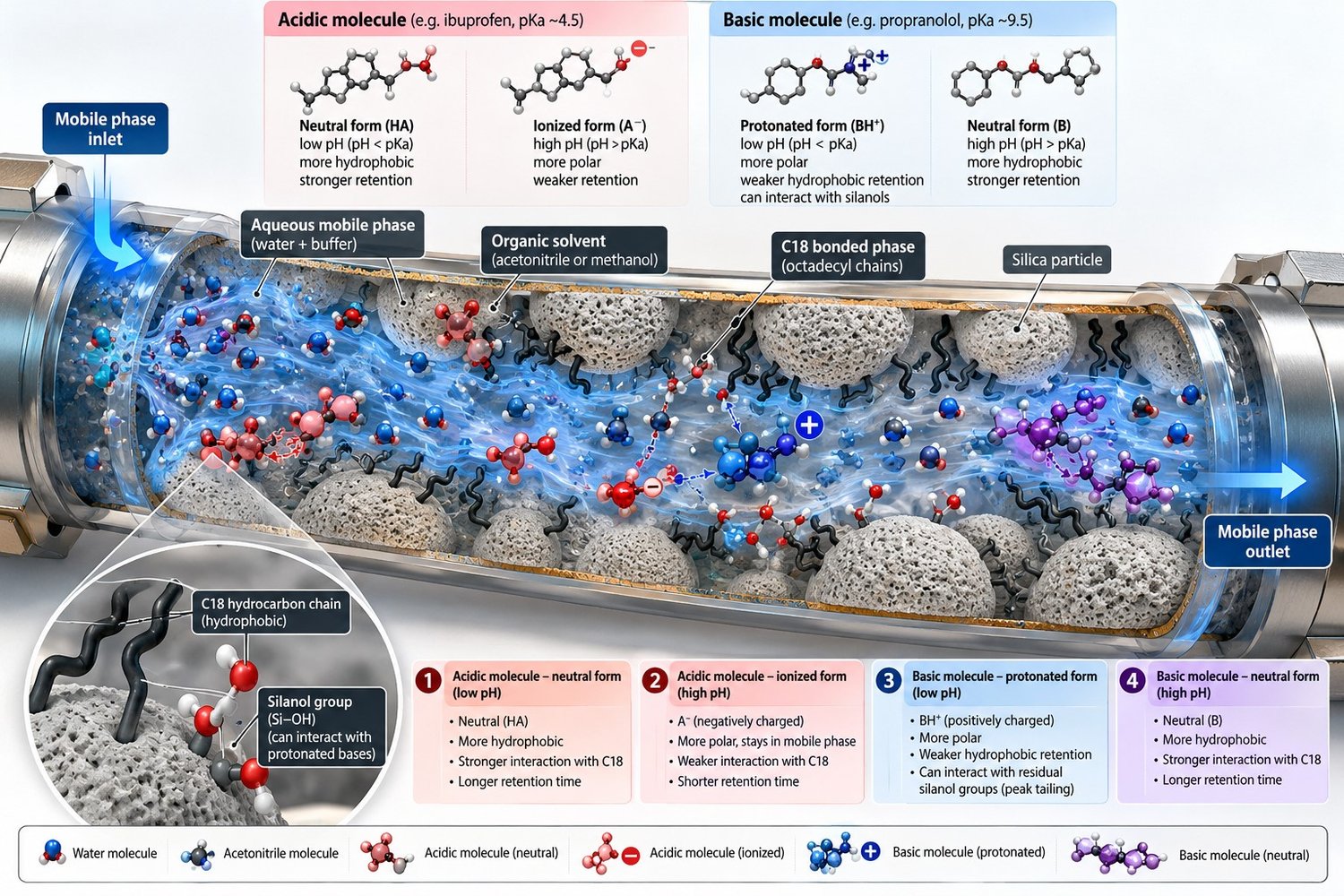
- 1.3 Inside the column: why compounds separate
- 1.4 Reading the chromatogram
- 1.5 The four numbers: k, α, N and resolution
- 1.6 Isocratic versus gradient elution
- 1.7 Module 1 recap and bench card
Module 2 · Columns and stationary phases (7 lessons, 30 min)
- 2.1 Anatomy of a column
- 2.2 Particles, plates and the van Deemter curve
- 2.3 Stationary phase chemistry
- 2.4 Choosing a column
- 2.5 Hands-on: the 10-Column Selection Simulator
- 2.6 Column care and lifetime
- 2.7 Module 2 recap and bench card
Module 3 · Mobile phase, pH and buffers (7 lessons, 23 min)
- 3.1 The organic modifier
- 3.2 pH and ionisation
- 3.3 How far from the pKa is far enough?
- 3.4 Buffers and additives
- 3.5 Hands-on: the 3-Compound Simulator and the pH lever
- 3.6 Mobile phase problems at the bench
- 3.7 Module 3 recap and bench card
Module 4 · Detectors, integration and system suitability (8 lessons, 23 min)
- 4.1 UV and diode array detection
- 4.2 Other detectors, and when you need them
- 4.3 Integration: turning peaks into numbers
- 4.4 From area to result: quantitation
- 4.5 System suitability
- 4.6 Hands-on: the system suitability calculator
- 4.7 When system suitability fails
- 4.8 Module 4 recap and bench card
Module 5 · Troubleshooting (6 lessons, 17 min)
- 5.1 A troubleshooting system
- 5.2 Pressure problems
- 5.3 Peak shape problems
- 5.4 Baseline problems
- 5.5 Retention and precision problems
- 5.6 Module 5 recap and troubleshooting matrix
Module 6 · Method development with QbD and ICH Q14 (7 lessons, 16 min)
- 6.1 From trial and error to QbD
- 6.2 Know the molecule first
- 6.3 Screening and gradient optimisation
- 6.4 Risk assessment and the design region
- 6.5 Hands-on: the gradient and column length levers
- 6.6 The control strategy and the method document
- 6.7 Module 6 recap and bench card
Module 7 · Robustness and design of experiments (5 lessons, 12 min)
- 7.1 What robustness really means
- 7.2 A two-level factorial, worked by hand
- 7.3 Screening designs, response surfaces and the design region
- 7.4 Hands-on: the DoE worksheet
- 7.5 From results to ranges and controls
Module 8 · Validation and the analytical lifecycle (7 lessons, 17 min)
- 8.1 Validation in the lifecycle
- 8.2 Which characteristics, for which test
- 8.3 Specificity and forced degradation
- 8.4 Range, response and the limits
- 8.5 Accuracy and precision
- 8.6 Hands-on: protocol, report and the practical studies
- 8.7 After validation: transfer, change and verification
Module 9 · Data integrity (5 lessons, 11 min)
- 9.1 ALCOA+: what trustworthy data looks like
- 9.2 Part 11 and Annex 11 in practice
- 9.3 Integration rules that stand up to inspection
- 9.4 Reading an audit trail like a reviewer
- 9.5 Hands-on: defending a manual integration
Module 10 · Capstone (5 lessons, 11 min)
- 10.1 The brief and the ATP
- 10.2 Development: screen, stress and optimise
- 10.3 Robustness and validation
- 10.4 Control strategy, your capstone and the final exam
- 10.5 Course wrap-up
Expand Your Learning
YouTube Channel: Watch step by step educational videos at YouTube/@PracticalPharmaScience.
