
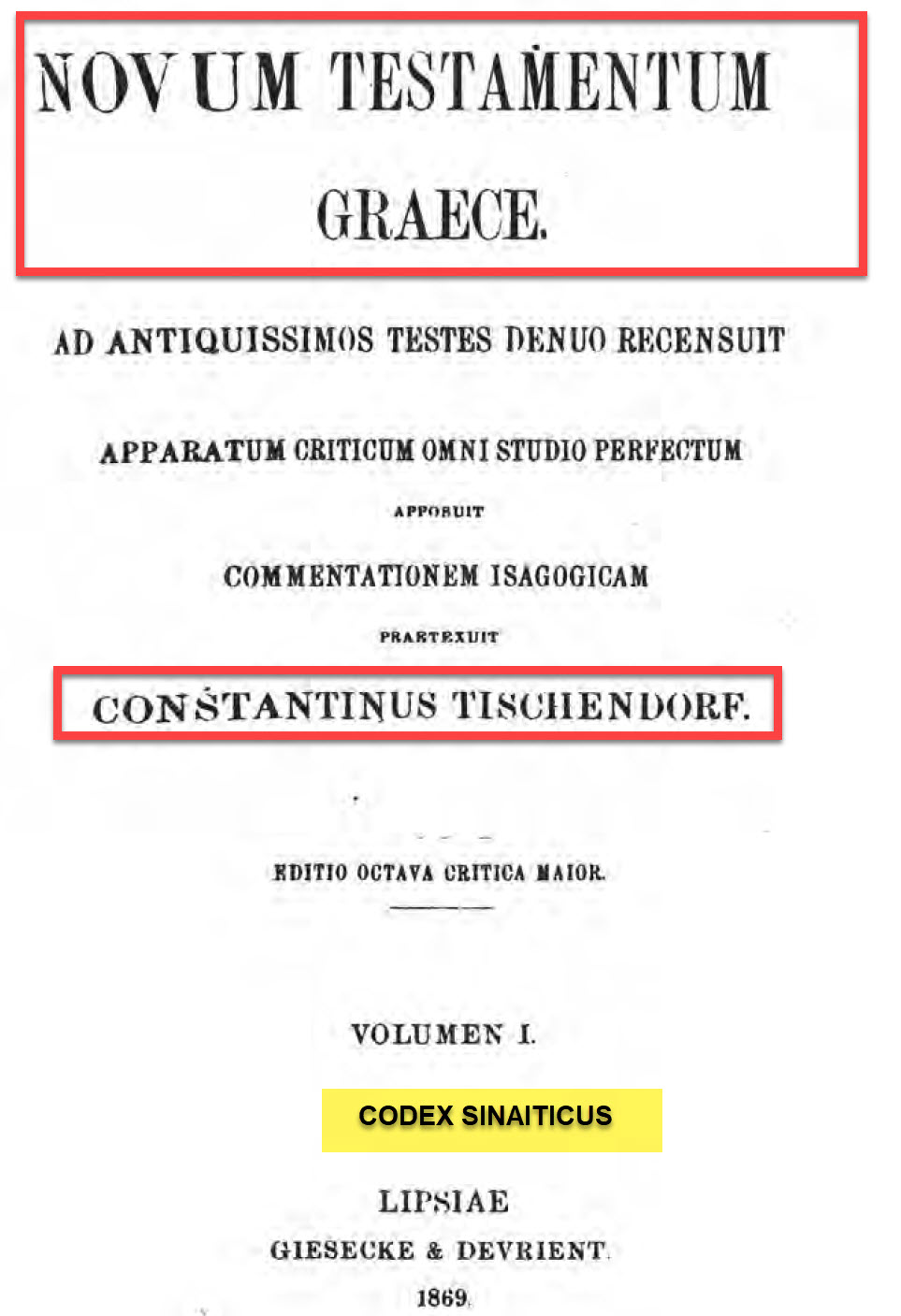
1869 Codex Sinaiticus Vol 1 Greek Four Gospels by Tischendorf
Tischendorf published in 1869 Volume 1 above of what is now known today as the Codex Sinaiticus. This volume 1 represents the Four Gospels within a larger series called the "Greek New Testament" by Tischendorf. (We will produce each volume separately in the future.) The Codex Sinaiticus is an entirely Greek version of the entire Bible -- the "Old" Testament and the "New" Testament plus two small add on works - Epistle of Barnabas and Shepherd of Hermas -- circulating in the 300s or 400s.
In the 1844 to 1859 period, Tischendorf in three trips discovered the entire Codex Sinaiticus at a monastery named St. Catherine's in the Sinai Peninsula. Now the Codex Sinaiticus largely sits in a British Museum, while one portion is in Russia.
ENGLISH TRANSLATION NEVER HAS HAPPENED
The Codex Sinaiticus has never been properly translated into English. Anderson started a project to do so in the 1860s, but failed to do a proper job. Nor did his heirs improve on it in the republication of 1918. The verdict is:
"Textual critics note that neither the 1918 edition nor Anderson's earlier 1866 work serves as a literal or pure representation of the actual Greek text found inside the physical Codex Sinaiticus manuscript. The 1918 text was adopted by the digital Codex Sinaiticus Project primarily as a generic English navigational aid rather than a strict translation of the 4th-century codex itself." [Google AI Search]
Even the Codex Sinaiticus project online where you can view a photo map of the entire Codex Sinaiticus -- https://codexsinaiticus.org/en/ -- concedes they use Anderson's text only for navigation, but not for any translation. The Codex Sinaiticus project reads:
“The English translation of the New Testament part of Codex Sinaiticus used on the website was taken from the translation by Henry Tompkins Anderson in The New Testament: translated from the Sinaitic manuscript discovered by Constantine Tischendorf at Mt Sinai (Cincinnati, 1918). This out-of-copyright translation does not provide a literal translation of the text in Codex Sinaiticus, but was included in the website to serve as a navigational aid.”
A list of the atrocious errors by Mr. Anderson or his heirs are at this url:
https://www.thetextofthegospels.com/2016/08/why-codex-sinaiticus-doesnt-say-what.html
The author of that page, James Snapp, remarks correctly:
If the Codex Sinaiticus website is going to continue using Anderson’s translation, its creators should take whatever steps are necessary to ensure that visitors cannot use Anderson’s translation without being informed that it is provided for navigation-purposes only and that it deviates frequently from the actual text of the manuscript. There is no good reason to hide this important explanation on a secondary webpage. (Another option, of course, is to adjust the translation so as to accurately conform to the contents of the manuscript.)
NOTEBOOK.GOOGLE.COM IS THE SOLUTION
The latest Notebooklm.google.com search engine allows an alternative. Whatever language exists in your PDFS which you upload to your Notebooklm database "notebook" -- in the free version you have up to 100 Notebooks with up to 100 sources (e.g., each PDF is a source), you can now overcome the lack of a handy English translation of the Codex Sinaiticus.
Your can query all 11 parts above - prepped in slices that fit within fNotebooklm's capacity -- is able to read the Greek to answer your question accros all 11 parts or as few as you wish to select.
In the answers to your Chat query, Notebooklm will print the actual letters in Greek in its answer (if you ask), and translate them into English. It takes about 5 minutes for an answer. Yet, without this tool, there would be no easier way to find the location, and translate it.
OUR SPECIAL ADAPTATION OF TISCHENDORF'S VOLUME 1 - THE FOUR GOSPELS
To that end, I have prepared Tischendorf's Four Gospels in Greek and Latin-- no English appears -- into 11 subparts so that they can be a easily read by Gemini's "Notebooklm" at notebooklm.google.com.
This Notebooklm search engine can instantaneously apply an English question to query a Greek or Latin text, and then translate this text from Greek or Latin to the language you used in the query. Once you download these 11 parts, you can do this type of search once you upload all 11 parts to a single notebook. Then go to the "Chat" box, and ask a question. The search engine of Notebooklm will translate the Greek and Latin in the Codex Sinaiticus as necessary to provide you accurate answers. You answer will arrive in 5 minutes or less, on average.
The 11 slices of Volume 1 - the Four Gospels in Greek and Latin -- are sized for NotebookLm -- 103 pages per slice max. I also used a high-end commercial OCR engine software to perform a Greek optical character recognition (OCR) besides a second pass to render the Latin (same as English lettering) into a text recognizable form.
These OCR passes thereby make Volume 1 accessible with natural language queries to uncover its contents for non-scholars who do not know anything about how to translate Greek.
DATING THE CODEX SINAITICUS - TRADITIONAL VIEW VS MY QUESTIONS
I pray this will be a great aid to Christians and non-Christians alike -- to analyze the contents of a text dating approximately no earlier than 330 CE (due to using tools Eusebius invented) and generally estimated to be from as late as 360 CE.
However, I do not agree on the early dating, and would put the dating to 393 AD at minimum, and likely in the early 400s..
Why?
Because the Codex Sinaiticus gives us contents first formally adopted in 393 AD at Hippo in Algeria as canon, it is more likely this work should be estimated to be 393 AD plus a few years. In other words, outside of Hippo in 392 AD - a single city-state, this version of the Four Gospels, Acts, the Epistles and Revelation never were combined beforehand.
Then one must also consider that appended to the Codex Sinaiticus are 2 stray works - the Epistle of Barnabas and the Shepherd of Hermes. This attaches 2 more works to what otherwise fits the canon first announced at the 393 AD Council of Hippo (Algeria). This strongly suggests it had time for more discussion and admission of new works than was even being discussed at the time the TEXT-TYPE of Codex Bezae was form. Hence, Codex Sinaiticus by all indicators is much later than a work like the Codex Bezae whose list of contents are much narrower, fitting within the Old Syriac and Old Latin framework from the mid-200s.
Scholars have gone unrefuted who advance this position that based on TEXT-TYPE the Codex Bezae is a copy of the texts from the mid-200s although paleographically the physical script is later - even 400 CE or later.
We read: "Underlying Text-Type: Scholars like J. Rendel Harris in the late 19th and early 20th centuries argued that the ancestral exemplar (the lost older manuscript that Codex Bezae was copied from) may have roots extending back into the 3rd century [i.e., the 200s]. [1] See THE ACTS OF THE APOSTLES (Translated from the Codex Bezae with an Introduction on its Lucan Origin and importance by Canon J. M. WILSON, D.D. (LONDON: THE MACMILLAN CO. : 1923)
1923
Old Latin Traditions: The Latin translation tradition embedded in the bilingual codex reflects older forms that circulated during or before the 3rd century, even though the physical copy was made later. [1]
The Codex Bezae in line with Old Latin and Old Syriac (200s CE) Christian Bible which include besides the Gospels, also the Book of Acts but also 3 John which was in the Old Syriac:
Gospel of Matthew (with several missing gaps/lacunae)
Gospel of John (with missing gaps)
Gospel of Luke
Gospel of Mark
Acts of the Apostles (with several missing gaps)
Third Epistle of John (only a short Latin-Greek fragment at the very end)
As to the additions, we read: ""Old Latin text traditions contain both the Book of Acts and 3 John." (Google AI).
"Book of Acts: Early Syriac tradition recognized and translated Acts (often aligning with the Western text-type), though surviving distinct "Old Syriac" witnesses focus heavily on the gospels (Evangelion da-Mepharreshe)." (Google AI.) But "3 John: No [did not include]. "The early Syriac tradition and the canonical standard (Peshitta) originally omitted ... 3 John, .... recognizing a narrower ... canon."
So while many sources will claim Codex Bezae is from 400 AD (precisely), its layout and what was "canon" fit a 200s era of the Old Latin, while the Codex Sinaiticus table of contents reads like list created after the 393 CE list at Hippo, Algeria, the first city-state to officially adopt a canon list that mirrors our current list.
Yet, Codex Sinaiticus should also be deemed later than Codex Bezae because it added two add-ons within the Codex Sinaiticus: [1] the Epistle of Barnabas and [2] the Shepherd of Hermas. These add-ons surely indicate a luxury to "expand" canon which the Codex Bezae never hand an inkling to advance them so high.
Hence Codex Bezae should likely be regarded as belonging to a much earlier epoch than the Codex Sinaiticus. A much more simple time in terms of canon.
Regardless of the dating, Codex Sinaiticus is a treasure to affirm that a high percentage of what we read today can be found in the Codex Sinaiticus.