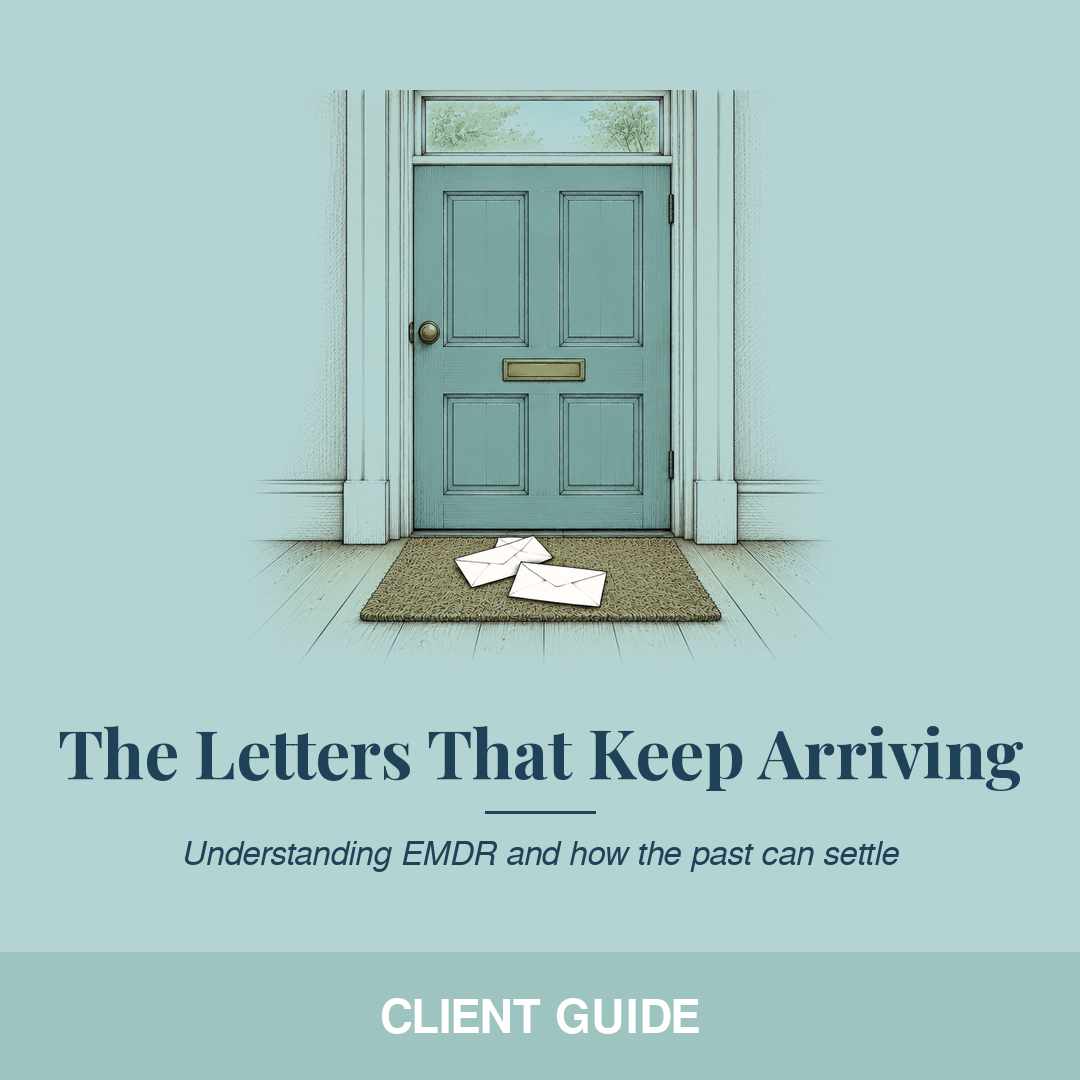
The Letters That Keep Arriving: EMDR Guide
A simple, reflective guide to help you understand EMDR and what to expect, written for clients rather than professionals.
Starting EMDR can feel unfamiliar. You may have questions about what will happen, why difficult experiences can continue to affect you, or how working with the past could possibly change how you feel in the present.
The Letters That Keep Arriving offers a gentle way to begin answering those questions.
It is built around a single, everyday image. Some experiences arrive at a time when they cannot be opened. They are never read and never filed, so they keep landing on the doormat, looking as urgent as the first time. EMDR offers a way to open those letters with someone beside you, and finally put them away with a date on them.
Rather than overwhelming you with technical explanations, the guide offers a starting point for curiosity, understanding and conversation.
How you can use this guide
You might use it to:
- understand what EMDR is before deciding whether to explore it
- make sense of why past experiences can continue to affect present-day responses
- explore the connection between memories, emotions, thoughts and body sensations
- know what to expect from an EMDR session, from preparation through to the end of each session
- think about questions you would like to ask a therapist
- revisit what you have discussed in therapy, in your own time
Between knowing and feeling
Sometimes understanding where a reaction comes from isn't enough. You may know exactly why you respond the way you do, and still wonder:
Why am I still affected by something that happened years ago?
Why does my body react when I know I'm safe now?
What actually happens when a memory is processed?
Will I have to talk about everything that happened?
The Letters That Keep Arriving is designed to help with these questions. It doesn't try to explain every aspect of EMDR. It offers a starting point from which you, and your therapist if you have one, can explore what EMDR might mean for you.
Written for clients
This guide is written for anyone who is considering EMDR, has recently begun, or would simply like to understand it better. It uses plain language, and you don't need to think about anything painful in order to read it.
Therapists may also find it useful to share with clients during the preparation phase of EMDR. It sits alongside The Bridge: Introducing EMDR to Clients, our free practitioner resource.
What's included
The Letters That Keep Arriving: A Client Guide to EMDR
A 4-page illustrated A4 PDF, designed to read on screen or print at home, including:
- why some memories stay vivid and close while others fade
- what a memory can hold beyond pictures
- what happens in EMDR, in three simple stages
- what stays in your hands throughout
- answers to common questions, including whether EMDR is hypnosis and whether it can be done online
- a few gentle questions to help you think about what you would like from therapy
Personal and practitioner use
This guide is provided for your own personal use. Therapists may print and share it with their own clients as part of their therapeutic work.
It may not be resold, redistributed, uploaded elsewhere, reproduced as part of another commercial product or shared with other practitioners without an appropriate licence.
If you work as part of a team or organisation and would like to use the guide across multiple practitioners, please get in touch about an appropriate licence.
Please note
This guide is for information only. It is not a substitute for assessment, therapy or professional advice, and it does not teach you how to carry out EMDR on yourself.
EMDR should always take place with a suitably trained therapist, following appropriate assessment and preparation.
If you are finding things very difficult, please speak to your GP or contact NHS 111. In an emergency, call 999.
Free resource
This guide is offered free of charge because we believe everyone deserves clear, accessible information about therapy, so they can make informed choices about the support they explore.
If you find it helpful, you may also wish to explore the other resources available from Place to Talk Therapies.