
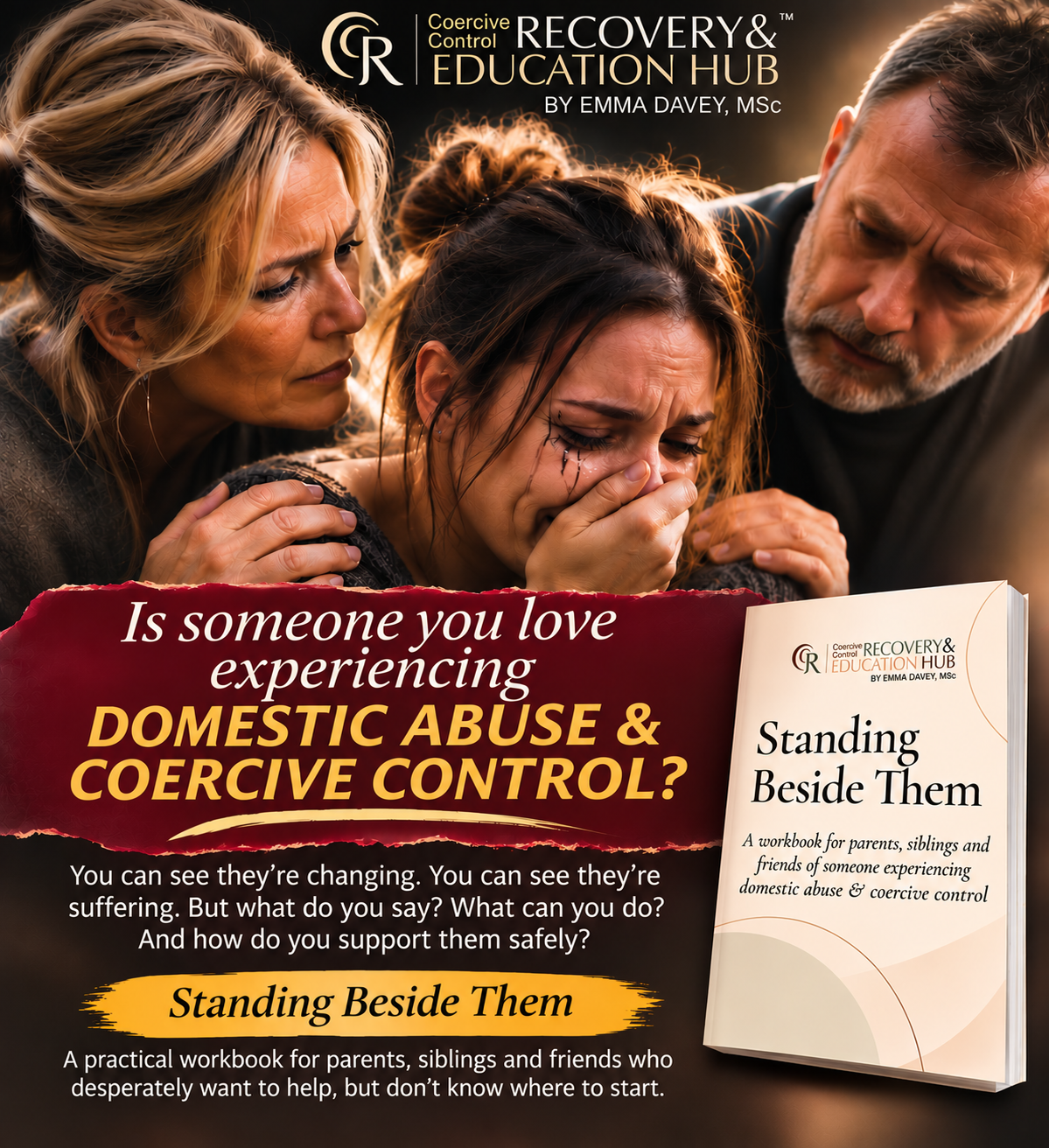
Standing Beside Them: A workbook for parents, siblings and friends of someone experiencing domestic abuse and coercive control
Standing Beside Them
A practical workbook for parents, siblings and friends supporting someone experiencing domestic abuse and coercive control
You can see it happening. Someone you love is changing, and you don’t know how to help.
Maybe your adult child has stopped calling. Maybe your sibling cancels plans at the last minute, checks their phone nervously, or defends a partner who you can see is slowly taking over their life. Maybe your best friend no longer seems like themselves. You feel worried, angry, helpless, and sometimes pushed away. You’re scared of saying the wrong thing and losing them altogether.
Standing Beside Them was written for you.
This workbook is for the people on the outside: the parents, siblings, grandparents and friends watching someone they love live with domestic abuse and coercive control. It explains what is really happening, why your loved one may not leave, and exactly what you can do to stay close, keep them safer and look after yourself along the way.
Who this workbook is for
- Parents of an adult child in an abusive or controlling relationship
- Siblings, grandparents, aunts and uncles worried about a family member
- Friends and colleagues who have noticed someone they care about changing
- Grandparents and relatives concerned about children living in an abusive home
- Anyone who has asked, “Why won’t they just leave?” and wants to truly understand
Domestic abuse and coercive control can happen to anyone, whatever their gender, age, background or sexuality. This workbook is written for every family and every relationship.
Why you need it
Coercive control is hard to see and even harder to understand from the outside. It rarely starts with violence. It starts with love-bombing, then slowly isolates, monitors, controls and frightens someone until they no longer recognise themselves.
Families often do what feels natural, like confronting the partner, pushing their loved one to leave or giving ultimatums. These can unintentionally make things more dangerous and push their loved one further away. Abusers also often target families directly, charming them, playing the victim and driving a wedge between relatives, because a divided family means a more isolated victim.
Leaving an abusive relationship can also be the most dangerous time. Supporting someone safely takes understanding, patience, careful documentation and the right professional help.
This workbook gives you that understanding, in a calm, compassionate and practical way.
What’s inside
Fourteen easy-to-follow parts, each with practical tools, reflection prompts and space to write:
- Understanding what is happening: coercive control explained in plain English, the law in England and Wales, the grooming phase, the cycle of abuse, and the Power and Control Wheel
- Signs and red flags: tick-lists of warning signs in your loved one, their partner and your relationship with them, including high-risk indicators
- Gaslighting and playing the victim: common gaslighting phrases, the DARVO pattern, reactive abuse, how abusers may try to manipulate you, and how to stop them dividing your family
- The impact on the person you love: trauma, the nervous system, survival responses (fight, flight, freeze and fawn), and the Power Threat Meaning Framework
- Why won’t they leave? The trauma bond, intermittent reinforcement, power, threats, embedded fear, and why leaving can be the most dangerous time
- What is happening to you: why your anger, guilt, grief and exhaustion are normal
- When they push you away: understanding their fear, what to say instead, and safe check-in messages
- How to stand beside them: what to say, what to avoid, practical support, code words, and how to behave safely around their partner
- When there are children: how children are affected, signs to look for at every age, and what to expect if Cafcass or social services get in touch
- When they leave: post-separation abuse, the trauma that surfaces later, what to do if they go back, and helping them reclaim who they are
- Noticing and documenting the changes: “before and after” snapshots and ready-to-use observation, contact and disclosure logs
- Evidence: what you can safely collect, an evidence coding system, a witness checklist, Clare’s Law, and how to prepare a witness statement
- Caring for yourself: settling your nervous system, healthy boundaries, a self-care plan and weekly check-ins
- When it is urgent: when to call 999, the Silent Solution, and your own emergency plan
Plus a full UK support directory of helplines and specialist services.
How it will help you
- Understand what your loved one is going through, and why they act the way they do
- Stop blaming yourself, or them
- Know exactly what to say (and what not to say) to keep the door open
- Stay connected even when they push you away
- Protect them by staying calm and neutral around their partner
- Spot gaslighting and manipulation aimed at your loved one and at you
- Keep a clear, dated record that could support them with police, solicitors, courts or Cafcass if they ever need it
- Know when and how to involve professionals, and what to do in an emergency
- Look after your own wellbeing so you can keep showing up for as long as it takes
Written by a specialist and a parent who has lived it
Standing Beside Them is written by Emma Davey MSc (Psychology of Coercive Control), a multi-award-winning trauma-informed MBACP counsellor, educator, and domestic abuse and coercive control specialist, and founder of the Coercive Control Recovery & Education Hub.
It is co-written with Debbie Davey, once a helpless mum who didn’t know how to save her daughter. Together they bring professional expertise and lived experience to every page, so you don’t have to work this out alone.
You can’t make them leave. But you can be the person who stays.
Standing Beside Them will help you become the steady, safe and informed presence your loved one needs, for as long as they need you.