
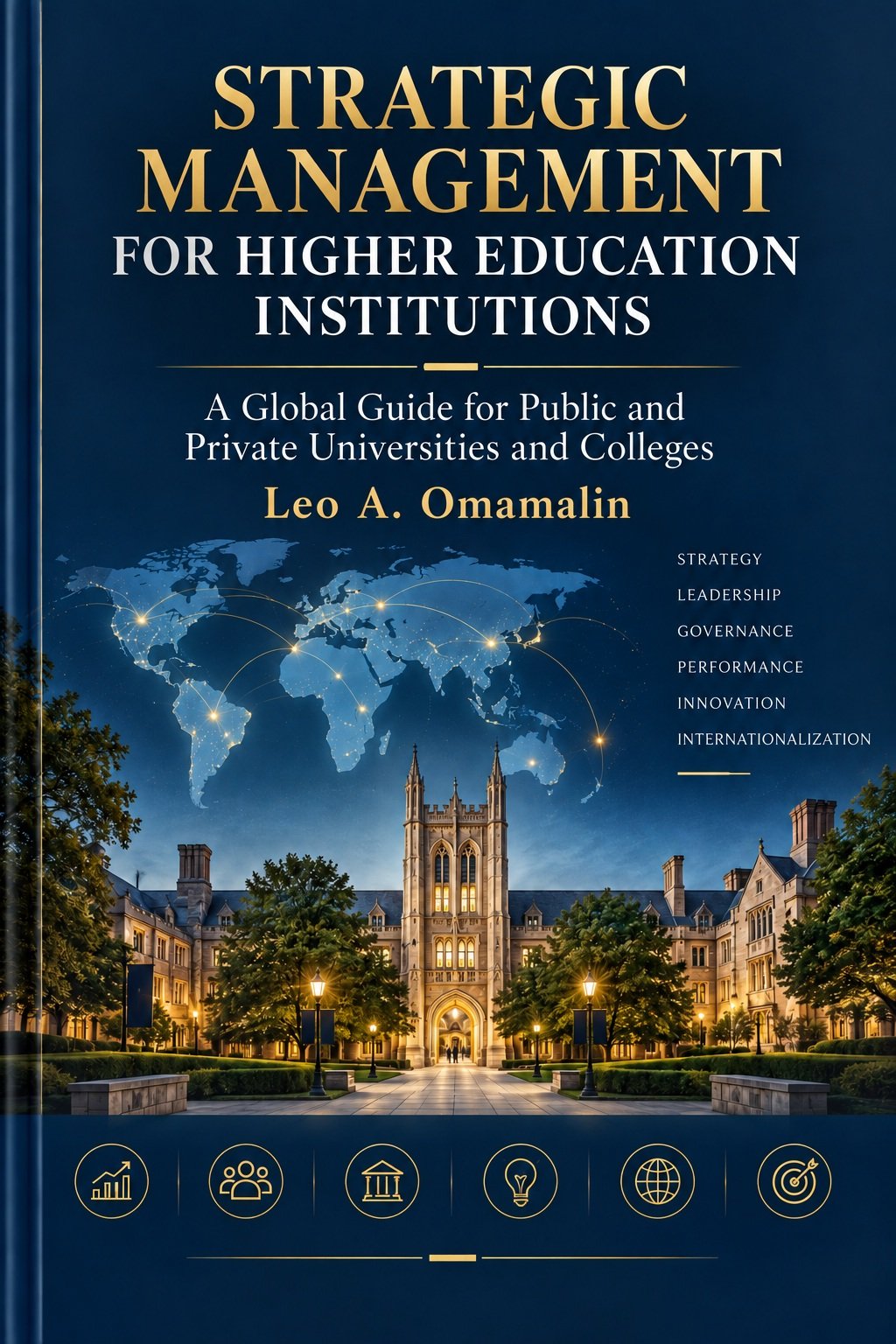
STRATEGIC MANAGEMENT FOR HIGHER EDUCATION INSTITUTIONS | A Global Guide for Public and Private Universities and Colleges
STRATEGIC MANAGEMENT FOR HIGHER EDUCATION INSTITUTIONS | A Global Guide for Public and Private Universities and Colleges is a comprehensive and practical guide for leaders, administrators, planners, faculty members, and decision-makers navigating the increasingly complex and competitive landscape of higher education.
Designed for public universities, state-funded institutions, private colleges and universities, nonprofit institutions, research-intensive universities, teaching-focused institutions, multicampus systems, and emerging digital and transnational education providers, this book translates the principles of strategic management into the realities of contemporary higher education.
Rather than treating universities simply as businesses, the book recognizes that higher education institutions pursue multiple forms of value: academic excellence, student success, research impact, societal contribution, institutional sustainability, financial resilience, innovation, international engagement, reputation, and public or stakeholder trust.
The book guides readers through the full strategic management cycle—from establishing institutional vision, mission, and goals to analyzing the external environment, assessing internal capabilities, selecting strategic directions, implementing initiatives, allocating resources, monitoring performance, and evaluating results.
Core strategic frameworks are presented in a higher-education context, including:
- PESTEL Analysis
- Porter’s Five Forces
- Competitive and Comparative Analysis
- Scenario Planning
- Benchmarking
- SWOT Analysis
- Resource-Based View
- Value Chain Analysis
- Core Competencies
- VRIO Framework
- Financial and Resource Analysis
- Cost Leadership, Differentiation, and Focus Strategies
- Blue Ocean Strategy
- Growth, Stability, Diversification, and Retrenchment Strategies
- Global, Multidomestic, and Transnational Strategies
- Organizational Structure and Strategic Leadership
- Institutional Culture and Change Management
- Key Performance Indicators
- Balanced Scorecard
- Strategic Control and Performance Management Systems
The book also examines the forces reshaping higher education worldwide, including artificial intelligence, digital transformation, changing student demographics, new credential models, international mobility, sustainability, financial pressures, competition for talent, research collaboration, rankings and reputation, and the growing demand for measurable institutional impact.
Through practical illustrations, flowcharts, strategic models, case discussions, comparative perspectives, templates, and application tools, complex management concepts are made easier to understand and apply in real institutional settings.
A distinctive feature of the book is its balanced treatment of both public and private higher education. It recognizes that while public universities often operate within government mandates, public accountability systems, and state funding structures, private institutions must also respond to market dynamics, tuition dependence, institutional positioning, philanthropy, reputation, and competitive differentiation. Despite these differences, both sectors face a common strategic challenge: how to remain relevant, resilient, distinctive, financially sustainable, and mission-driven in a rapidly changing world.
The book also presents international higher-education case examples and cross-sector strategic lessons to help readers understand how institutions can respond to disruption, pursue innovation, strengthen organizational capabilities, and build sustainable competitive or institutional advantage.
STRATEGIC MANAGEMENT FOR HIGHER EDUCATION INSTITUTIONS is especially valuable for:
University presidents and rectors; vice presidents and provosts; deans and directors; strategic planning and institutional effectiveness officers; governing boards and trustees; finance and resource managers; quality assurance and accreditation professionals; internationalization officers; research and innovation leaders; faculty members; graduate students; education policymakers; and professionals involved in institutional planning, governance, and transformation.
Ultimately, this book is about more than preparing strategic plans. It is about developing the capacity of higher education institutions to make better choices, align resources with priorities, adapt intelligently to change, measure what matters, and create lasting value for students, communities, societies, and future generations.
It is a practical guide for transforming strategy from a document into a disciplined process of direction, execution, learning, and institutional impact.