
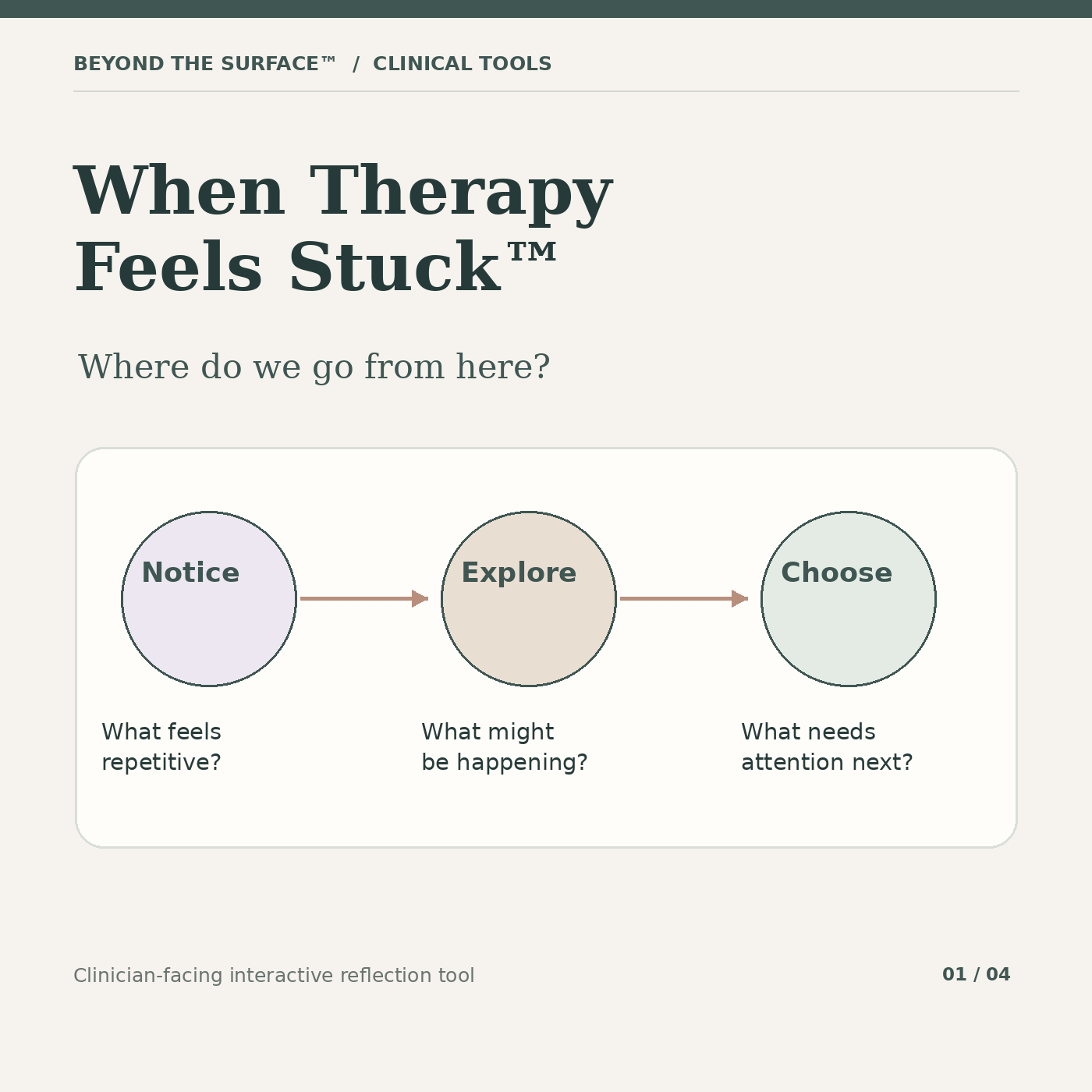

When Therapy Feels Stuck™ Where Do We Go From Here?
♦️When Therapy Feels Stuck™ Where Do We Go From Here?When Therapy Stalls, Repeats, or Loses Direction♦️
Standalone Clinician-Facing Interactive Tool
Sometimes the question isn't, “What intervention should I try next?”
It's:
What is actually keeping this work from moving?
When Therapy Feels Stuck™ is an interactive clinical reflection and direction tool for therapists navigating cases where sessions have become repetitive, progress has slowed, insight isn't translating into change, familiar interventions no longer seem to move the work forward, treatment goals have become unclear, or the therapist simply finds themselves wondering:
Where do we go from here?
Rather than automatically locating the problem within the client or offering another list of interventions, this tool helps clinicians step back and examine the larger clinical picture.
Explore where the stuckness may actually be occurring
Work through guided reflection around:
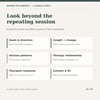
- thinking and meaning
- emotional processing
- behavior and application
- insight and integration
- readiness and ambivalence
- skill access
- relational patterns
- treatment goals and direction
- therapeutic relationship and process
- therapist response and capacity
- contextual and maintaining factors
- assessment, fit, specialty, and level-of-care considerations
Revisit whether the treatment goals still fit
Long-term therapy can continue around goals that have changed, become too broad, been partially achieved, or are no longer mutually understood.
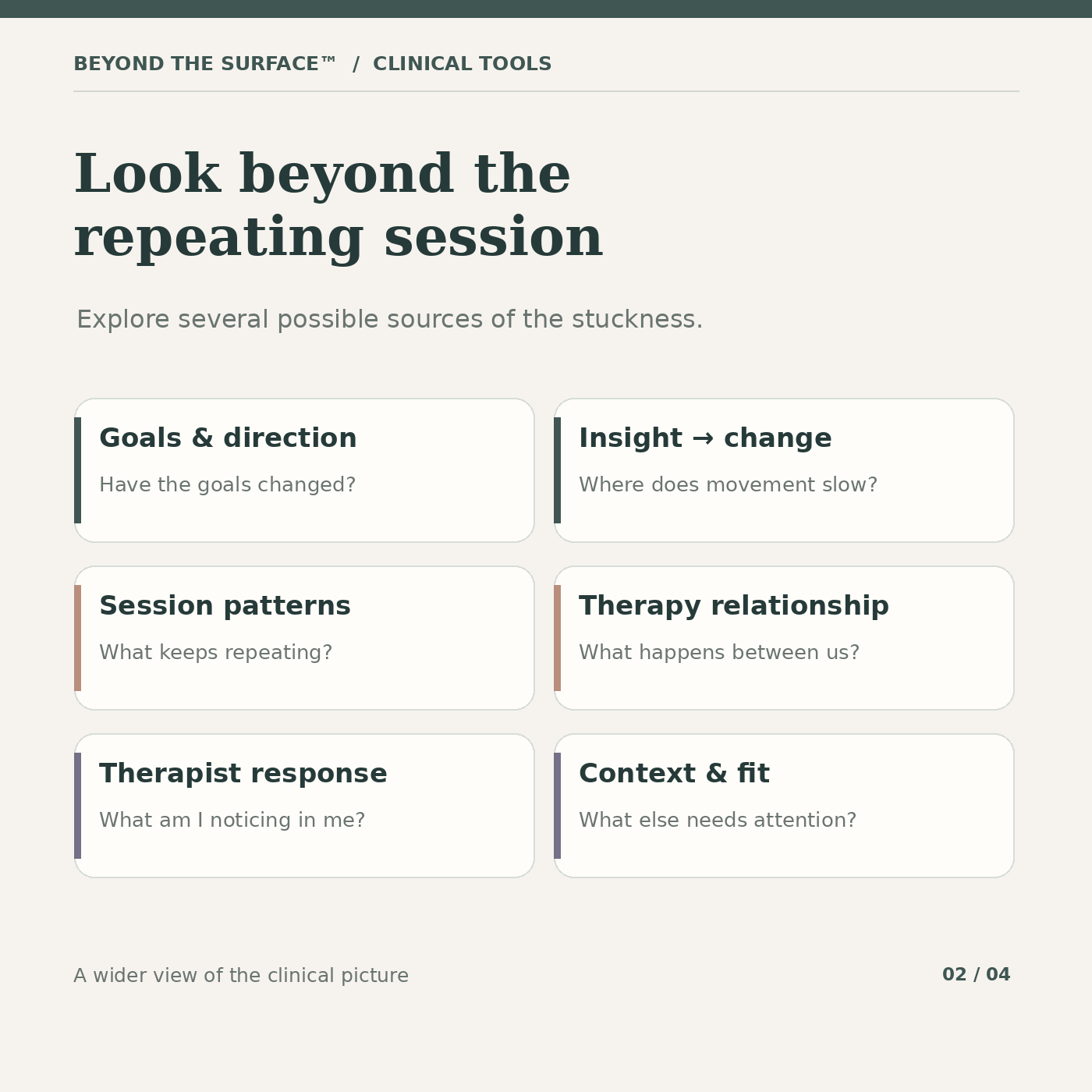
The Goal & Treatment Direction section helps clinicians examine:
Original Goal → What Changed → What Remains → What Matters Now → How We'll Know
Explore whether therapist and client are still working toward the same destination before adding another intervention.
Look beyond “We've already tried everything”
The tool does more than inventory modalities.
Instead, it examines what treatment has actually been asking the client to do.
Have multiple interventions still primarily focused on understanding, reframing, reassurance, or talking?
Would the work benefit from a shift toward experience, practice, behavioral experimentation, emotional processing, tolerating uncertainty, relational work, or another clinical function?
Examine what may be maintaining the pattern
Explore possible short-term functions of persistent responses without automatically labeling them as resistance.
Consider protection, avoidance, reassurance, predictability, emotional intensity, competing goals, relational consequences, environmental reinforcement, uncertainty, and the possible costs of change.
Look at what is happening inside the therapy relationship
Use the Therapy Loop to explore:
Client Pattern → Therapist Response → What Happens Between Us → Immediate Effect → Longer-Term Effect → Pattern Returns
Consider whether the therapy relationship has begun adapting around the same difficulty that appears elsewhere in the client's life.
Include the therapist in the formulation
Reflect on frustration, caution, protectiveness, overfunctioning, depletion, pressure to create change, loss of curiosity, fear of challenging, competence, and clinical fit.
The therapist's response is treated as information to explore, not proof about the client.
Go deeper with 18 clinical pathways
The Clinical Deep Dive includes guided support for:
- Insight Without Change
- Thinking / Meaning Loops
- Emotional Processing Difficulty
- Behavior / Application Gaps
- Skill Access Under Activation
- Avoidance / Protection
- Ambivalence / Readiness
- Reassurance / Certainty Cycles
- Goal / Treatment Drift
- Therapeutic Relationship / Rupture
- Therapist Overfunctioning
- Fear of Challenging
- Therapist Depletion / Burnout
- Plateau / Maintenance
- Assessment / Conceptualization Gaps
- Fit / Competence / Specialty
- Referral / Transition
- I Still Don't Know
Each pathway goes beyond identifying a concern and provides differentiation questions, clinical considerations, ways to work with the pattern, language that may be brought into session, what not to automatically keep doing, and what to watch for next.
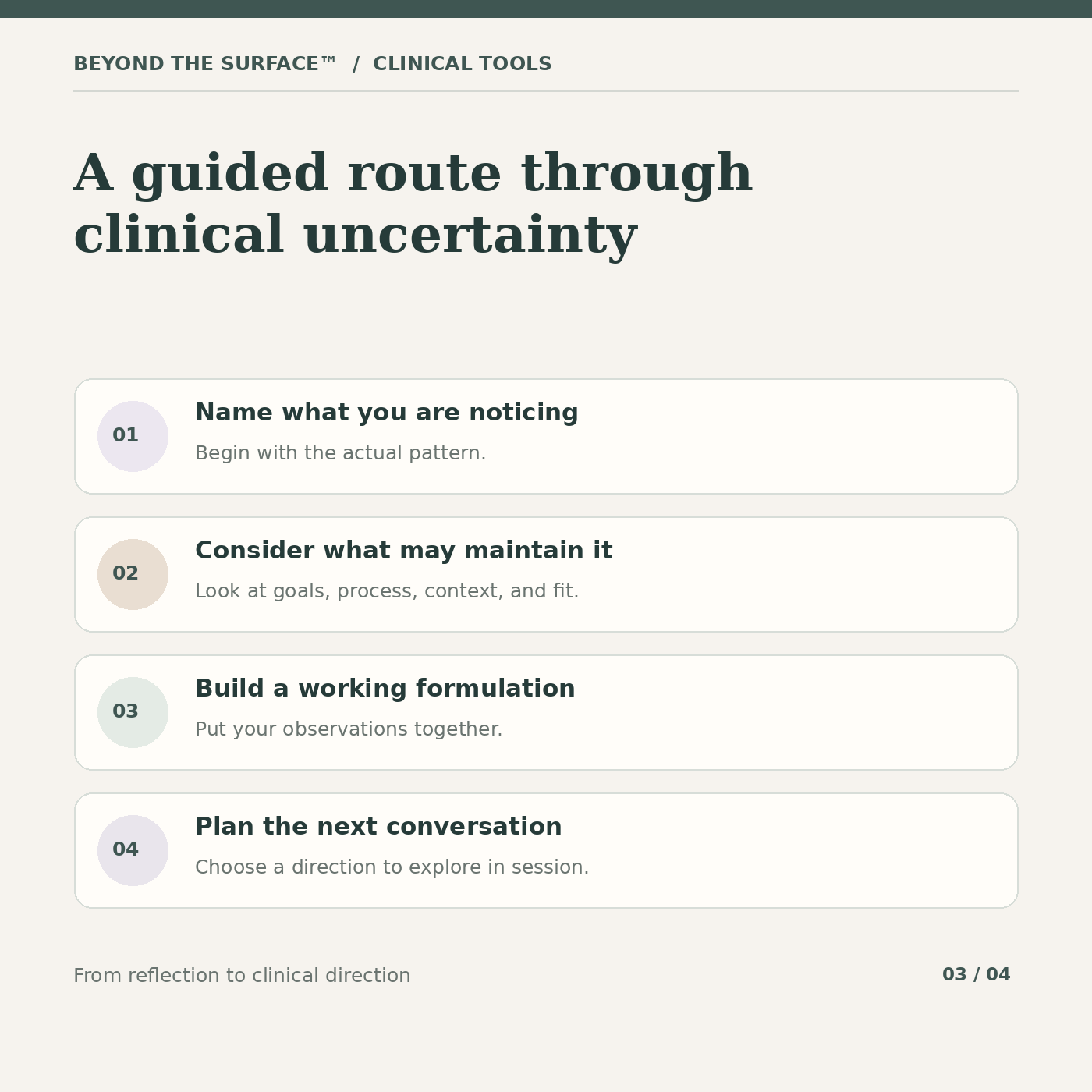
Build a working clinical formulation
Bring information from across the tool together to identify:
- what appears most central
- contributing factors
- what the client already understands or can do
- what treatment has heavily emphasized
- what may be less explored
- treatment-goal status
- therapy-process considerations
- therapist considerations
- missing information
- competing explanations
The formulation remains a working hypothesis rather than a conclusion about the client.
Connect the formulation to other BTS clinical tools
The built-in BTS Clinical Bridge helps clinicians move from:
“What seems stuck?”
to:
“What clinical task needs support next?”
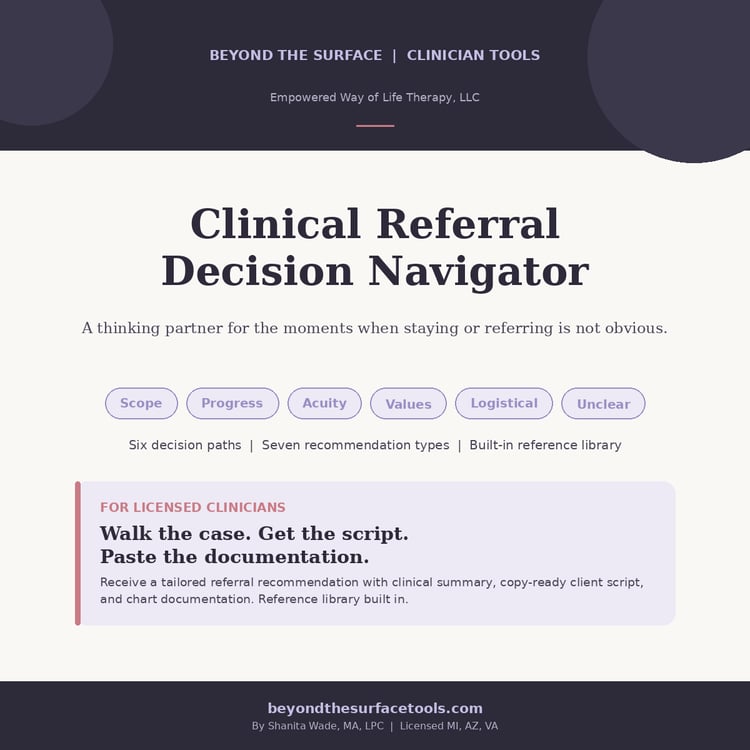
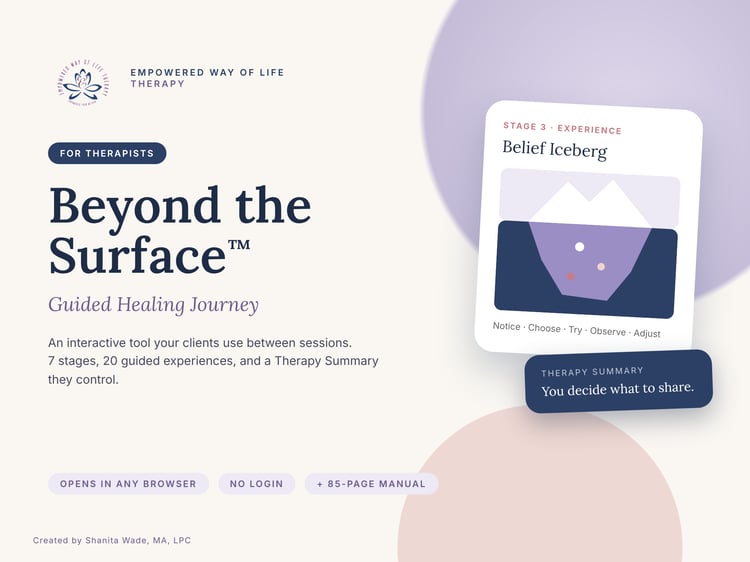
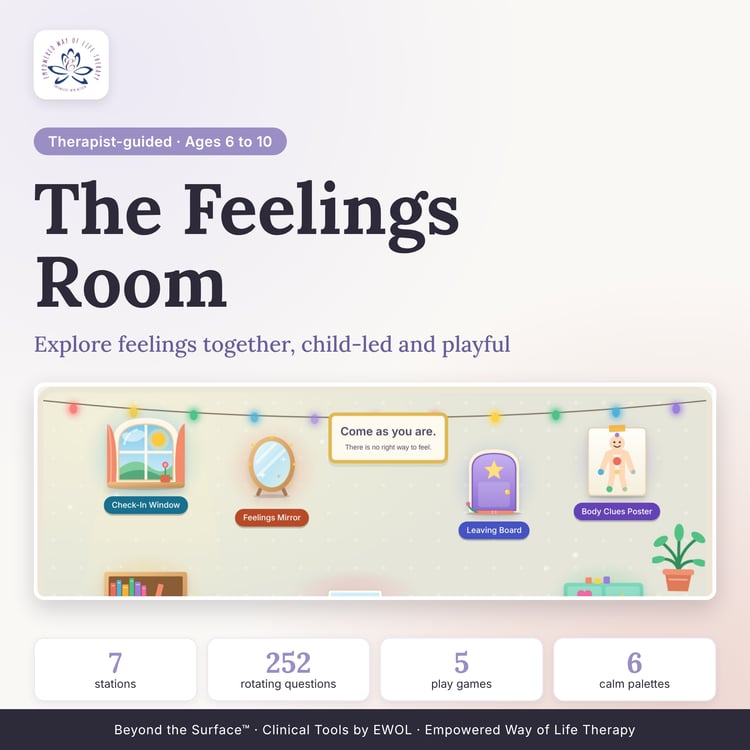
When appropriate, the navigator connects that task with existing Beyond the Surface™ resources such as From Insight to Integration™, Feeling It Through™, Beyond the Number™, Navigating the Moment™, Between Us, Communication to Clarity™, attachment/relational-wounds resources, Calming Room, and Coping vs. Regulation™.
And sometimes the navigator intentionally recommends no additional tool yet because the next step is better addressed through goal clarification, rupture repair, assessment, consultation, therapist change, maintenance planning, specialty care, referral, or transition.
Leave with something you can actually use next session
The final section converts reflection into a focused Next-Session Clinical Plan.
Identify:
One primary stuck point
What you want to understand rather than immediately fix
One collaborative question to bring into the room
One thing you will intentionally do differently
What you will stop automatically doing more of
The specific clinical job of any BTS resource you choose to use
What new information you will watch for
What would make you change course
The goal isn't to solve the entire case in one sitting.
It's to help restore thoughtful clinical movement when therapy has begun to stall, repeat, or lose direction.
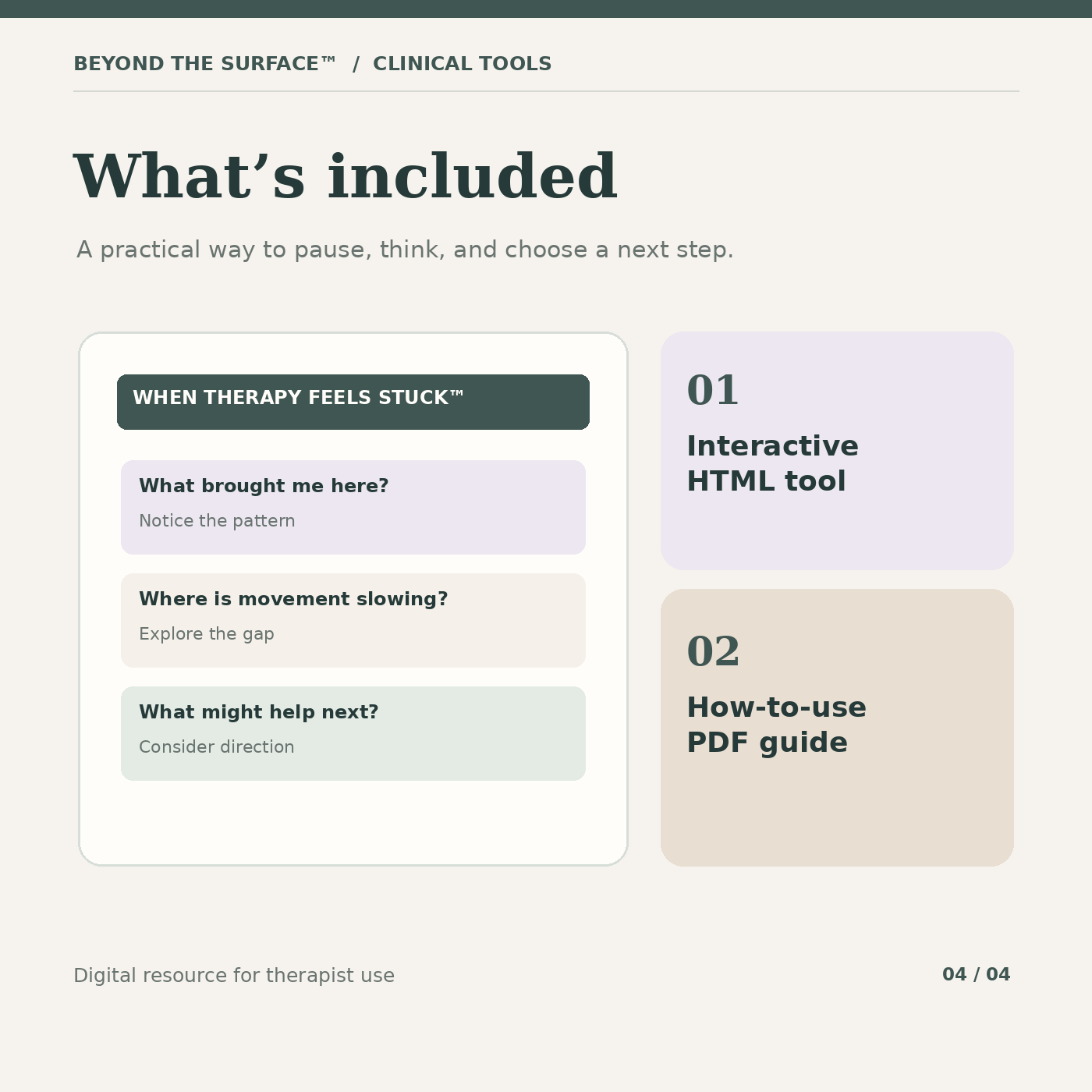
Included
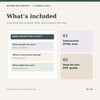
- Self-contained interactive HTML clinical tool
- Guided case reflection
- Goal & Treatment Direction Review
- Visual clinical maps
- 18 Clinical Deep Dive pathways
- Working Stuckness Formulation
- Clinical Direction guidance
- BTS Clinical Bridge
- Consultation preparation support
- Next-Session Clinical Plan
- Local browser saving
- Print / Save as PDF functionality
- How-to-Use Guide
Standalone resource.
Designed for
Licensed and appropriately trained mental health clinicians using the resource within their professional scope.
Format
Digital interactive HTML resource. No subscription or software installation is required to use the downloaded tool. Entries remain in the browser's local storage unless cleared.
Important
This is a clinician-facing educational and reflective resource. It is not a diagnostic instrument, risk assessment, treatment protocol, or substitute for professional judgment, assessment, supervision, consultation, or applicable ethical, legal, licensing, and payer requirements.