

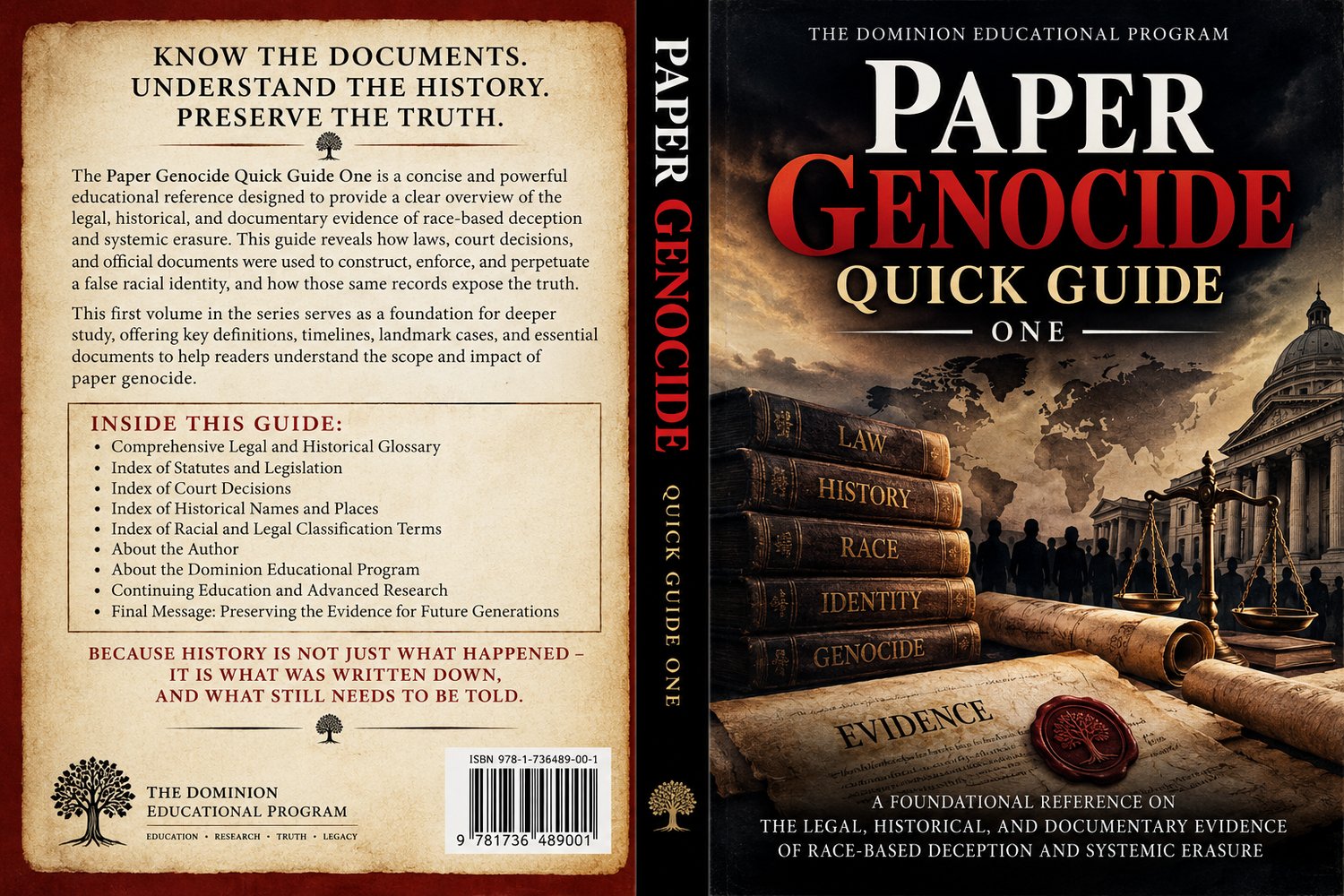
THE PAPER GENOCIDE: 1492–1950 Quick Guide One
THE PAPER GENOCIDE: 1492–1950
Quick Guide One
A Historical and Legal Examination of Government Classification, Indigenous Identity, and the Records That Shaped Generations
Author: NobEL Sha-doe Ali
Dominion Educational Program
What if your family's historical records tell only part of its story?
Throughout American history, governments used classifications such as Indian, Negro, Moor, Mulatto, Colored, and White to identify populations, regulate legal status, and maintain official records.
But what did these classifications actually mean? Who established them? How did their definitions change? And what happens when a family's recorded identity does not accurately reflect its documented ancestry or community history?
The Paper Genocide: 1492–1950 — Quick Guide One takes readers on an extensive educational journey through nearly five centuries of colonial legislation, slavery laws, constitutional developments, census classifications, Indigenous recognition policies, and government recordkeeping.
From the earliest European colonial claims to Virginia's Racial Integrity Act of 1924 and Walter Plecker's twentieth-century administrative directives, this book examines the original legal authorities and historical documents behind the classifications that influenced generations of American families.
What You'll Discover Inside
Lesson One — 1492–1619: The Foundation of Colonial Classification
Explore Indigenous nations before European colonization, papal decrees, early imperial claims, and the beginnings of colonial legal classification.
Lesson Two — 1620–1750: The Legal Construction of Hereditary Slavery
Examine Virginia's original statutes concerning Moors, Indians, Negroes, Mulattoes, Christians, freedom, and hereditary bondage.
Lesson Three — 1750–1865: Race, Freedom, Citizenship, and the Law
Investigate freedom lawsuits, early naturalization laws, Indigenous removal, citizenship disputes, and the constitutional abolition of slavery.
Lesson Four — 1865–1910: Reconstruction, Census Classification, and Indigenous Enrollment
Discover how Reconstruction legislation, federal census categories, North Carolina's Indigenous recognition statutes, and the Dawes enrollment system influenced official documentation.
Lesson Five — 1910–1950: The Paper Genocide and the Administrative Record
Study Virginia's Racial Integrity Act, Walter Plecker's 1943 correspondence and surname lists, and federal census instructions that affected the recording of Indigenous ancestry.
Lesson Six — Restoring the Historical Record and Protecting Family Identity
Learn practical methods for tracing ancestors, comparing conflicting records, preparing genealogical evidence, requesting lawful corrections, and preserving family history.
More Than a History Book — An Educational Research System
This comprehensive guide includes:
- Six structured lessons with historical explanations, teaching scenarios, and comprehension questions.
- The Dominion Historical Document Vault, organizing original laws, court decisions, census instructions, administrative records, and historical references.
- Genealogical research worksheets to help document ancestors and family relationships.
- Evidence packet and correspondence templates for organizing historical records and exploring lawful correction procedures.
- Historical legal case studies demonstrating how courts and government agencies treated ancestry and classification.
- Student exercises, instructor answers, and final assessments to strengthen comprehension.
- A final family classification and historical record audit project, guiding readers through a complete documentary investigation.
- An educational course-completion certificate template.
Who Is This Book For?
This guide is designed for independent researchers, family historians, genealogists, educators, students of American legal history, and anyone interested in how official government classifications influenced the historical identities recorded for American families.
Whether you're investigating your ancestry, studying Indigenous history, or learning to interpret historical statutes, this guide provides an organized starting point grounded in documentary evidence.
The Dominion Educational Mission
We believe history should be examined through its original sources—not simply repeated through assumptions or interpretations.
Our mission is to equip students with the tools to comprehend historical law, investigate the documentary record, distinguish ancestral identity from government classification, and preserve reliable evidence for future generations.
749-page complete digital edition.
Preserve the Evidence. Comprehend the Law. Reclaim the Knowledge of Your Family's History.
Published through the Dominion Educational Program.
For historical research and educational purposes. Documented ancestry, government classification, and tribal political citizenship are distinct matters governed by different evidence and legal requirements.