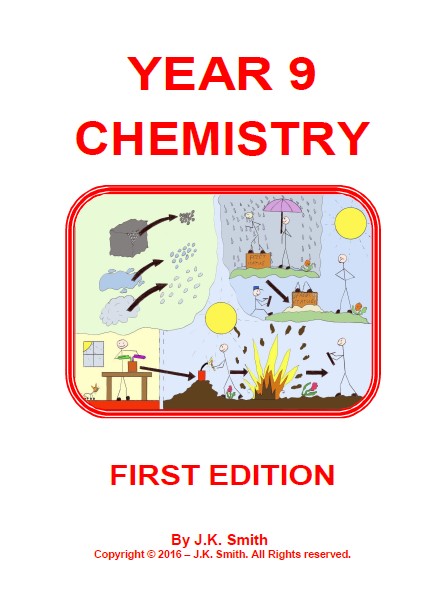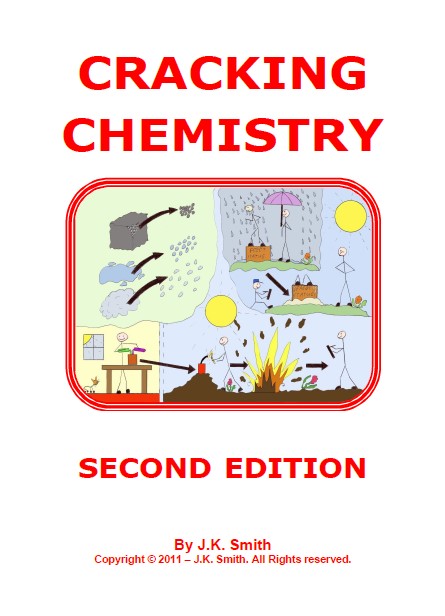

Cracking Chemistry (13+yrs) and Workbook by JK Smith
With over 30 years of teaching science experience, Jeff K Smith wrote Cracking Chemistry to address the ever-increasing need for a suitable textbook to go along with teachings of chemistry as a subject at school as well as to fill the void of an easily understandable, well-written and enjoyable textbook on the subject.
Even though the book is written at the level of UK Key Stage 3, that means students aged between 11 – 14 years, Jeff's 30 years of teaching experience has empirically demonstrated that students struggling at higher levels, such as GCSEs (aged between 14 – 16 years) and A-Level (aged between 16 – 18 years), are unable to grasp the materials at their level without understanding of lower-level material.
The concept is simple, how can one understand the advanced materials of a subject without first understanding the basics of the subject?
Cracking Chemistry is a 300-pages, full-coloured textbook with a unique twist: all key chemistry words are fully defined including their Greek, Latin or Arabic roots. Add to this a comprehensive glossary. Moreover, the book comes with a 93-pages workbook which takes the student through the textbook step by step. The workbook includes extensive exercises and fun drills for the student to do to ensure he or she has a full grasp of the subject.
Because the textbook and its accompanying workbook are laid out perfectly for self-study, it is a perfect combination for homeschooling, and the book is not limited by age. For example, if your child is only 8 or 9 but can easily get through the workbook, then there is no limit! Conversely, the same applies for older children or even adults. Age is not a limit and should not be used for comparison. What is important is achieving a full understanding of the subject, no matter the age, child or adult!
This is a digital download in PDF format. You are able to print for your own use only e.g. printing the workbook to sign off each step, but not for distribution or resale.
Topics covered Cracking Chemistry include:
Part 1: Properties of Matter
Part 2: Elements, Compounds and Mixtures
Part 3: Chemical Reactions
Part 4: Acids and Bases
Part 5: The Periodic Table
The workbook will guide you carefully through Cracking Chemistry to achieve a thorough understanding of the valuable information it contains so that you can use it in your life.
In Part 1, you will be learning:
(i) What properties different types of matter have
(ii) How types of matter are grouped depending on their use by man
(iii) The physical changes that they can undergo
(iv) How different types of matter can be separated from each other
(v) The differences between metals and non-metals
In Part 2, you will be learning:
(i) What elements, compounds and mixtures are
(ii) How elements are organised
(iii) How compounds are named
(iv) How compounds can be broken down into elements
In Part 3, you will be learning:
(i) The difference between physical and chemical changes
(ii) Why chemicals react
(iii) The different types of chemical bonds and reactions
(iv) What things affect the rate of a chemical reaction
(v) Useful and nuisance reactions
(vi) Chemical reactions involved in the rock cycle (the process by which rocks are produced, changed and destroyed)
In Part 4, you will be learning:
(i) What acids and bases actually are
(ii) What properties they have
(iii) How their strengths are measured
(iv) How metals react with acids, air and water
(v) What the reactivity series of metals is
(vi) How acids and bases react with each other how acids and bases react with each other
In Part 5, you will be learning:
(i) What the Periodic Table is
(ii) How the elements are grouped on it
(iii) Why atoms of different elements react with each other
(iv) How atoms combine with each other
(v) How they are built up or destroyed,
(vi) What atomic energy is