
Minimalist Budget Binder Printable PDF | Budget Planner & Finance Tracker
The Minimalist Budget Binder Printable PDF
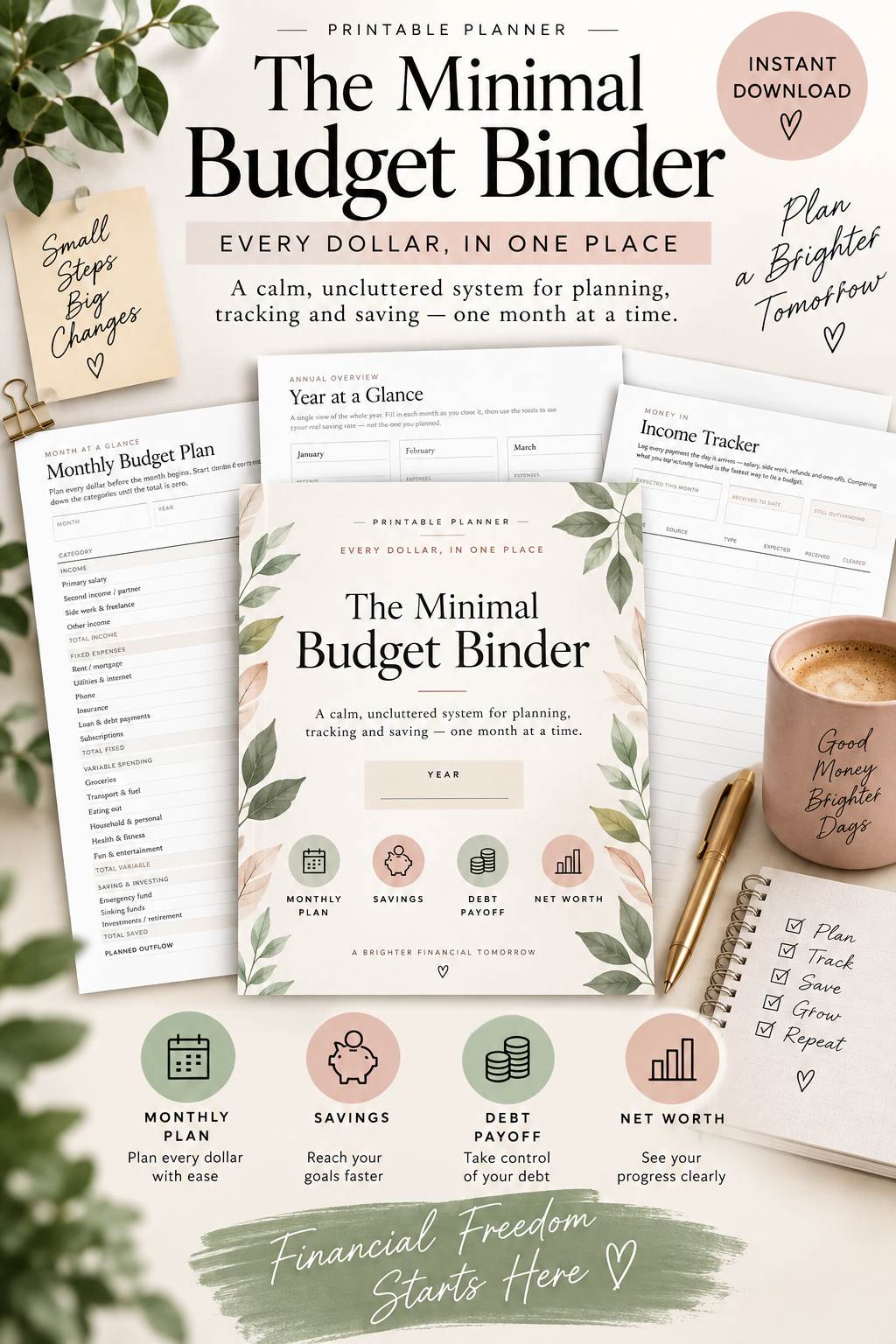
A simple 14-page printable budget planner designed to bring your income, spending, bills, savings, debt payoff, and financial goals together in one calm, organized system.
If budgeting has started to feel complicated, scattered, or difficult to maintain, The Minimal Budget Binder gives you a simpler place to begin.
This minimalist budget binder printable PDF combines practical budgeting worksheets with financial tracking pages so you can plan your month, record what actually happens, monitor savings, organize recurring bills, work toward debt payoff, and review your progress over time.
Instead of juggling loose notes, spreadsheets, and separate trackers, you can keep your core financial planning pages together in one printable budget binder.
What Is The Minimal Budget Binder?
The Minimal Budget Binder is a 14-page printable budget planner and personal finance organizer built around a straightforward monthly money routine.
The system starts with a yearly overview, moves into monthly budgeting and financial tracking, and finishes with reflection and planning for the next month.
It is designed for people who prefer a clean, uncluttered budget planner PDF rather than an overwhelming collection of complicated financial worksheets.
Use the pages in a physical binder, folder, or other paper-planning setup and build your financial routine one month at a time.
What You Get — 14 Printable Pages
1. Cover
A simple minimalist cover with space for your year.
2. How to Use This Binder
A six-step introduction explains how to establish your baseline, create a monthly budget, track income and bills, build savings, approach debt, and complete your monthly review. Printing guidance is included as well.
3. Year at a Glance
See January through December in one place with space for income, expenses, savings, and balance. The year-end section gives you space for total income, total expenses, total saved, and saving rate.
4. Monthly Budget Plan
Build your monthly budget before the month begins. Organize income, fixed expenses, variable spending, savings, and investing while comparing planned amounts with actual results and differences.
5. Income Tracker
Record income by date and source, including expected and received amounts, with a cleared field to help you keep track of money that has arrived.
6. Bill Payment Checklist
Keep recurring bills organized with due dates, amounts, auto-pay information, payment status, and confirmation details.
7. Debt Payoff Tracker
Track balances, APR, minimum payments, extra payments, and new balances. The page also introduces the debt snowball and debt avalanche approaches so you can record the method you choose to follow.
8. Sinking Funds
Plan ahead for expenses that do not arrive every month. Track your goal, monthly contribution, amount saved, remaining balance, and target date.
9. Savings Goal Tracker
Turn a savings goal into visible progress with an 80-box savings tracker and a monthly deposit and balance log.
10. No-Spend Challenge
Use the 31-day calendar to record your no-spend progress and follow simple challenge rules around meals, non-essential purchases, promotional emails, and allowed expenses.
11. Subscription Audit
Review recurring subscriptions and look beyond the monthly price by recording the annualized cost. Use the keep/cancel section and quiet-leaks checklist to examine recurring services.
12. Net Worth Tracker
Track assets and liabilities quarterly across Q1, Q2, Q3, and Q4, including savings, investments, retirement accounts, property, vehicles, loans, credit cards, mortgage, and other debts.
13. Monthly Review & Reflection
Close each month by recording income, spending, savings, and a simple 1–5 reflection. Review what went well, what you would change, your biggest win, and your focus for next month.
14. Notes & Ideas
A full-page dot grid gives you flexible space for financial notes, goals, ideas, reminders, and future planning.
Plan Your Monthly Budget With Less Clutter
The heart of this printable finance planner is the Monthly Budget Plan.
Start with the income you expect, organize fixed expenses such as housing, utilities, insurance, loans, and subscriptions, then account for variable spending such as groceries, transportation, eating out, household expenses, health, and entertainment.
The planner also gives you dedicated areas for emergency savings, sinking funds, and investments or retirement.
Because the page includes planned, actual, and difference fields, you can look back at what you expected and compare it with what actually happened.
Track Income and Bills
A budget works better when you know what money is coming in and what payments are going out.
The Income Tracker provides a simple way to record expected and received income.
The Bill Payment Checklist gives recurring payments their own organized space, including due dates, amounts, auto-pay status, payment status, and confirmation information.
Together, these pages help create a repeatable monthly money-management routine.
Save With Specific Goals
Saving becomes easier to organize when different purposes have their own place.
Use Sinking Funds for planned future costs such as travel, insurance renewals, vehicle expenses, gifts, home repairs, taxes, annual subscriptions, and other predictable expenses.
Then use the Savings Goal Tracker to work toward a specific target using the visual 80-box progress grid and monthly deposit log.
Create a Debt Payoff Plan
The Debt Payoff Tracker gives you one place to record balances, APR, minimum payments, extra payments, and new balances.
It also introduces two familiar debt payoff approaches: debt snowball and debt avalanche.
The purpose is not to provide individualized financial advice. Instead, the worksheet gives you an organized place to document your balances and the payoff approach you decide to use.
See Your Financial Progress
Budgeting is more than tracking individual expenses.
The Year at a Glance page lets you see the broader picture across twelve months, while the Net Worth Tracker helps you record assets and liabilities quarterly.
The Monthly Review & Reflection page then gives you an opportunity to look at what worked, what changed, what you accomplished, and what you want to focus on next.
Review Spending Habits
Two pages add another layer of financial organization: the No-Spend Challenge and Subscription Audit.
The No-Spend Challenge gives you a 31-day framework for recording progress and following simple spending rules.
The Subscription Audit helps you examine recurring services and compare their monthly and annualized costs, giving you a dedicated place to decide what to keep or cancel.
Who Is This Budget Binder For?
The Minimal Budget Binder can be useful for:
- Adults organizing personal finances
- Couples planning household finances
- Budgeting beginners
- People working toward savings goals
- People organizing debt payments
- Anyone who prefers paper-based financial planning
- Minimalist planners who want a clean budgeting system
- People who want their budgeting worksheets together in one binder
It can also work as a practical starting point for anyone who wants to create a more consistent monthly money routine.
How To Use It
A simple workflow is:
1. Print your pages.
The included printing instructions explain how to print the planner.
2. Place the pages in a binder or folder.
3. Complete your annual overview.
4. Create your monthly budget.
5. Record income and bills as they occur.
6. Update your savings, sinking funds, and debt trackers.
7. Complete the monthly review.
8. Carry the lessons into your next month.
The goal is not to create another complicated financial system. It is to make your money routine easier to repeat.
What Makes This Budget Planner Different?
The Minimal Budget Binder brings several areas of personal finance into one 14-page printable system without relying on a huge collection of worksheets.
You get monthly budgeting, income tracking, bill organization, debt payoff tracking, sinking funds, savings goals, a no-spend challenge, subscription review, net worth tracking, and monthly reflection.
The design is intentionally minimalist and uncluttered, so the pages remain practical for handwriting and repeated monthly use.
What You Receive
You receive The Minimal Budget Binder, a 14-page digital PDF containing the complete printable planner system.
The included pages cover:
- Annual financial overview
- Monthly budget planning
- Income tracking
- Bill payment tracking
- Debt payoff
- Sinking funds
- Savings goals
- No-spend tracking
- Subscription auditing
- Net worth
- Monthly financial review
- Notes and ideas
The product's printing instructions specify US Letter (8.5 × 11 inches) at 100% scale / Actual Size.
This is a digital product; no physical binder or printed product is included.
Start Building a Simpler Money Routine
If you want a minimalist budget binder printable PDF that brings planning, tracking, saving, debt organization, and financial review into one practical system, The Minimal Budget Binder gives you the pages to get started.
Print the pages you need, place them together, plan your month, track what happens, and use the monthly review to reset for the next one.
Make your money easier to see. Make your plan easier to follow. Start your next month with The Minimal Budget Binder.