
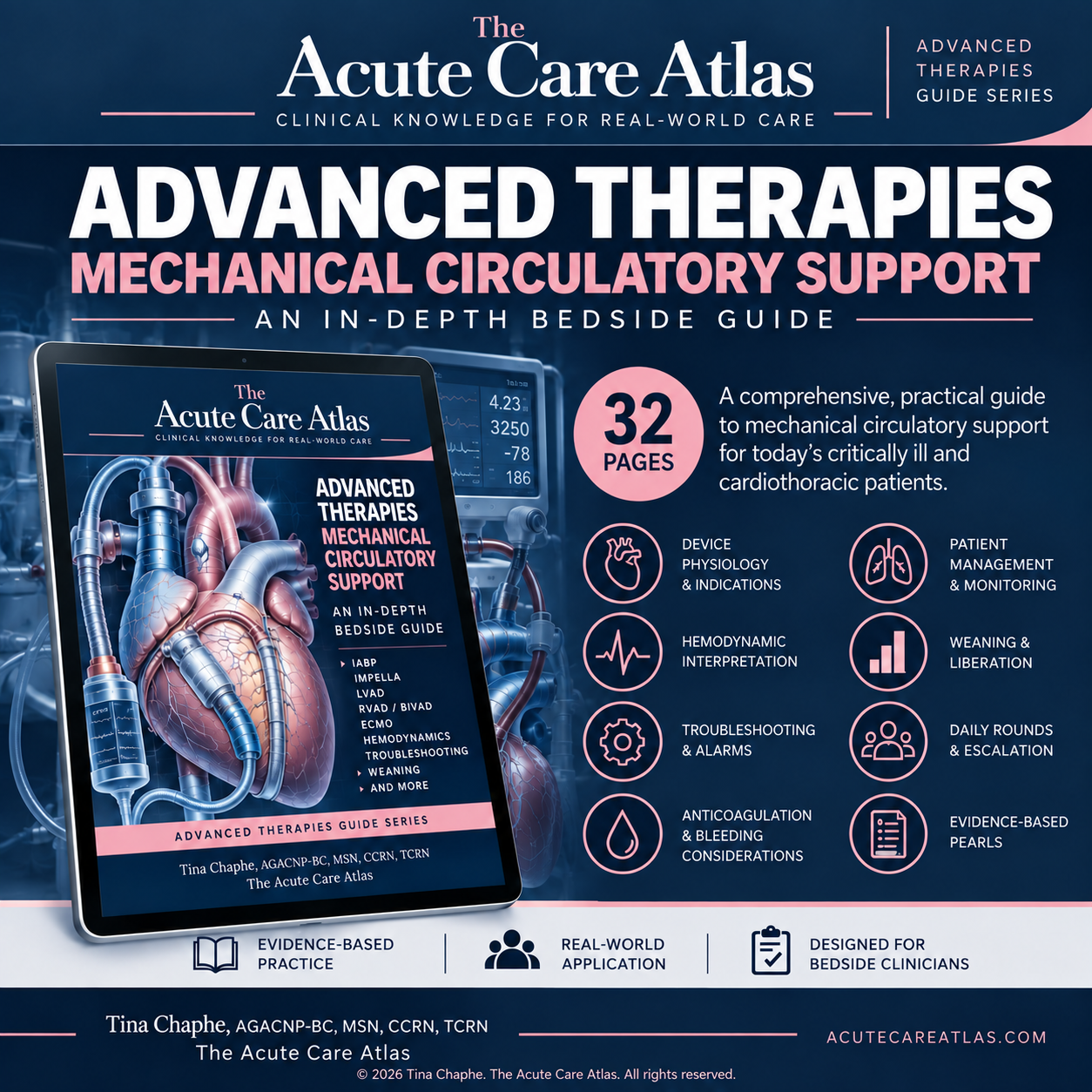
Advanced Therapies: Mechanical Circulatory Support
Mechanical circulatory support becomes much easier to understand when the device is viewed as a response to a specific physiologic problem.
Advanced Therapies: Mechanical Circulatory Support takes that approach.
Rather than teaching clinicians to memorize console numbers and alarms, the guide connects cardiogenic-shock phenotype, hemodynamics, ventricular function, device mechanics and patient perfusion.
It covers IABP, Impella CP and 5.5, durable LVAD, temporary RVAD/BiVAD, VA-ECMO, VV-ECMO and combined-support concepts.
Readers work through device selection, hemodynamic interpretation, alarms, suction and low-flow states, hemolysis, anticoagulation, LV distension, RV failure, transport, mobilization, weaning and emergency escalation.
The guide repeatedly reinforces a critical MCS principle: displayed flow does not necessarily equal adequate systemic perfusion.
It also teaches clinicians to identify the job support needs to accomplish before focusing on a particular device—for example, LV unloading, RV support, circulatory rescue or respiratory support.
What you'll learn
- Cardiogenic-shock phenotype and SCAI staging concepts
- CI, CPO, PAPi, SVR and filling-pressure interpretation
- Matching support to LV, RV, biventricular or respiratory failure
- IABP physiology, timing and troubleshooting
- Impella CP and 5.5 physiology, position, suction and purge management
- Hemolysis recognition
- Durable LVAD physiology and low-flow differential
- RV failure during LV support
- Temporary RVAD and BiVAD flow balance
- VA versus VV ECMO
- ECMO chatter, low flow, circuit pressures and oxygenator concerns
- VA-ECMO LV distension and unloading
- ECPELLA concepts
- Anticoagulation and bleeding considerations
- Weaning and liberation
- Mobilization and transport
- Daily MCS rounds and high-risk escalation patterns
The finished guide also includes a structured mechanical-support rounds template that brings together indication, device settings, perfusion, ventricular loading, respiratory status, anticoagulation, access/circuit assessment and the day's bridge decision.
Intended audience
Acute-care NPs/PAs, critical-care and CT-surgery APPs, ICU nurses, MCS nurses, APP fellows, advanced critical-care trainees and experienced clinicians seeking a structured mechanical-support bedside reference.
Educational Use Disclaimer
This digital guide is intended for education and professional development only. It does not constitute medical advice and does not replace patient-specific assessment, professional clinical judgment, institutional policies or protocols, current medication references, manufacturer instructions for use, professional guidelines, credentialing requirements, or direction from the responsible clinical team. Clinical information and device guidance may change over time. Always verify current recommendations and follow applicable institutional policies and standards of care.
This product is independently developed and is not affiliated with or endorsed by any hospital, university, healthcare system, manufacturer, professional organization, or government agency.
Individual-Use License
Purchase includes a single-user license for the individual purchaser. Redistribution, resale, public posting, sharing of the digital file, uploading to shared drives or learning-management systems, institutional reproduction, or creation of derivative commercial products is prohibited without written permission from The Acute Care Atlas.
© 2026 Tina Chaphe. The Acute Care Atlas. All rights reserved.