Money Lab: Kid Economics, Canada edition (Grades 2 to 5)
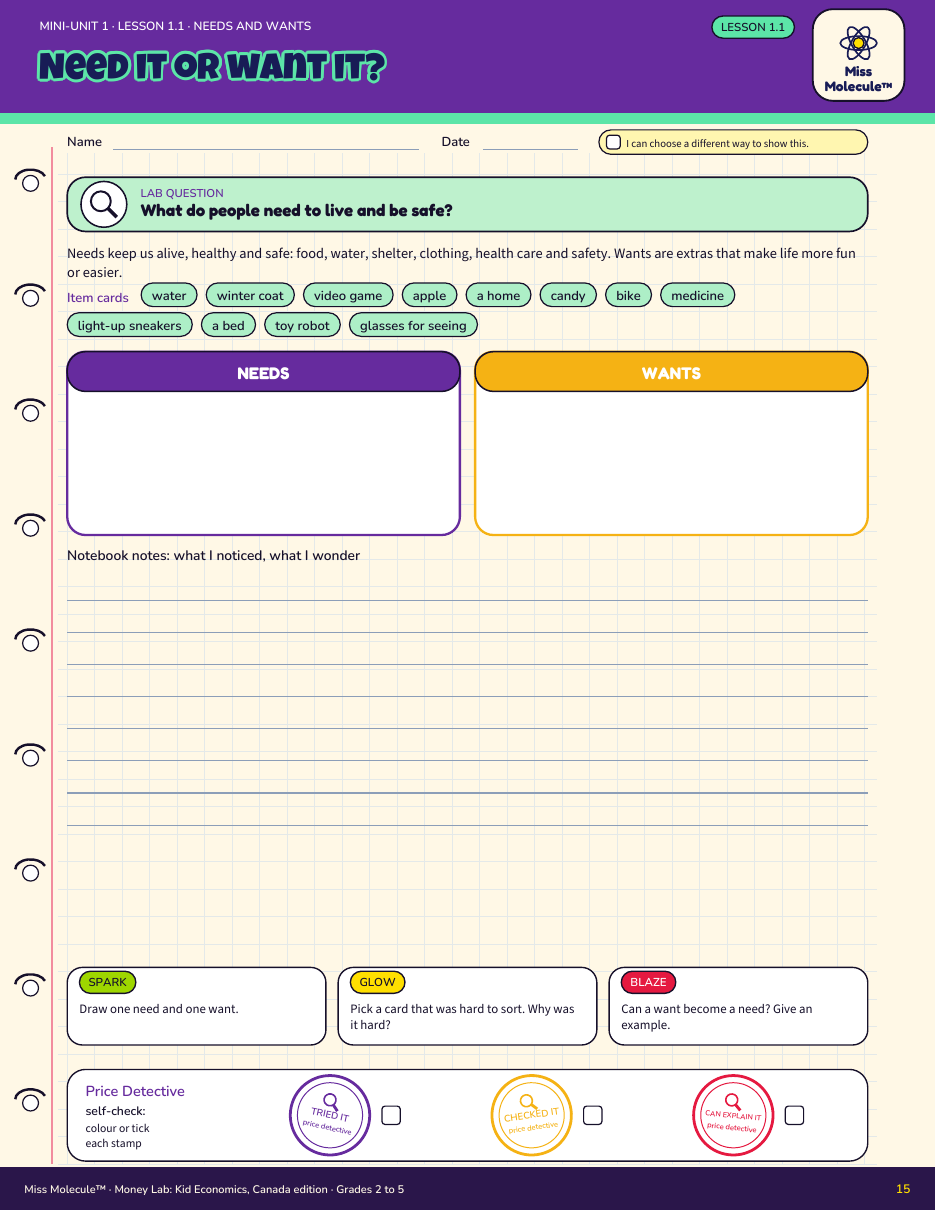
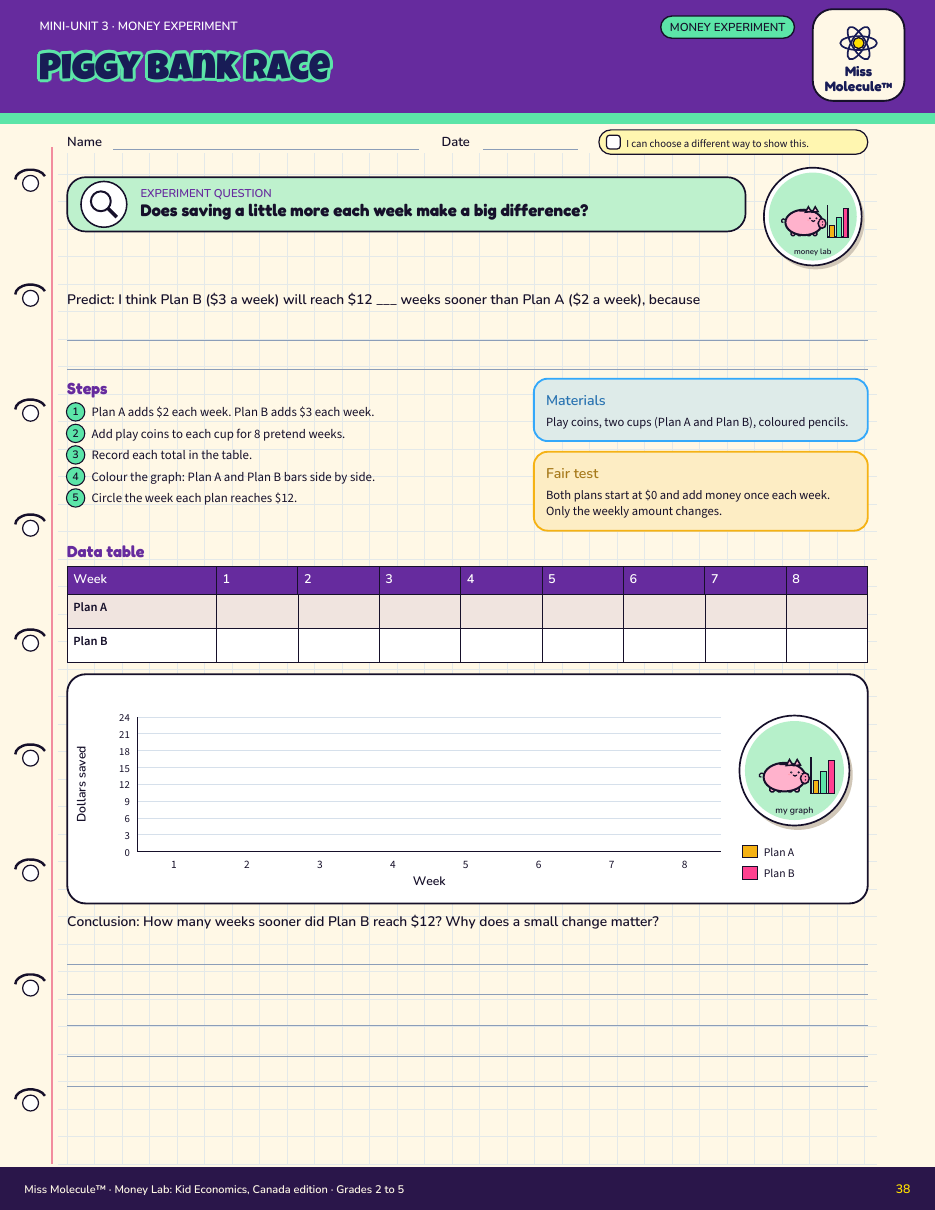
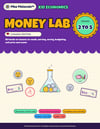
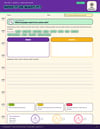
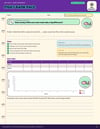
Money Lab treats money like a science. Students ask a lab question, test it with play money, record data and explain what they found. Six mini-units cover needs and wants, earning and counting money, saving, budgeting, unit price and comparing, and scams and safe spending. Each mini-unit has a teacher plan, a lesson guide, five notebook-style lesson pages, a Money Experiment and a unit check with spaced review. Every lesson page has a lab question, Spark, Glow and Blaze tasks and three Price Detective self-check stamps. Students count nickels, dimes, quarters, loonies and toonies, practise cash rounding to the nearest 5 cents, make change by counting up, plan savings with a piggy bank graph, add Ontario HST to a receipt, find unit prices, and use pause, think, ask before they spend or click. Everything uses pretend people, pretend shops and pretend prices, and nobody is ever asked about their own family's money. The book ends with a project: Molecule Market Day.
What is inside
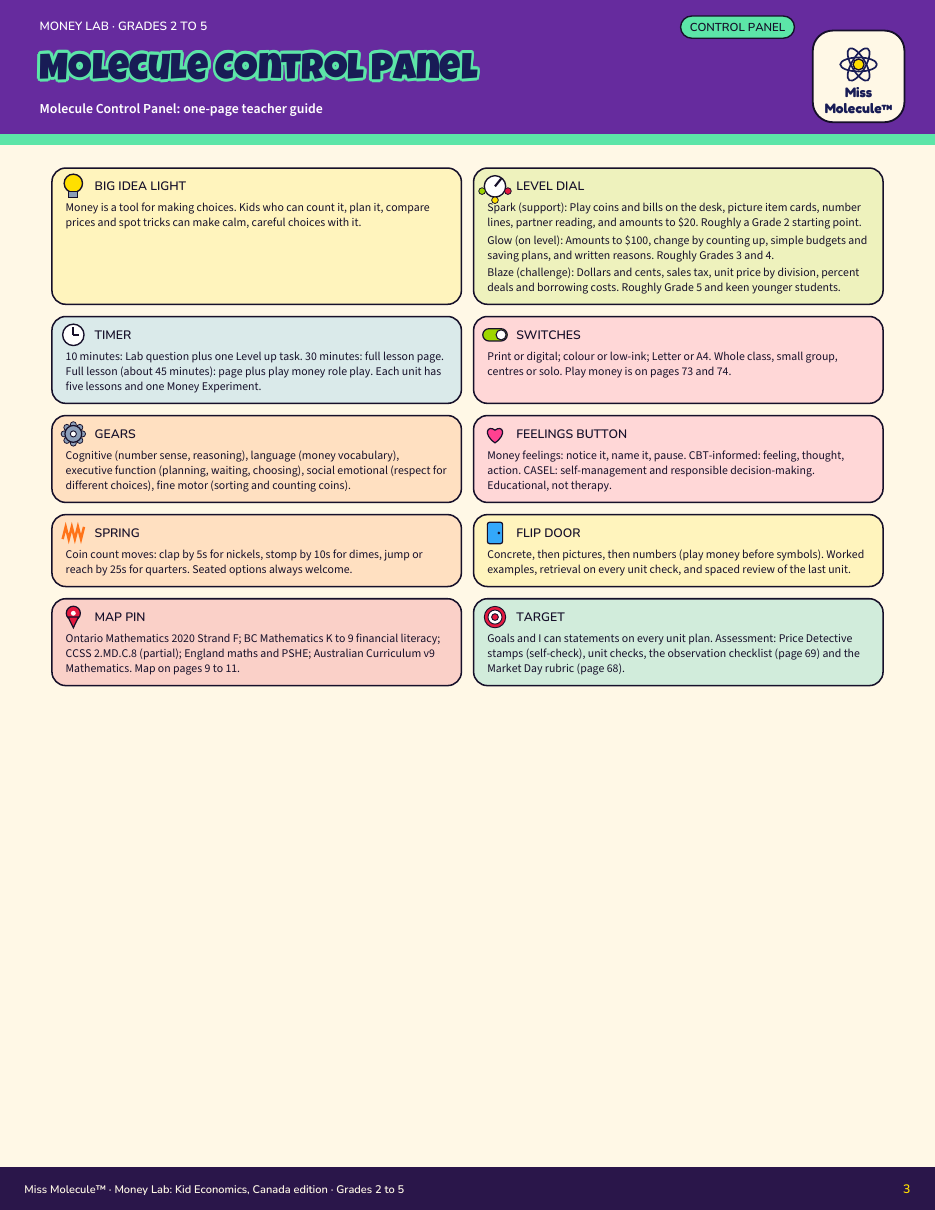
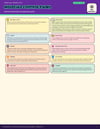
- Molecule Control Panel, welcome page, levels and UDL page, Money talk with care page
- Meet Canadian coins (including the penny phase-out and cash rounding) and Meet Canadian bills (polymer notes, tactile dots, older notes)
- How we draw money: a plain summary of the Bank of Canada's rules for bank note images and how this book follows them
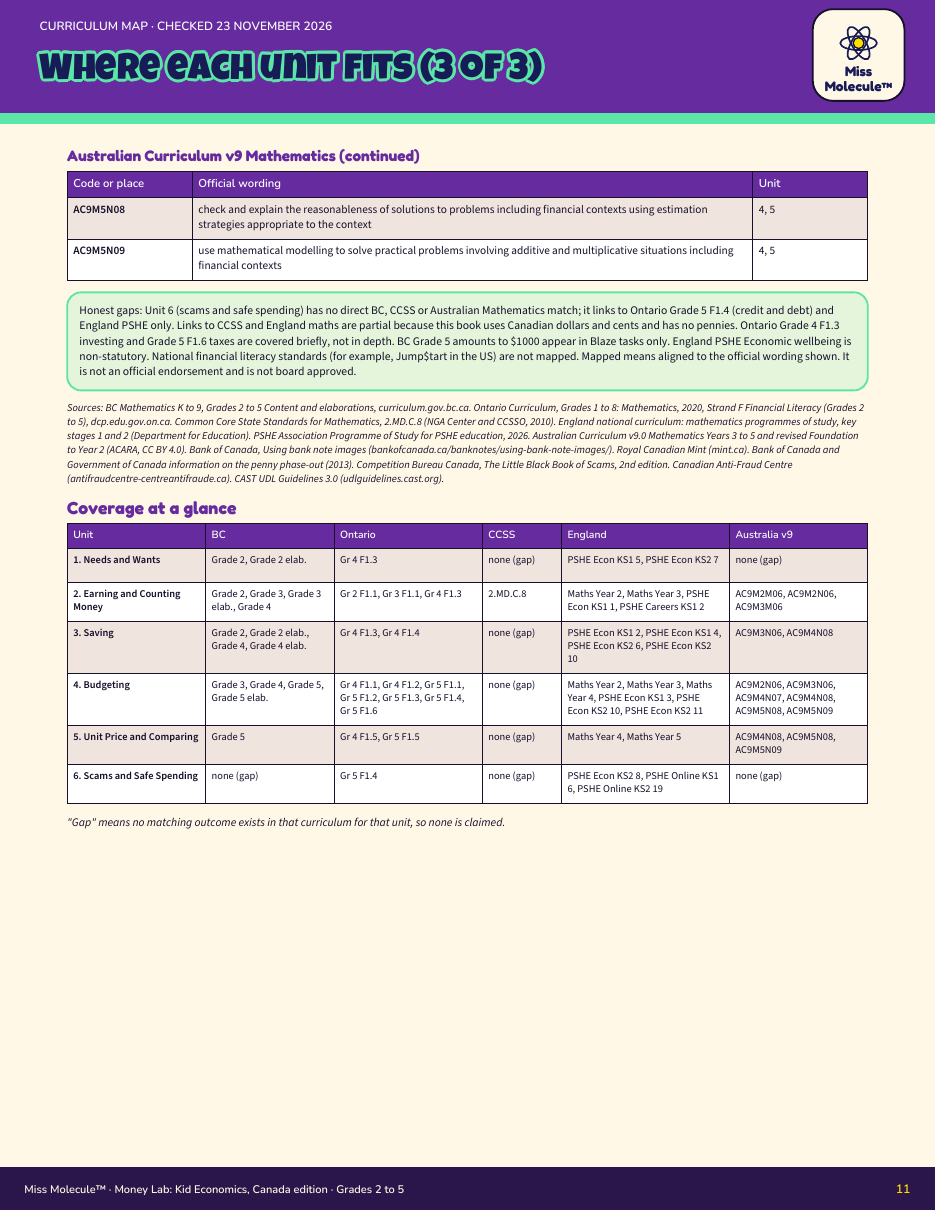
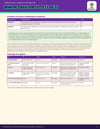
- Three page curriculum map with official wording, honest gaps and a coverage matrix, plus year at a glance
- 6 mini-units, 9 pages each: Needs and Wants; Earning and Counting Money; Saving; Budgeting; Unit Price and Comparing; Scams and Safe Spending
- Six Money Experiments: The Wait-a-Day Want Test; Does Sorting Coins Make Counting Faster?; Piggy Bank Race; Round It!; Price Detective Field Study; Scam Spotter Challenge
- Spark, Glow and Blaze tasks on every lesson page
- Project (Molecule Market Day), rubric, observation checklist, two page answer key, glossary
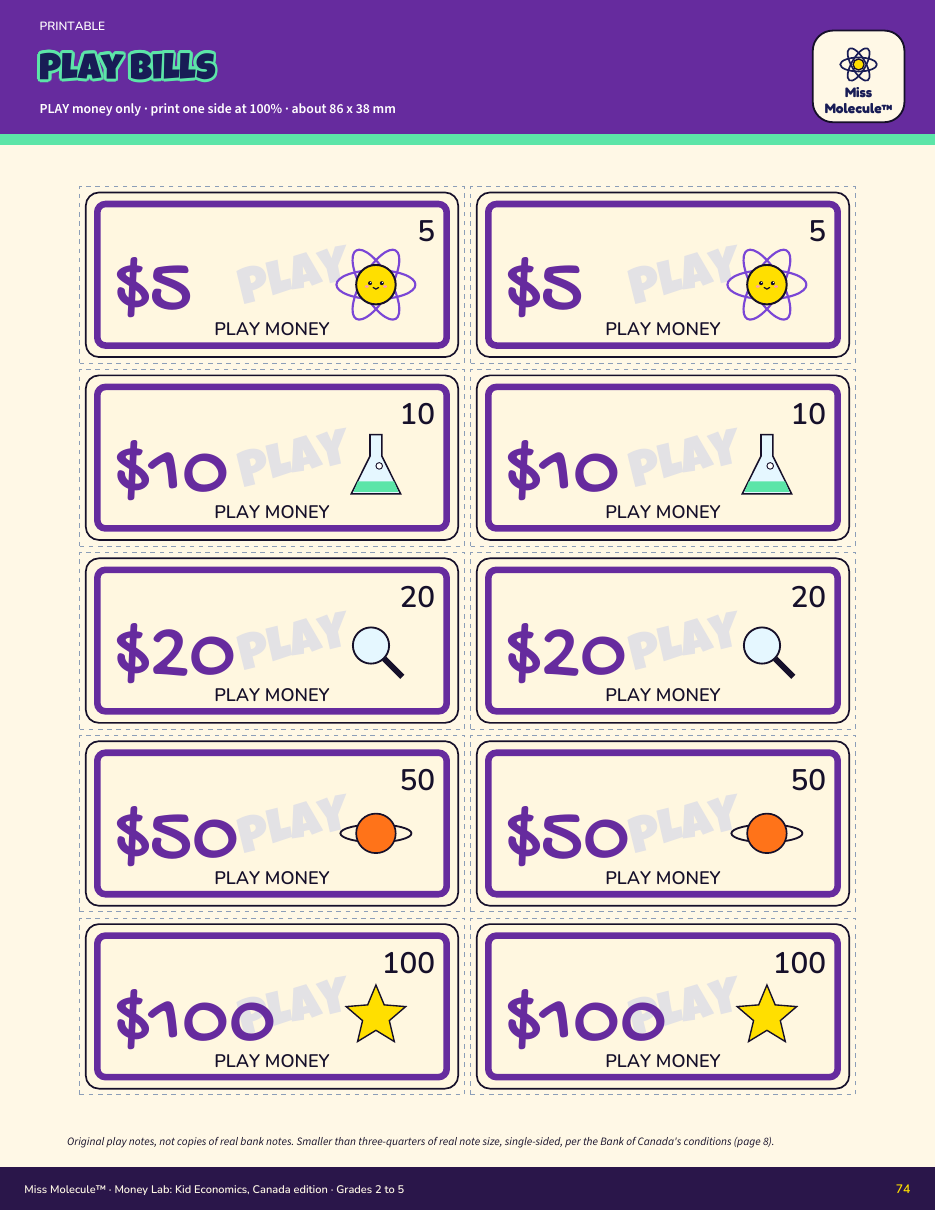
- Printable play coins, play bills, a Price Detective sticker sheet, a certificate and a family letter, licence page
Curriculum links (checked against official sources on 23 November 2026)
- BC Mathematics K to 9, financial literacy Content for Grades 2, 3, 4 and 5, plus elaborations (BC uses statements, not codes)
- Ontario Mathematics 2020, Strand F Financial Literacy: Grade 2 F1.1; Grade 3 F1.1; Grade 4 F1.1, F1.2, F1.3, F1.4, F1.5; Grade 5 F1.1, F1.2, F1.3, F1.4, F1.5, F1.6
- Common Core State Standards for Mathematics: 2.MD.C.8 (partial: Canadian coins, no pennies)
- England national curriculum mathematics: Year 2 (two money statements), Year 3, Year 4 and Year 5 money statements (partial: dollars and cents, not pounds and pence)
- England PSHE Association Programme of Study 2026: Economic wellbeing KS1 1 to 5 and KS2 6, 7, 8, 10, 11; Careers KS1 2; Online life and safety KS1 6 and KS2 19
- Australian Curriculum v9 Mathematics: AC9M2M06 and AC9M2N06 (revised Foundation to Year 2), AC9M3M06, AC9M3N06, AC9M4N07, AC9M4N08, AC9M5N08, AC9M5N09
Honest gaps: Unit 6 (scams and safe spending) has no direct BC, CCSS or Australian Mathematics match; it links to Ontario Grade 5 F1.4 (credit and debt) and England PSHE only. Links to CCSS and England maths are partial because the book uses Canadian dollars and cents and has no pennies. Ontario Grade 4 F1.3 investing and Grade 5 F1.6 taxes are covered briefly, not in depth. BC Grade 5 amounts to $1000 appear in Blaze tasks only. England PSHE Economic wellbeing is non-statutory. National financial literacy standards (for example, Jump$tart in the US) are not mapped. Each gap is printed in the PDF.
Inclusion: built on Universal Design for Learning (CAST UDL Guidelines 3.0, 2024). Play money first, then pictures, then numbers; every student page offers the pass chip "I can choose a different way to show this."; access ideas for students who are blind or have low vision (including the tactile dots on real Canadian notes), Deaf or hard of hearing, neurodivergent, or who need fine motor support. The project includes an inclusion plan for every shopper.
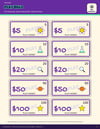
Money images: no bank note or coin image is reproduced. All coins are plain circles with a value; play bills are original drawings in one neutral brand style for every value, not a real note colour (cream with a grape border, the value in a doodle font, a different science doodle per value, PLAY MONEY and a PLAY watermark) with no portraits, animals, ships, symbols, windows or security features, printed single-sided at about 86 x 38 mm, well under three-quarters of real note size. This follows the Bank of Canada's conditions on Using bank note images (bankofcanada.ca/banknotes/using-bank-note-images/, checked 23 November 2026), which the book summarizes and cites on page 8. Real coin designs belong to the Royal Canadian Mint and are not drawn; "loonie" and "toonie" are used only as everyday names. Neither organisation produced or endorses this resource.
Money facts used: penny production ended in 2012 and distribution ended 4 February 2013, with cash totals rounded to the nearest 5 cents and electronic payments not rounded; older $1, $2, $25, $500 and $1000 notes lost legal tender status on 1 January 2021 but keep their value; current notes are polymer with raised tactile dots. Scam content draws on the Competition Bureau Canada's The Little Black Book of Scams and the Canadian Anti-Fraud Centre. Ontario HST (13%) is used as a labelled example; families are told to check their own province or territory.
Common Core State Standards: © Copyright 2010. National Governors Association Center for Best Practices and Council of Chief State School Officers. All rights reserved. Australian Curriculum content (ACARA) is used under CC BY 4.0.
Fine print
Educational resource only. Not financial, investment, tax, legal or banking advice. Prices, tax rates, interest and fees are simplified classroom examples, not real offers. No money, savings or learning results are promised. This is not therapy or counselling; the Feelings button and Money feelings notes are CBT-informed educational skills practice only.
AI disclosure: the text was drafted with AI help and then checked and edited by the creator. Every illustration, coin, play bill and stamp is original vector art drawn in code (shapes and lines), with no AI image generation. Fonts are open licence (SIL Open Font License).
Licence: one teacher's classroom, or one family or homeschool. Print as many copies as that group needs. Do not share, resell or post the files publicly. Miss Molecule™ is a trademark of its creator. Mapped means aligned to the official wording shown; it is not an official endorsement and is not board approved.
© 2026 Miss Molecule. All rights reserved. Miss Molecule™. Licensed for one classroom or one household. No resale, sharing, shared sites or AI training.